
Art and finance: the challenge is to transform private wealth into public value
From the management of collections to support for cultural institutions, private capital is seeking new models of engagement; questions have arisen regarding generational succession and the measurement of benefits to the community

Key points
Art is increasingly becoming part of wealth management strategies, but support for private collections does not necessarily translate into new funding for museums, foundations and artistic production. It is this disconnect that lies at the heart of one of the key issues in the relationship between finance and culture: how can private wealth be transformed into an investment capable of generating lasting benefits for the wider community as well?
The Deloitte Art & Finance Report 2025 offers an initial indication. 51 per cent of the wealth managers surveyed state that they offer services relating to art and collectables, compared with around 25 per cent in 2011. This figure points to the growing integration of art into wealth management, but does not equate to an increase in investment directed towards cultural institutions. Furthermore, difficulties remain regarding the valuation, management and complexity of this market.
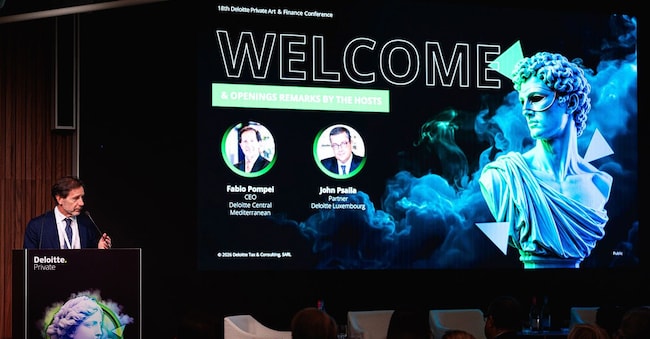
This issue takes on particular significance in cities of art, where heritage conservation, the sustainability of institutions and the development of cultural activities require ongoing resources. Venice, host city of the 18th Deloitte Private Art & Finance Conference, “Tomorrow’s Cultural Cities: From Patronage to Portfolio”, organised by Deloitte Luxembourg and Deloitte Italia, is a prime example: here, the relationship between the public and private sectors concerns not only the protection of monuments, but also the ability to sustain culture as a driver of development, innovation and employment.
Private collections: between inheritance and the public interest
One of the most sensitive issues concerns the transfer of private collections. The handover from one generation to the next is not merely a matter of inheritance or taxation: it can also determine the future of collections built up over decades, sometimes comprising works of historical and artistic significance. Heirs are faced with choices that can have consequences for the market and for the preservation of cultural heritage: keeping the collection within the family, selling part of it, entrusting it to a foundation, or making it accessible to the public through loans and agreements with museums.
These are decisions that require expertise, financial resources and a long-term vision. Setting up a foundation can provide a means of organising the management and ensuring the continuity of the collection, but it entails costs and responsibilities. Lending works to a museum can also facilitate public access to the works without transferring ownership.
Art asset management is thus faced with an issue that goes beyond the preservation of economic value: how can the interests of owners and heirs be reconciled with the opportunities for safeguarding and promoting a heritage which, in some cases, is also of broader cultural significance?

