
Art Basel 2024: reaping the seeds of the contemporary
Fil rouge is the conceptualism that seems to dominate the selected poetics: little figurative, little decorativism and little artificial intelligence
4' min read
Key points
4' min read
It can be convincing, even enthusiastic, as well as disconcerting and disappointing: Art Basel certainly does not leave one indifferent, and under Maike Cruse's first direction, it has confirmed itself to be a precious showcase of international contemporary art, a privileged observatory from which to review emerging trends, discover new things, witness confirmations and even intuit the processes of historicisation of the masters of our present.
Almost three hundred tunnels involved
.The 2024 edition of the most important international contemporary art fair - founded in 1970, with today almost three hundred galleries involved, so much so as to deserve the definition of "Art Olympics" by the "New York Times" -, seems to us to emphasise three fundamental areas of creative research in particular the ecological question, understood not only as an aesthetic investigation of environmentalism, but also as the investigation of a poetics of the man-nature relationship, through a non-dualistic reflection on the fundamental poles of this bond, with its properly cosmological traits (nature and culture, organic, inorganic, individual and species); the political-social question, with the exhibition of an engagé art, committed to the defence of human rights, minorities and oppressed populations (Kader Attia's very current work "Intifada: The Endless Rhizomes of Revolution"), as well as in the reflection - at times influenced by the vague woke - on the contradictions inscribed in the history of Western self-consciousness; the aesthetic contribution of "other" cultures, whether these be minorities within the Western world or, more often, the expression of Oriental traditions or those of emerging countries - the "alien" creations of Omyo Cho, a plastic modelling of the sci-fi universe and a futuristic look at the processes of transmission of memory, are astounding in this sense.
Loading...
“Unlimited”
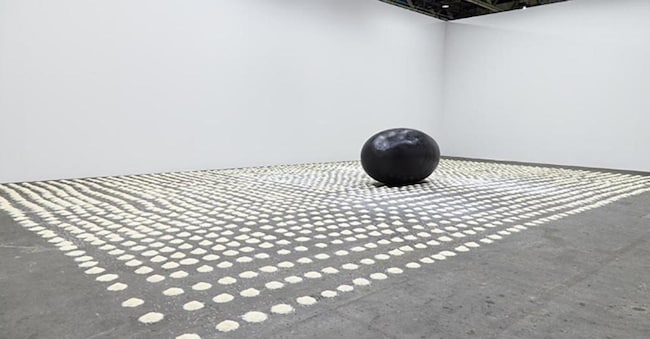
The backdrop to these themes is the celebration of the creativity of the great masters of the post World War II period and the beginning of the new millennium: Emilio Isgrò, Christo, Dan Flavin, Keith Haring, Donald Judd, Jannis Kounellis, Yayoi Kusama, and Salvo are among the most prestigious names of this edition, highlighted in particular in the "Unlimited" section (curated by Giovanni Carmine), 16.000 metres of space dedicated to monumental installations, which transcend the classical parameters of an exhibition fair, showing the monumentality that characterises the artistic gesture of a substantial slice of contemporary expressiveness. Seventy installations, including evocative examples of video art, are on display here, imposing themselves on visitors eager to be amazed.
The interactivity of numerous works determines an active participation in their enjoyment by the public: one enters a paradoxically serious 'playground', where the re-appropriation of the value of gaming re-enchants the world and reminds us of our essence as 'homo ludens', to quote Johan Huizinga's famous insight.
Intellectualisation of the artistic experience
.The common thread running through the entire exhibition is the conceptualism that seems to dominate the poetics selected for the event: few examples of the figurative (in painting as well as in sculpture), little decorativism (however, a splendid work by Damien Hirst, proposed by Gagosian, with a butterfly theme, stands out), surprisingly little artificial intelligence, almost no space given to pop art or visually satisfying forms of aesthetics - certainly also in the wake of the widespread criticism of beauty "at all costs" that governs our daily society of the image, Art Basel rejects likeness and induces reflexivity, rewarding the philosophical role of works that suggest doubts, considerations and meditations. The risk, always just around the corner, is that of an intellectualisation of the artistic experience and a loss of the centrality of its sensitive dimension. Thus, in 'School of Languages', Ryan Gander offers us a treatment of human evolution, combined with a critique of capitalism, by means of an installation comprising a studio, a desk and a gorilla-shaped puppet in natural size and self-moving, but it is a missed opportunity.


Brand connect
Loading...
