Fair

Art Basel Paris, signs of recovery in the downturn. Karim Crippa new director

The current edition records million-dollar sales, but with a price contraction. Painting, especially abstract, dominates. The market now looks to the Middle East
by Silvia Anna Barrilà

5' min read

Translated by AI
Versione italiana

5' min read

Translated by AI
Versione italiana

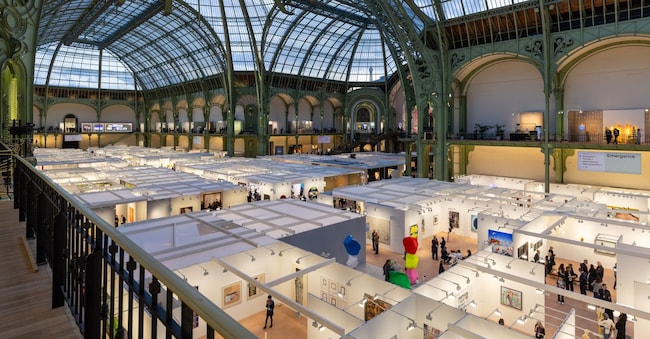
While the fourth edition of Art Basel Paris is underway at the Grand Palais in Paris, it has been announced who will be directing the next edition after Clément Delépine submitted his resignation to go to Lafayette Anticipations: Karim Crippa, born in 1991, has worked for Art Basel since 2018 and is currently Head of Communications for Art Basel Paris and Senior Editor for Art Basel globally. A choice, therefore, that did not fall on a well-known name from the French curatorial world and that favoured, instead, the growth of an internal profile within the organisation.
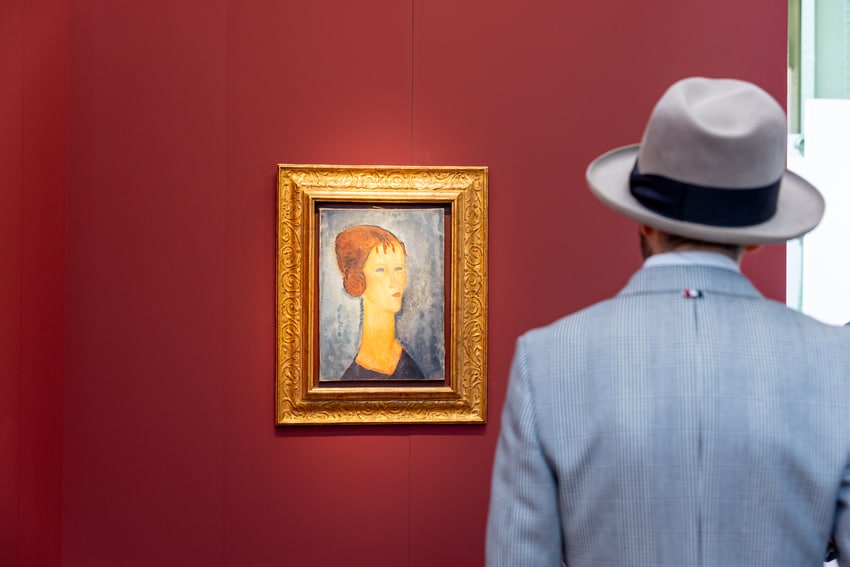
L’opera di Modigliani venduta da Pace a quasi 10 milioni di dollari, courtesy Art Basel

L'Avant Première

But until Sunday all eyes are still on this edition of the fair, which started as early as Tuesday afternoon, a day earlier than last year, to better distribute the VIPs who, last year, were too crowded in the stands and the aisles on preview day. The model worked: the invitations were made by the galleries themselves, who summoned their top clients, and the sales were there. Among the most important were a EUR 4.2 million Burri 'Sacco' by Thaddaeus Ropac and the nearly ten million dollar Modigliani presented by Pace, which sanctioned the powerful gallery's entry into the Italian artist's market and thus a new beginning.
Loading...

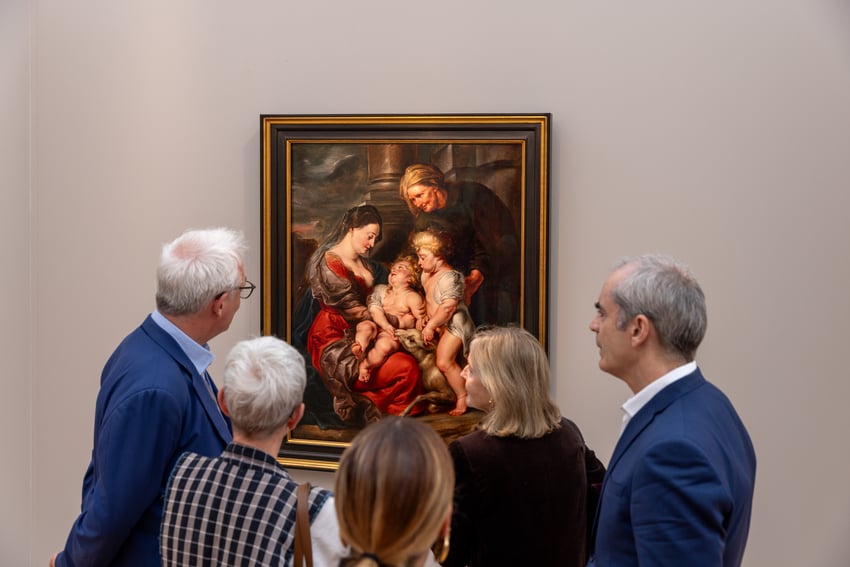
L’opera di Rubens presentata da Gagosian ad Art Basel Paris 2025, courtesy Art Basel

Gagosian went for the historical, even, bringing a painting by Rubens and contravening Art Basel's rule of presenting only art from the 20th century onwards. The price has not been declared, but the work - a 'Virgin and Child, Saint Elisabeth and Saint John the Baptist' - already went to auction five years ago at Sotheby's in New York for EUR 6.5 million and the current price, according to rumours, should not be that far off.

Other sales during Tuesday afternoon's so-called "Avant Première" were the $4.5 million 1999 painting "Children's Playing" by Agnes Martin, included in the in-depth "Minimal Art" exhibition at the Bourse de Commerce by François Pinault, along with a painting from 2025 by Lee Ufan, which sold for €900,000, and Jiro Takamatsu's 'Orange Rectangle', 1973 by Jiro Takamatsu, which sold for €52,000.
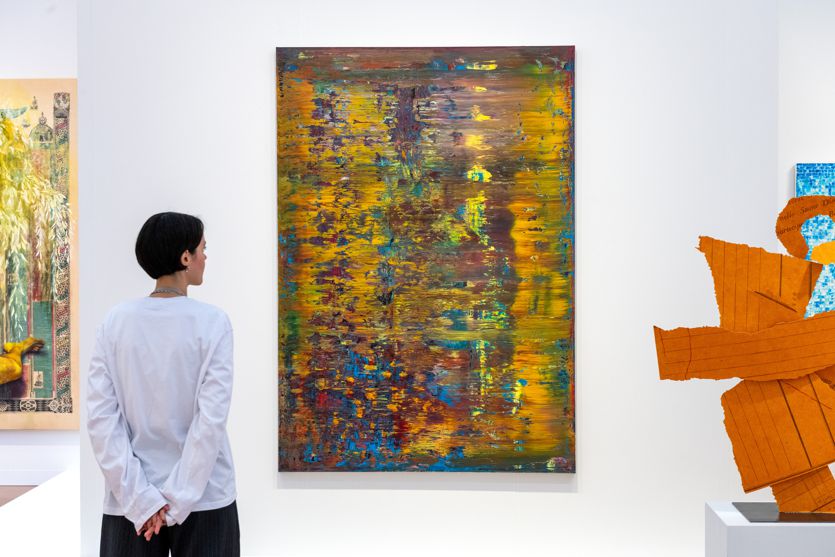
L’opera di Gerhard Richter venduta da Hauser & Wirth a 23 milioni di dollari, courtesy Art Basel

But the most expensive work was a $23 million 1987 abstract painting by German artist Gerhard Richter at Hauser & Wirth, currently on show in Paris at the Fondation Louis Vuitton with a major retrospective, and at David Zwirner's gallery, which sold 16 editions by the artist for $400,000 each. Other record prices were $11.5 million for a 2007 painting by Julie Mehretu at White Cube and $7.5 million for a sculpture by Ruth Asawa at David Zwirner.
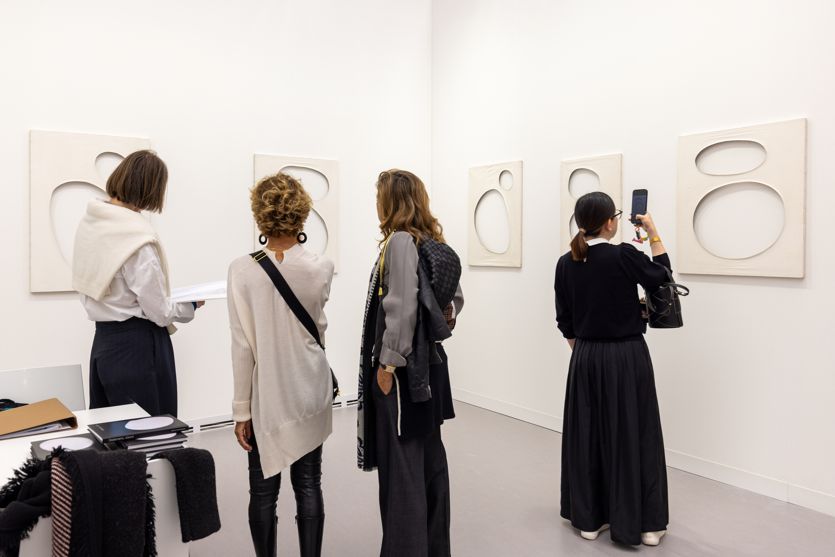
Lo stand di Frittelli Arte Contemporanea con i Volumi di Dadamaino ad Art Basel Paris 2025, courtesy Art Basel

Bending

"In the first six months of the year we had a significant downturn," commented Vincenzo De Bellis, Chief Artistic Officer and Global Director of Art Basel Fairs. "Then, immediately after the summer break, things started to move significantly, even more than we could have expected. This is not to say that the market is not in a downturn, because of course it is, but both the fairs in New York, the news from London last week, and the auctions gave very positive signals." But what has stimulated this recovery, if one can speak of a recovery? "Hard to say. I think a downturn is natural after more or less 15 years of steady and, in many respects, even outsized growth. Certainly the aspects of international geopolitics have influenced the downturn and, certainly, the generational change. Today, new collectors are emerging who have a different price point and tastes, to which we are slowly adapting. On the recovery, I may be proved wrong in a few weeks, but in relation to the first few days of the fair we are very happy. At the fair, painting continues to dominate the offer, but there is an increasing mixture of abstraction and figuration, indeed the former almost dominates the latter, after so many years characterised by the opposite trend.

Looking at the Middle East

Despite millionaire sales making the headlines, the downward adjustment in art values is there and collectors are focusing on a lower price bracket. From the point of view of market geography, "I would like to emphasise that Europe remains a very flourishing market, despite the socio-political problems," says De Bellis. "In the United States there is a downturn, as well as in China, but they remain two leading markets, responsible for a large part of sales. We are very focused on the development of new markets: our idea concerns the whole region of the Middle East, North Africa and South Asia, which are a big slice of the world and which the art world has never visited so much, although there is a lot of art to show and a lot of collecting to develop".

Compared to some fifteen years ago, the Middle East today has a more mature art system, as testified by Mohammed Hafiz, co-founder of the Saudi gallery Athr, who is on the selection committee of the new Art Basel Qatar, the first edition of which will be held in February. "The beginning was marked by government investment, but the market cannot be sustained on that alone and today there are private collectors, patrons, local institutions, which constitute an ecosystem of art and culture. The museums that have sprung up in Doha, the Emirates and Saudi Arabia are not in competition with each other, but represent an enrichment for the whole region'. At the fair, Athr presented an all-women stand, just as it did at Frieze, with Sarah Abu Abdallah, Haifa Algwaiz and Lulua Alyahya, all born in the 1990s, whose works were already sold during the Avant Première at prices between €2,500 and €15,000.

The artists

Female predominance characterised many of the fair's stands, above all, the 'Premises' section, dedicated to proposals with a distinctly curatorial accent. Most of them focused on historical artists to be studied, such as the Korean Lee ShinJa, pioneer of textile art (sales between 70,000 and 200,000 dollars at Tina Kim Gallery); the Impressionist painter Marie Bracquemond (seven works sold between 39,000 and 52,000 euros at Pauline Pavec); Lucia Moholy, Bauhaus photographer (at Kadel Willborn, prices between 2.700 and 60 thousand euros); but also Dadamaino, with a series of black and white "Volumes", presented by Frittelli of Florence (from 2 October with a gallery also in Milan shared with Michela Rizzo of Venice). This is a significant initiative for the Italian artist after the investigations into this very group of works, which damaged the market and caused prices to fall, although they ended with the acquittal of the suspects. "Collectors who saw the presentation felt reassured," commented Simone Frittelli. Prices ranged from 45 thousand to 90 thousand euro. "Deliberately low values for a historical artist, who has been able to assert herself in a scene dominated by men, in order to give her new impetus and value".

The Fashion Crisis

But there is another element that has certainly influenced the downturn in the art market, and that is the crisis in the luxury and fashion sector, which probably has more effect than the stock market trend, which has so often been less correlated to that of art. There are many initiatives linked to the world of fashion, both inside and outside the fair, from Louis Vuitton, which dominates the balcony of the Grand Palais with an inflatable pop by Takashi Murakami, to Guerlain with Claudine Drai, represented by Galleria Maggiore G.A.M. of Bologna and recently entered the collection of the Centre Pompidou, to Miu Miu with the performance byHelen Marten at d'Iéna, which presents a reflection on life, from childhood to old age, with 30 chapters dealing with as many themes. And then the inauguration of the new headquarters of the Fondation Cartier, with its large building right in front of the Louvre, with a statement that goes beyond the art world.

Copyright reserved ©
Loading...

Brand connect

Loading...

Newsletter

Notizie e approfondimenti sugli avvenimenti politici, economici e finanziari.

Iscriviti