
Art calls for action in Nick Brandt’s photographs
In a world premiere in Turin, the British photographer presents the latest, previously unseen instalment of his series *The Day May Break*, which explores environmental collapse. This time, the focus is on refugees in Jordan.

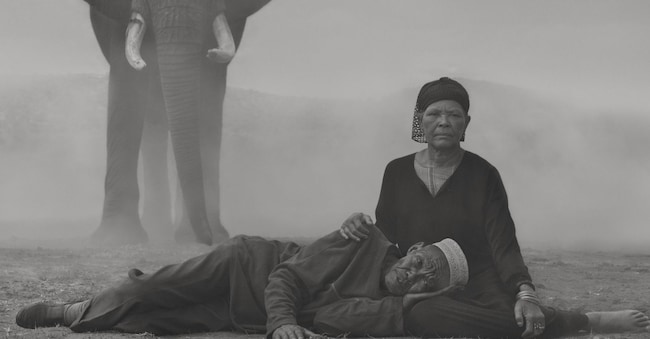
Our connection to one another remains the only force to cling to when all seems lost. Ftaim and her family’s pyramid of bodies endures. On cardboard pedestals, it defies the verticality of the sky in order to be heard and become visible to the world. The same soaring form as the mountains, the monochrome minimalism binding the silhouettes to the background. Whether they are wild animals whose habitat has been destroyed, or human figures on the edge of the Earth, the subjects of Nick Brandt’s photographs always convey a sense of tragedy with rare formal composure. They are an elegy for a world on the brink of extinction. A portrait of resilience as an antidote to inaction.
Artistic subjects such as the biblical illustrations engraved by Gustave Doré. From zebras to elephants, from Syrian women with their children in their laps to the slender figure of little Laila silhouetted against the backdrop of the Jordanian desert. Such is the scene in this final chapter of the series *The Day May Break*. The fourth instalment, a previously unseen body of work – his first to receive partial funding (from Intesa San Paolo) – was created during 2024 and previewed in Turin, in an exhibition curated by Arianna Rinaldo featuring 67 large-format photographs and a behind-the-scenes section.
A project – launched at the end of 2020 and carried out across Kenya, Zimbabwe, Bolivia, Fiji and Jordan – which centres on ‘ecocide’. This is how the photographer describes it – “literally, the murder of our home, planet Earth” – referring to its dictionary definition as destruction through deliberate or negligent human action, and its etymology, from the Greek oikos, meaning ‘home’, and the Latin caedere, meaning ‘to cut down’. Now, for the first time, all the chapters are brought together in Turin. Chapter One, in Kenya and Zimbabwe in 2021: within the same frame, the shared dignity and common sense of loss experienced by animals – saved from poaching and habitat destruction – and people displaced by cyclones and prolonged droughts. Chapter Two, in Bolivia in 2022, the same fate on another continent: once again, scenes shrouded in mist (created on site using non-toxic smoke machines) as a symbol of a natural world rapidly vanishing from view. SINK/RISE – Chapter Three, set in Fiji in 2023, captures the beauty of the marine environment and the tension of impending loss: the only chapter rendered in colour and the most surreal, featuring people photographed underwater (thanks to hidden weights), members of coastal communities at risk of being submerged by rising sea levels. Finally, *The Echo of Our Voices – Chapter Four*, set in Jordan in 2024, featuring Syrian families from refugee camps against the desolate backdrop of the desert.
Sixty-two years old, having devoted half his life to photographing a planet we are destroying – his series *Inherit the Dust* (2016) and *This Empty World* (2019), and now his new work at the Dadaab refugee camp in Kenya – Nick Brandt’s art has always spurred the public on to “millions of small actions”. In 1995, the “click” that set it all in motion: the filming of Michael Jackson’s music video. ‘Earth Song’, a title emblematic in itself, whose lyrics already listed all the fundamental issues to which he would devote himself: humanity’s drift and the uncertainty of tomorrow; the weeping shores, the seas and the burnt forests; elephants and children dying; the skies falling and the breath we lack; apathy and faith. And a question, The Question: “This weeping Earth. What have we done to the world? We’ve reduced the Kingdoms to dust. Do we give a damn?”.
Nick Brandt. The Day May Break. Light at the End of the Day. Turin, Gallerie d’Italia, until 6 September. Curated by Arianna Rinaldo. https://gallerieditalia.com

