Art Collaboration Kyoto invites galleries to collaborate, with impressive results
More and more international operators are drawn to this format and are testing the Japanese market, including through exhibitions held in temples

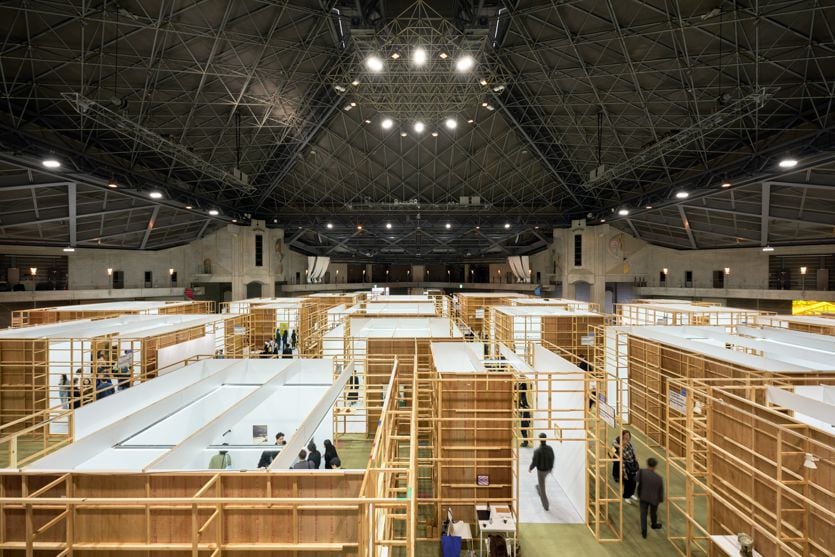
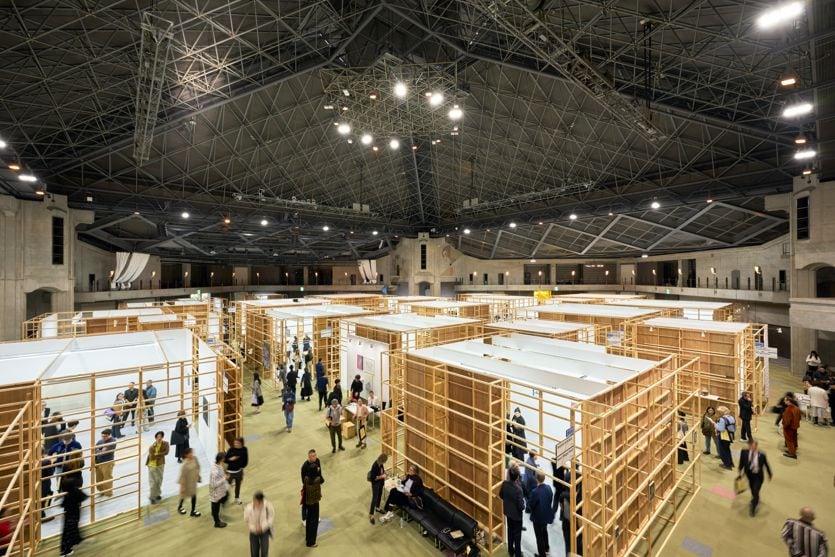
In Kyoto, Japan, a rather unique art fair has been running for several years now: Art Collaboration Kyoto, the sixth edition of which took place last weekend, from 7 to 9 November. The event is based on the concept of collaboration and is highly regarded by gallery owners. In a context such as Japan’s, which can be difficult to navigate due to the language barrier, Art Collaboration Kyoto is a winning concept: it involves Japanese and international galleries applying to take part together, sharing a stand design, the stand hire costs (which are very reasonable, ranging from around 3,400 euros for the smallest stands to 17,000 euros for the largest) and also their contacts at the fair. With 25 Japanese and 27 international galleries (two stands were shared between three galleries), the fair is compact and easy to navigate, and by no means tiring. The fair’s welcoming atmosphere also stems from its architecture: the stands are constructed from old packing crates for artworks, making the fair environmentally sustainable, but also giving it a warm feel, a far cry from the ‘white cube’, with a wooden latticework reminiscent of Japanese Minimalism. One minor point: the diagonal layout of the stands is a little confusing, which tends to make you go round in circles and makes it difficult to get from point A to point B.
More international galleries
In recent years, the fair has attracted an increasing number of participants from abroad. This year there are 17 new international galleries (out of 27), including names such as Hauser & Wirth, Meyer Riegger, Modern Art and Ingleby. For many of them, the decision was prompted by a highly successful parallel programme running alongside the fair: exhibitions in the city’s ancient temples, a setting of immense charm that artists are keen to be part of.
“This is the first time we’ve attended an art fair in Japan,” said Yuta Nakajima of Hauser & Wirth. “The opportunity hadn’t arisen before, and we seized the chance presented by the exhibition of Lorna Simpson at Daiko-in Temple, where her collages engage in a dialogue with the paintings on the walls. We’re taking part in the fair with Taro Nasu, as we jointly represent Pierre Huyghe, and Takesada Matsutani has exhibited here in the past. That’s how the idea for a stand featuring works based on words and text came about. We already had Japanese collectors, but we’re seeing new people and new young buyers, many of whom come from industries such as fashion, music and technology.” The two galleries sold a work by Marcel Broodthaers for 65,000 euros, a print by Glenn Ligon for 32,000 dollars and two works by David Horvitz for 3,500 dollars.
Also making its debut was Meyer Riegger Wolff, in collaboration with Misako & Rosen (Meyer Riegger Wolff embodies this spirit of collaboration, having been founded through the merger of the Berlin-based firm Meyer Riegger and the Paris-based firm Jocelyn Wolff to open an office in Seoul). In addition to their stand, they have also organised an exhibition of Miriam Cahn’s work in the historic Yuuhisai Koudoukan centre. They sold a painting by Miriam Cahn for 45,000 francs; a painting by Yunyao Zhang for 10,000 euros; and two paintings by Sugihara Reina for 5,000 and 10,000 euros respectively.
Modern Art and Ingleby took Andrew Cranston to the Ryosuku-in temple and participated in the fair with Monaka-Hill, whilst Carlos/Ishikawa organised two exhibitions featuring two artists: Issy Wood and Evelyn Taocheng Wang.
Among the new participants is Triangolo from Cremona, which has brought along the young Italian artist Mario Uliassi (born in 2000), who works with the traditional Japanese lacquer urushi, reinterpreting it in his works. “We met the Hagiwara Projects gallery at the alternative Parloir fair in Milan because we were neighbours,” explained Leonardo Caldonazzo Arvedi and Ludovica Baldrighi, “We’d been keeping an eye on this fair for some time and it won us over, because the challenge when you take part in an event for the first time is connecting with the public; here, that’s made easier”. Alongside the works by Mario Uliassi (priced from 1,200 to 2,500 euros), there are those by Yuji Akatsuka (up to 6,000 euros).
Serious and dedicated collectors
The Berlin-based Neugerriemschneider gallery, meanwhile, is taking part for the fourth year running, this time in collaboration with another gallery for the first time (there is a smaller parallel section, ‘Kyoto Meetings’, in which galleries can participate independently with projects linked to the city’s history and culture). The German gallery has teamed up with Shibunkaku, a historic gallery founded in 1937, creating a fascinating dialogue between traditional Japanese art and contemporary art, for example, with a drawing by Elizabeth Peyton from 1997 in dialogue with a watercolour and ink on paper by Léonard-Tsuguharu Foujita from 1919, or a work featuring layered glass by Olafur Eliasson from 2026 in dialogue with a stone sculpture by Yamada Hikaru from 1980.