
The art of fashion and life according to Elsa Schiaparelli on show in London
At the Victoria & Albert Museum more than two hundred dresses, accessories, photographs and works of art tell the story of the designer's disruptive creativity, but also the present and future of the fashion house

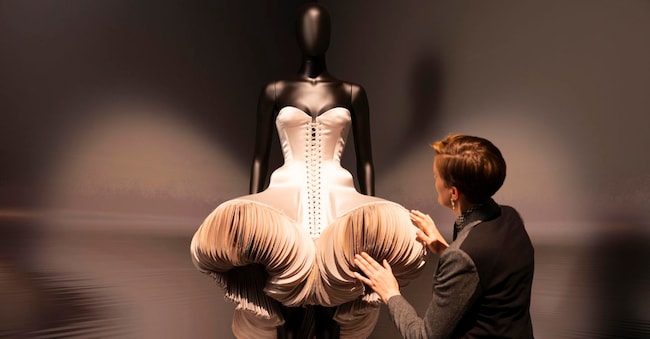
Creating clothes is not a profession, but an art: in this statement lies the essence of Elsa Schiaparelli, one of the most creative and innovative fashion designers of the 20th century. The Victoria & Albert Museum in London is now dedicating a major retrospective to this intrepid fashion pioneer, the first exhibition on the Schiaparelli maison ever held in Britain.
Born into a family of intellectuals in Rome in 1890, Elsa had fled to Paris at the age of only 23 to find the freedom to experiment. In 1927, with typical audacity, the completely self-taught designer had launched her first collection of sportswear, aimed at an active, modern woman. Her jumpers with trompe l'oeil decorations like bows were immediately imitated.
The success of Schiaparelli Pour le Sport quickly led her to expand her range, creating day and evening dresses. Her suits are always modern, using new materials and original prints, but also practical: jackets, for example, always have roomy pockets to avoid the need to carry a handbag, while traditional skirts are often replaced by trousers.
As early as 1932 her atelier had 400 employees and was creating over seven thousand haute couture garments a year for an increasingly international clientele. In 1935 Schiaparelli moved her atelier to 21 Place Vendôme, described by her as 'the centre of world elegance' and by Salvador Dali as 'the beating heart of the Parisian surrealist movement'.
The heart of the exhibition is precisely the close collaboration with some of the great artists of the time, based on a mutual admiration. She was a muse for the Surrealists and Futurists. It was she, with her original and sometimes puzzling creations, who inspired and influenced artists such as Dali, but also Man Ray, Jean Cocteau, Alberto Giacometti and Pablo Picasso. She was "the centre of a constellation of painters, sculptors, photographers, writers and craftsmen", according to Sonnet Stanfill, curator of the exhibition.

