
Art, history and elegance: here's where to go for Art Nouveau holidays
From Sicily to Merano sumptuous spa buildings, hotels and bathing establishments to rediscover the enchantment of fin de siècle atmospheres

4' min read
Key points
4' min read
After having closed the 2025 edition of Art Nouveau Week with more than 20,000 attendees at tours, guided tours, exhibitions and costume events throughout Italy, the Italia Liberty association, led by Andrea Speziali, which from 2019 aims to rediscover this peculiar style and its historical period, has already defined that the theme for 2026 will be the sea. The organic forms and graceful elegance of Art Nouveau, which was also all the rage in Italy between the end of the 19th century and the first decade of the 20th century, modelled numerous buildings destined for period 'villeggiatura', a passion of the nascent and increasingly wealthy European bourgeoisie that was rediscovering Italy in a renewed, and more democratic, Grand Tour, amidst new seaside resorts, villes d'eaux, and huge yet elegant hotels.
Travel to Italy
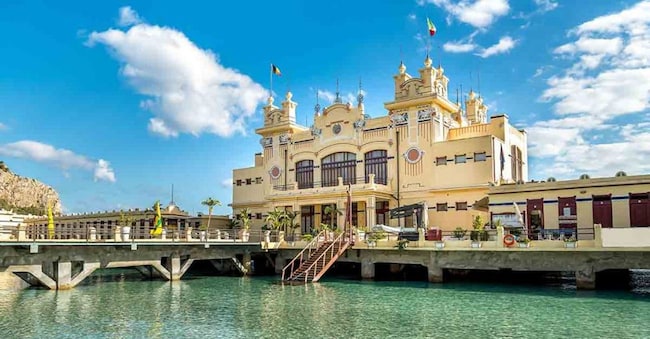
.A journey in Italy along the sites of Art Nouveau holidays cannot but start from the Antico Stabilimento Balneare di Mondello, which perfectly interprets the creative and innovative energy of the period. It was 1890 when the Prince of Scalea and the mayor of Palermo, Emanuele Paternò, started the reclamation of that marshy area, which would soon become one of Europe's most popular and elegant seaside destinations. Built on a large pile-dwelling hugging the turquoise sea, its interiors were designed by Ernesto Basile, the prince of Palermo Art Nouveau, who would also sign the fabulous Florio villas and even the Chamber of Deputies hall and the famous Montecitorio Transatlantic. Inaugurated in July 1912, in its long history the Stabilimento has known glories and despoliations and after having hosted for decades the Charleston restaurant, one of the city's most famous banners (now relocated to a Liberty-style venue in the city centre), it is now home to the scenic Le Terrazze restaurant, to be reached by crossing the monumental entrance on viale Regina Elena.
From Tuscany to Lombardy
.Overflowing with Art Nouveau is another promenade, the Passeggiata Margherita in Viareggio: in the Gran Caffé Margherita Giacomo Puccini loved to dine, who asked the artist Galileo Chini (one of the creators of the café, together with Alfredo Belluomini) to sign the sets for his last opera, Turandot, and to decorate his villa in Torre del Lago. During his long and glorious career, Chini also oversaw the decoration of another magnificent building where Art Nouveau already met Art Deco, the Terme Berzieri in Salsomaggiore, in the province of Parma. Fifty kilos of gold were distributed on the façade, inside frescoes and stuccoes, at an estimated cost of around 30 million euro today. After a period of crisis, thanks to an investment by QC Terme, the spa is set to return to its former glory. The same company had already invested 11 years ago in the renovation of another symbolic building of Italian Art Nouveau thermalism, the sumptuous Casino di San Pellegrino Terme, in the Bergamo-based Val Brembana, with its monumental staircases and exciting stained-glass windows by Giovanni Beltrami (those in the Chamber of Deputies are also his). On the other bank of the Brembo river, meanwhile, the Grand Hotel, inaugurated in 1904 but closed since 1979, is waiting to reopen its grand doors: the concession has been given for 99 years to the Californian company Ekn Development, which will turn it into a modern hotel with 120 rooms. And while the Art Nouveau buildings of Montecatini Terme are also seeking new life, the case of Palazzo Fiuggi is very successful: opened in 1913 in the Latium town, it was the first in Europe to offer an outdoor swimming pool. Renovated and redeveloped in 2021, the memory of dozens of famous guests (in 1914 Vittorio Emanuele III signed the act sanctioning Italy's participation in the First World War) echoes in the halls decorated by the little-known but brilliant Roman architect Garibaldi Burba, where today one can try the cuisine, in a hypersalutist version, of the three-starred chef Heinz Beck.
On the shores of Lake Maggiore and among the flowers of Trauttmansdorff Castle
Atmospheres that can be found, with the necessary contemporary inclusions, in other historic hotels: perhaps no one better represents Italian Art Nouveau than the Grand Hotel in Rimini, adored by Fellini, a sort of spaceship that has been looking out over the Adriatic Sea with its enormous pale façade since 1908. In the same year, the Regina Palace Hotel, in Stresa, on the shores of Lake Maggiore, began to welcome its elegant guests: in its garden, Pietro Mascagni wrote his arias, the candidates for the title of Miss Italy of the immediate post-war period paraded, and today you cannot miss a visit to the Bar 1900, for a fin de siècle aperitif with Vermouth and Absinthe or a signature cocktail with exotic fruit. On the other hand, the Grand Hotel Miramare in Santa Margherita Ligure, designed by Andrea Fustinoni, one of the most important Italian collectors in this category, has focused on the highly successful encounter between Art Nouveau and contemporary art. The building has always been a collector of innovation: in 1933, 30 years after its opening, Guglielmo Marconi transmitted the first radiotelegraphic and radiotelephonic signal in history from a terrace of the hotel (today the Marconi veranda). And while other grand dames of the era sleep, waiting for a lover investor to awaken them (for example, the Portofino Kulm, between the gulf of Tigullio and the gulf of Paradise), South Tyrol, too, offers delights for Art Nouveau enthusiasts, under the chandeliers of the dining room of the Bemelmans Post in Collalbo (Bolzano) or at the Villa Westend in Merano, where the stucco flowers on the façade reflect those of the gardens of Trauttmansdorff Castle, which can also be reached on foot from the hotel.


