Art Appointments

In Venice, an exhibition to raise awareness of sea pollution

Casa Sanlorenzo hosts the second chapter of Breathtaking, photographer Fabrizio Ferri's installation investigating the vulnerability of aquatic ecosystems.

by Angelica Moschin

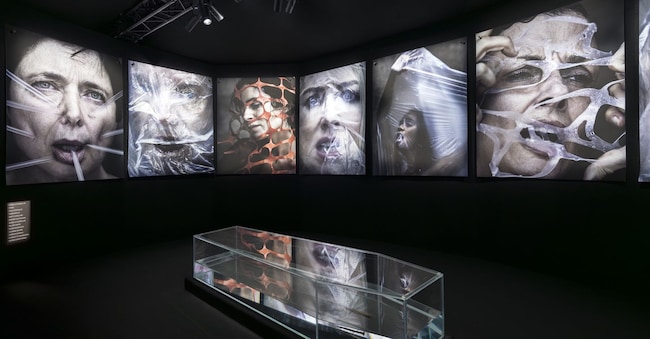
Breathtaking (Photography © Ugo Carmeni 2025)

7' min read

7' min read

For the city that is perhaps among the world's most exposed to the issue of climate change and rising seas, namely Venice, the Breathtaking exhibition is a remainder and also an invitation to action. Inaugurated today at Casa Sanlorenzo and conceived by artist Fabrizio Ferri, it is in its second chapter: after debuting at the Museum of Natural History in Milan last April, it now lands in Venice thanks to Sanlorenzo Arts, and can be visited until 23 November. The installation focuses on a reflection on the effect of plastics and microplastics in the oceans, thanks to some of the most famous faces in music, cinema, and art. The Venetian novelty is Ferri's involvement of music legend and activist Sting, who joins names such as Willem Dafoe, Isabella Rossellini and Susan Sarandon, all of whom are witnesses to the vulnerability of aquatic ecosystems.

This is the first exhibition hosted by Casa Sanlorenzo, the brand's new cultural hub recently opened in a restored 1940s villa overlooking the Basilica of Santa Maria della Salute. Renovated by Sanlorenzo's artistic director, Piero Lissoni, and accessible via the first pedestrian bridge built in Venice since 2008, it is a place of interdisciplinary exploration where design meets the themes of environmental awareness, to generate a dialogue open to the public. This is why the choice fell on Fabrizio Ferri and his investigation that uses art as a means to ask questions and reflect on the future of the Planet.

Loading...

The photographer had told HTSI about the debut of the exhibition in Milan in a long interview (which we republish here), in which he touched on the central themes of his art, such as the invitation to action and the importance of provoking doubt in the observer.
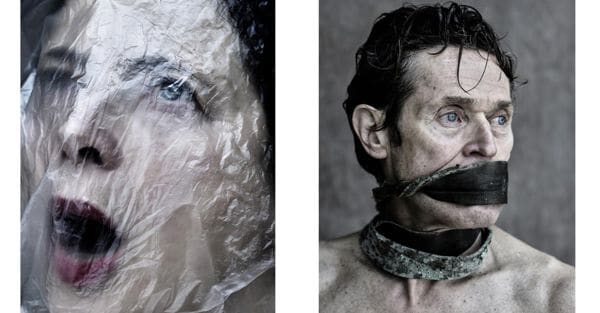
Isabella Rossellini e Willem Dafoe.

There had never been a camera in my house. So I knew absolutely nothing about photography, nor could I imagine that one day it would be my profession'. So says Fabrizio Ferri from his home in New York. His first step into this world was completely accidental. "I was 17 years old when I went with a friend to a big May Day event. He had a camera and at one point gave it to me. I saw a man in front of me holding his small son on his shoulders. I took the picture and the next day my friend printed it for me. A reporter from the daily newspaper Paese Sera passed by my house, he was looking for a symbolic image to tell the story of the event. He saw my photo and wanted to publish it. I earned 50 lire. I thought I could continue'. And so it was.
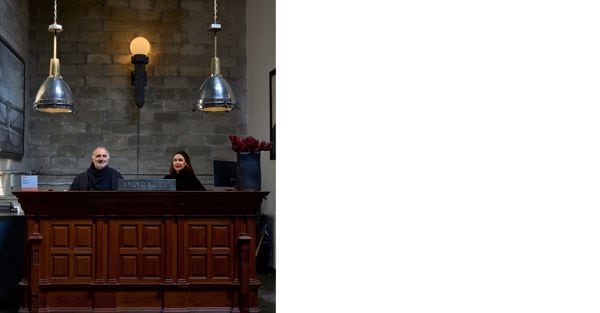
Ferri e Polverelli al front desk dei loro studi fotografici a Williamsburg, New York. ©Charlie McAteer

Ferri became not only a photographer, but an artist capable of moving from fashion to advertising, from cinema to music, always maintaining a personal, intense vision. He has never stopped at the surface of pure aesthetics, he has delved into the soul of characters, portraying their strength and vulnerability at the same time. In his multifaceted journey, the leitmotif is rigour. "Otherwise you risk losing yourself. Limits are as fundamental in business as in creativity. Art is born from a balance between chaos and discipline. Chaos is the raw material, indispensable for creating something new; then you need a certain amount of precision to order it and make it communicable. Without chaos there is no innovation. Without discipline there is no form'. Entrepreneurship is also a creative act that requires the same approach: starting from ideas and shaping them into concrete projects. A perfect synthesis of freedom and rigour.

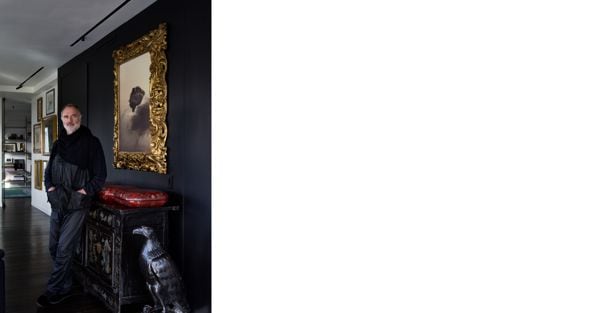
Ferri, nella sua casa, davanti al suo scatto “Julius”, 2003, esposto dentro una cornice barocca: ritrae una testa marmorea di Giulio Cesare. Le scatole e l’armadio cinesi sono del 1700 circa. L’aquila in cast iron dei primi del 1900 adornava un palazzo di New York. ©Charlie McAteer

In an era dominated by the fleeting image, where social media prizes the immediacy of virality, Ferri reflects on the nature of a timeless shot. "Uniqueness cannot be chased, because it is precisely when you stop looking for it that it manifests itself. What makes a shot timeless is not its ability to amaze in the present, but to continue to excite over time'. Like classical music or art, the power lies in its ability to vibrate beyond the moment, to renew itself emotionally and diachronically in every era. "There is no formula, but if you can touch universal chords, a work becomes contemporary, regardless of when it was created". I ask him what it means to photograph with this perspective. "For me it is never a passive gesture. It is pure creation: a silent dialogue between what I hear and what I see. An intense search to decipher, sublimate and share emotions. It is not a matter of accumulating surfaces, but of digging deep into them'. If it is not a simple mirror of reality, then what is it? According to Fabrizio Ferri, the photographer never captures the moment, he creates it. And therein lies the heart: the instant is not taken for granted because it is shaped through choices.

"Years ago I gave one of my cameras to a friend. I have never been a fetishist, they are working tools. I used a lot of them, different sizes and different brands'. Still, that model has remained in his heart. "My wife must have realised this and went to a flea market to buy me an identical camera. Today, technology offers endless models and endless possibilities, which is an advantage, but requires awareness. "Photography requires boldness, discipline and confidence in one's vision. Stopping the moment is an act of responsibility. The secret of any meaningful photo is not what you see, but what you make and leave to time'.

This truth resonates deeply when reflecting on the relationship between perfection and authenticity. In a world obsessed with retouching, can the sublime still exist in imperfection? Ferri has no doubts: 'Error is essential. In the unfinished, in imperfection there is the human, to give it up would mean losing ourselves. It is from this conviction that my installation entitled Breathtaking was born. An immersive project that takes the form of an act of social responsibility, questioning urgent issues such as sustainability and the environmental crisis, where art becomes a tool for revealing uncomfortable truths and restoring humanity beyond retouched appearances". At the centre of the installation, a large crystal coffin filled with water symbolises the fragility of our Planet and the fate that looms if we do not change course. The photographs portray 12 well-known faces from different artistic and cultural backgrounds: Helena Christensen, Misty Copeland, Willem Dafoe, Charlotte Gainsbourg, Gala Gonzalez, Julianne Moore, Bridget Moynahan, Carolyn Murphy, Isabella Rossellini, Susan Sarandon and Naomi Watts. These iconic figures, symbols of talent and resilience, become spokespersons for a powerful and universal message. The photographs, unframed but hung with two hand-forged iron nails, evoke a dramatic and profound allegory: "Truth, uncomfortable and inevitable, is always crucified, both in the evangelical and historical sense.

Here, women suffocated by plastic become living symbols of the environmental crisis, recognisable faces transformed into silent cries against pollution. A painful truth, ignored, sacrificed. But it is precisely this truth that I want to bring to light'. The minimal lighting amplifies the emotional impact, leaving the viewer in a state of dismay. "I want those who leave this installation to look down, because there are no easy answers. Art sometimes illuminates, other times questions, here it reveals a burning truth, impossible to ignore. In a world where sustainability has become an imperative, I also reflect a lot on how to reinvent the visual language of luxury in an ethical key, without trivialising it. Luxury should not be synonymous with excess, but with awareness. The choice of raw materials, the craftsmanship of details and the absence of frills express precisely this; it is not about what we take away, but what we leave behind. Essentiality becomes an act of resistance against the superfluous'. Ferri has integrated an innovative sound element into the exhibition, the result of his collaboration with Marina Abramović. For the duration of the exhibition, with the exception of the opening, visitors will be able to wear industrial headphones, the kind used on construction sites with pneumatic hammers, to completely isolate themselves from external noise. "I do not want to lead the viewer with explanations or suggestive music. Any attempt to lead him by the hand would be detrimental to the installation. The aim is to immerse him in a radical solitude, forcing him to listen only to the beating of his own heart.

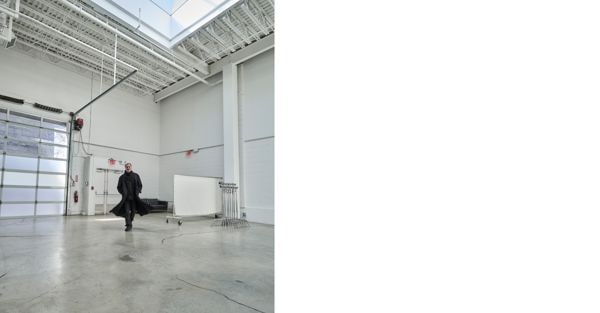
Ferri nello Studio Daylight di Industria. ©Charlie McAteer

It is like being at the bottom of the sea, surrounded by these works that speak to you directly, without filters. Only then can you really perceive the message. I am not looking for answers. I expect those who come here to leave with more questions than certainties. Art does not necessarily have to comfort; sometimes it has to disturb, shake, make us feel vulnerable'. The event, organised by Nobile Agency with the Università Cattolica del Sacro Cuore, is an artistic and social manifesto, an invitation to confront the contradictions of the present, in a dialogue that goes beyond time and space. I ask him what he would choose to frame if he had to take a portrait of humanity today. He replies smiling: 'I have already done it. It is a simple image, which is also the first page of my autobiography, Until Here. Fotografia di una vita (Rizzoli): a sunset over the sea, a moment when the horizon disappears. There are no clouds, there is nothing to obstruct the view, yet the horizon line is not visible. The sea evaporates, hiding the line. You believe the horizon is there, but you do not see it.

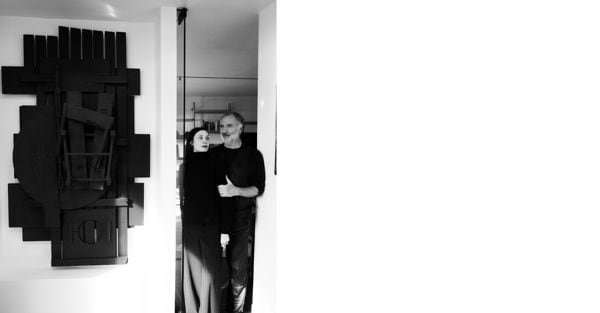
Ferri e Polverelli nella loro casa, accanto a una scultura di Louise Nevelson, “Untitled”, 1976. ©Charlie McAteer

This impossibility of perceiving what exists is absolute perception'. What does he think he represented, after all, with this shot? 'Faith', he says. A reflection echoing Tertullian's maxim, credo quia absurdum est (I believe because it is absurd). The intent is clear: an act of trust in the impossible, in the transcendent that escapes our immediate perception. It is not a matter of denying the contingency - the crises, the miseries, the contradictions of the present - but of putting them into perspective. "We must acknowledge them, but remind ourselves that man is something else. He is part of something impossible, transcendent. There is a greatness in us that no immanence can ever take away. Do you remember Goethe and the Faust? We are part of that force that eternally desires evil and eternally works good: a living paradox of extraordinary humanity'.

Copyright reserved ©
Loading...
Loading...

Newsletter

Notizie e approfondimenti sugli avvenimenti politici, economici e finanziari.

Iscriviti