
Art Nouveau Week 2026: from 8 to 14 July, Italia celebrates the Belle Époque in the sign of the sea
Curated by Professor Andrea Speziali and promoted by the Italia Liberty association, the eighth edition transforms the Peninsula into an open-air museum, celebrating the deep connection between modernist aesthetics and marine symbolism. Among the great novelties, a prestigious state recognition: the issue of an official commemorative postage stamp by the Ministry of Enterprise and Made in Italy

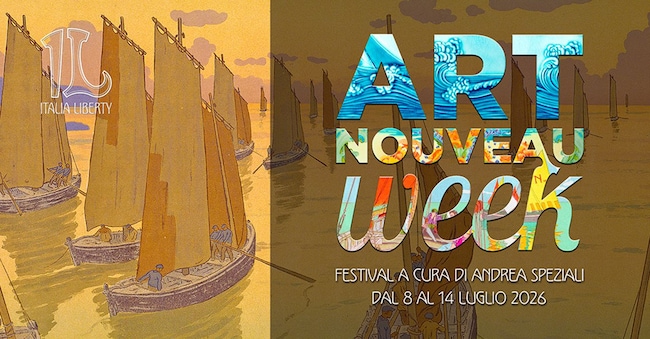
More than 750 activities are scheduled, including guided tours, grand tours, exhibitions, conferences, themed experiences and workshops, with special openings of more than 1,500 sites including villas, civic residences, palaces, hotels and gardens From 8 to 14 July 2026 in more than three hundred cities around the world comes Art Nouveau Week, the week dedicated to the cultural and artistic current of the early 20th century in its most diverse expressions.
The official inauguration and institutional recognition: rimini and the State stamp
The formal start and official inauguration of the Art Nouveau Week 2026 celebrations will take place on 8 July in the setting of the Riviera Romagnola, precisely in Rimini. The venue designated for the ribbon-cutting ceremony will be the splendid Villa Embassy, an authentic symbol of Romagna's glorious Art Nouveau season.
Coinciding with the formal opening of the exhibition, there will be a very high-profile institutional moment. The commemorative stamp entitled "Art Nouveau in Italia" will in fact be presented to the public and the authorities. This special postal value is issued directly by the Ministry of Business and Made in Italia, and is part of the prestigious and selective thematic series entitled "Le Eccellenze del Patrimonio culturale italiano" (The Excellence of Italy's Cultural Heritage).
This philatelic issue constitutes a fundamental institutional recognition of the Liberty heritage spread throughout the country. It unequivocally underlines the extraordinary cultural value, identity impact and strong tourist value of an artistic and architectural current that has indelibly marked and redefined the urban history and urban development of our country.
700 events: guided tours, grand tours, conferences, and exhibitions
In this eighth edition organised by the Associazione Italia Liberty and curated by the subject expert Andrea Speziali together with an outstanding scientific and honorary committee, there is a programme of seven hundred activities including guided tours, grand tours, conferences, scientific lectures, exhibitions, workshops and thematic experiences where you can discover Art Nouveau as an unprecedented photograph thanks to a group of two hundred and thirty licensed tourist guides, twenty or so tour leaders who, together with a large group of lecturers and academics, will tell you about and take you on a journey to discover thousands of artistic and architectural masterpieces in different countries.
A schedule of appointments (further on) that bring what was the Art Nouveau artistic current of the late 19th and early 20th century to the centre of global attention. The leitmotif of the 2026 edition is the Sea.
A series of asynchronous lectures will involve the public in an unprecedented exhibition to get to know in its entirety what was the Art Nouveau artistic current in all its facets: literature, graphics, drawing, illustration, painting, sculpture, precious, fashion, architecture and cuisine. Some lectures focus on authors of the period and themes such as the female figure.
The expert on the subject, lecturer Andrea Speziali, will also introduce you to previously unseen Art Nouveau artefacts in twenty meetings scheduled for each day of the week.
Also distributed free of charge is the catalogue containing the entire programme, the conference proceedings of the previous edition and an extraordinary census of some 40,000 Art Nouveau buildings in the way of over a thousand pages in total as a complete and unprecedented atlas of Art Nouveau.
Exclusive Art Nouveau Tours
Travels in the Art Nouveau dream under the sign of Antoni Gaudi: Italia Liberty also announces a series of exclusive tours dedicated to Art Nouveau. These trips, designed for an audience that loves art and elegance, will take place between Italia and Europe, with itineraries that combine culture, architecture and refinement. At the forefront of these is "The Secret Geometry of Antoni Gaudì", scheduled for the weekend of 11 July to 12 July, an experience reserved for a select audience that allows them to discover as never before the work of one of the world's most extraordinary modernist architects in the year of the 100th anniversary of the architect's death.
On 10 June 2026, exactly one hundred years after the death of the architect and artist who designed the Sagrada Familia Basilica, Antoni Gaudí will be celebrated on "World Art Nouveau Day" (WAND). On this occasion, the Italia Liberty association - promoter of the anniversary - will organise a conference dedicated to the Catalan master and officially present the complete festival programme.
Four major exhibitions from Cadegliano and Treviso on Art Nouveau advertising posters in collaboration with the Salce Foundation, in Pesaro the nature of Art Nouveau from sea corals to shells in dialogue with Marche ceramics from Molaroni to Ruggeri to New York with an exhibition on Tiffany and masterpieces of Art Nouveau applied arts at the Macklowe Gallery.
Daily guided tours lasting from one to three hours designed by Andrea Speziali together with a team of two hundred and thirty qualified tourist guides in over two hundred and thirty Italian cities that will include access to Art Nouveau buildings normally closed to the public that bear witness to a panorama still protected thanks to town planning restrictions, allowing participants a unique experience going back in time. Abroad from Spain to Belgium to the rest of the world in over fifty cities where guided tours will be held to discover the various declinations of Art Nouveau among boulevards, villas, palaces, hotels, gardens and museums for a total of three hundred cities worldwide.
A journey through art, history and memory comes to life in Italy's main monumental cemeteries, with a series of guided tours dedicated to Art Nouveau and funerary art between the 19th and 20th centuries.
Arising from Napoleon's reforms on burials, Italy's monumental cemeteries became authentic cities of stone, where the emerging bourgeoisie left an indelible mark by entrusting the greatest sculptors of the time with the celebration of their affections and social rise. This often little-known heritage is now open to the general public through guided tours of chapels, statues and funerary monuments of extraordinary artistic value.
If the Parisian cemetery of Père-Lachaise is considered the prototype of the 19th century monumental cemetery, it was in Italia - and particularly in the North - that the phenomenon found its most accomplished expression, with the birth of imposing and richly decorated cemeteries. Art Nouveau, in particular, with its soft, symbolic lines, found its fullest application in Italian funerary art, as can be seen in the works of Luigi Orengo, Leonardo Bistolfi, Medardo Rosso, Adolfo Wildt, Giacomo Manzù and many others, visible in the cemeteries of Genoa, Milan, Turin and beyond.
These places preserve the remains of some of the most important figures of Italian culture. At the Famedio del Monumentale in Milan alone lie Alessandro Manzoni, Francesco Hayez, Salvatore Quasimodo, Arturo Toscanini, among others.
The Italia Liberty association intends to enhance and promote these extraordinary places through a series of guided itineraries, designed for citizens, art lovers and cultural tourists. The list of cemeteries involved includes: Cimitero del Verano (Rome), Cimitero Monumentale di Staglieno (Genoa), Cimitero Monumentale di Milano, Cimitero della Certosa (Bologna), Cimitero Civico (Bergamo), Cimitero Monumentale (Trieste), Cimitero Monumentale (Turin), Monumental Cemetery (Verona), Monumental Cemetery of the Porte Sante (Florence), Monumental Cemetery (Bari), Cimitero Vantiniano (Brescia), Monumental Cemetery (Alessandria), Monumental Cemetery (Cremona).
An invitation to rediscover a little-known but fascinating chapter of our heritage, where art and memory come together in a timeless tale.
The programme in the different Italian regions
A packed calendar of guided tours in the second week of July will take citizens and tourists alike to discover and rediscover the Art Nouveau heritage scattered across the boot. Each tour is guided by experts and requires advance booking.
In Abruzzo, we begin on Wednesday 8 July in Pescara with a tour of architecture, wrought iron and concrete sculptures in the Art Nouveau style such as Teatro Michetti and the villas along Via D'Annunzio. On Wednesday 9 July the appointment is in Sulmona, departing from the Caffetteria Piazza Venti, for a tour of the decorated facades of the centre and the elegant palazzine of Viale Patini. On Saturday 12 July, L'Aquila unveils its rare but precious Art Nouveau examples, including Villino Nurzia and Villino Relleva, starting from the Villa Comunale.
In Basilicata, the protagonist is Melfi, with exclusive visits to Palazzo Pastore on Saturday 12 and Sunday 13 July. Guided tours also allow visitors to admire the recently restored panoramic tower. Also on Saturday 12 July, there will be an urban walk to discover the city's Art Nouveau testimonies, from the Carlucci pharmacy to Palazzo Pastore itself.
The Calabria offers two itineraries in Reggio Calabria. On Thursday 11 July, a walk through eclectic and Art Deco architecture, such as Palazzo Spinelli, Melissari and Mottareale. Monday 14 July is the turn of an in-depth tour that includes the Palazzo della Prefettura, designed by Gino Zani, Palazzo Corigliano and other historic buildings between the seafront and the centre.
In Naples, the charm of the Belle Époque is revealed through the Petraio staircase and hillside districts such as Vomero, Posillipo and Chiaia, with tours amidst breathtaking views and flowery architecture, enriched by local anecdotes and legends. Also in the Campania capital, an itinerary explores the Art Nouveau style of Vomero, with significant stops linked to the city's religious and film history.
In Emilia-Romagna, the proposal becomes even more articulated. In Riccione and Rimini, walks take visitors among the historic residences of the Belle Époque, revealing details and authors of a happy era. In Bologna two itineraries cross the city centre and the avenues outside the walls to discover the Art Nouveau villas, while in Ferrara a morning route reveals the lesser-known face of the city: the floral architecture of Ciro Contini along Viale Cavour. Cesenatico enchants with its seaside villas and Art Nouveau fishmongers, while Cervia promises an immersion in the 'dream of Palanti', between urban dreaming and artistic decoration.
Sogliano al Rubicone stands out for the free opening of the Arte Povera and Disco d'Epoca Museums, with collector Roberto Parenti personally guiding visitors among masterpieces by Mucha, Dudovich and Terzi. In Gambettola, the ancient Town Hall reveals its Art Nouveau face in a free itinerary between civic history and decorative art. Faenza participates with an exclusive stop at the International Ceramics Museum.
In Friuli Venezia Giulia, the appointment is in Trieste on Wednesday 9 July at 4 p.m. with a walk among the Art Nouveau dwellings concealed among the 19th-century buildings, along an itinerary that from Piazza del Governo through the heart of the city to Via Rossetti, amidst elegant views and testimonies of Triestine modernism between 1900 and 1920.
Although Lazio lacks Art Nouveau examples compared to other Italian regions, also due to the demolition of buildings during the century, something stands out in Rome. It starts on Tuesday 8 July at 9.30 am with exclusive access to the villino Ximenes, built in 1902 as the residence and studio of sculptor Ettore Ximenes, and continues at 7.30 pm with a walk in the Prati district among villas decorated by great names such as Cambellotti and Mazzucotelli. On Wednesday 9 July at 10:30 a.m., the Boncompagni Ludovisi Museum will be visited amidst furniture, fashion and decorative arts of the 20th century, while at 7 p.m. we will explore the Ludovisi district, a symbol of elegance and urban development at the beginning of the 20th century, amidst architecture by Koch, Basile and Busiri Vici.
On Thursday 11 July at 6 p.m., we will walk through the Trieste-Salario district to the eclectic Coppedè district, where the Liberty imagery takes shape amidst symbolism, styles and fairy-tale suggestions. The cycle of appointments concludes on Saturday 12 July at 5 pm with a visit to the Casina delle Civette at Villa Torlonia, a masterpiece of Roman Art Nouveau with its glass decorated by artists such as Duilio Cambellotti and Cesare Picchiarini.
In Liguria, the Italia Liberty association is proposing a series of guided tours to discover Liberty art and architecture. In Genoa, on Tuesday 8 July, it will be possible to explore the Monumental Cemetery of Staglieno with a walk devoted to Liberty sculptures by artists such as Leonardo Bistolfi and Vittorio Lavezzari. On 14 July, a visit to Villa Grock in Imperia is scheduled to admire the stained-glass windows and Art Nouveau decorations customised by the famous circus artist Grock. In Altare, on 13 July, the Museo dell'Arte Vetraria Altarese proposes a visit to Villa Rosa, an Art Nouveau masterpiece and home to the museum dedicated to the local glassmaking tradition. In La Spezia, on Saturday 12 July, a walk through the splendid Art Nouveau buildings of the working-class district is scheduled, with a focus on sculptures and paintings inspired by nature. In Savona, on Wednesday 9 July, visitors will be able to discover a rich Art Nouveau heritage with a long walk among villas, shops and historic buildings, including Villa Zanelli and Palazzo Viglenzoni. Also in Imperia, on 9 July, it will be possible to visit the MACI Villa Faravelli to learn about a large Art Nouveau stained-glass window and explore the artistic phenomenon of the early 20th century. In Chiavari, on Wednesday 9 July there will be a special itinerary among Art Nouveau villas and palaces, with a focus on the Rococo influences and the stories of the bourgeois families who inhabited these historic residences. All visits require compulsory booking and will be confirmed once the minimum number of participants has been reached.
The Lombardy region turns out to be the capital of Art Nouveau for the works of Giuseppe Sommaruga, a protagonist of the Modernist season in Italia.
Numerous guided tours celebrate the Art Nouveau style in various Italian cities. In Cernobbio, an evocative DJ set inspired by the flight of butterflies opens at Villa Bernasconi. In Lecco, a walk among Art Nouveau buildings and decorations among wrought iron and stone leads to the discovery of historic museum sites. Lodi offers a journey through noble palaces, from Gothic to Baroque, recounting centuries of history and civil and religious power. In Milan, in collaboration with architect Marta Candiani, two appointments explore Palazzo Castiglioni, a masterpiece by Giuseppe Sommaruga, and the Porta Venezia district, the heart of the city's Art Nouveau style. Brescia makes itself known for its Art Nouveau hidden in the main streets and bourgeois palaces, with a new itinerary dedicated to the Art Nouveau façades of the early 20th century. In Monza, visits from the museum to the historic centre and a route through villas and palaces inspired by the queen. Crespi d'Adda instead offers an immersion in the workers' village, a unique example of industrial archaeology and harmony between efficiency and architectural beauty.
In the Marches, in Pesaro, on Tuesday 8 July at 6 p.m. there will be a tour of the city's most important Art Nouveau villas, with a subsequent visit to the Ceramiche Artistiche Molaroni company, to discover the architecture and artefacts of the late 19th and early 20th century.
In Molise, on Wednesday 9 July at 5.30 p.m., visitors can take part in a walk in Campobasso to discover the modernist and Art Deco decorations that transformed the city in the early 20th century. The route includes significant stops such as the decorated ceiling of the Convitto Nazionale Mario Pagano (Mario Pagano National Boarding School), the Villetta Flora, the Teatro Savoia and numerous examples signed by the Tucci workshop and architect Nicola Guerriero.
The Piedmont, a region devoted to Art Nouveau second to Lombardy, sees the involvement of Turin and Stresa with special events including shows and guided tours.
The review "Stresa on the Harmony of Art Nouveau. Notes, words, colours" on Saturday 12 and Sunday 13 July includes a series of initiatives put on by the City of Stresa in cooperation with the Italia Liberty association devoted to recalling Art Nouveau in works of art, fashion and music. Participation is free of charge to pay homage to what was the fascinating Art Nouveau period with exhibitions, shows and workshops. In Turin, you will be able to discover the city's most elegant neighbourhoods - from Cit Turin to San Donato, from Crocetta to Borgo San Paolo - to admire the masterpieces of Art Nouveau architecture up close, amidst floral details, wrought iron and fascinating stories of a city in full ferment in the late 19th and early 20th centuries.
In Puglia, in Bari, two walks are scheduled on 8 and 9 July at 10am to explore local modernism, with examples of Art Nouveau and Art Deco decoration, including frescoes attributed to Duilio Cambellotti in a special entrance. Visits will take place once a minimum number of participants is reached and are subject to booking.
In Sardinia, in Arborea on 8 July there will be a modernist walk to discover 20th-century architecture between Modernism and Déco. In Sassari, on 9 July, an itinerary in the Monumental Cemetery is scheduled to admire Liberty monuments with a strong symbolic and esoteric value. In Cagliari, on Saturday 12 July, visitors will be able to explore a veritable open-air museum of Art Nouveau decorations with a special focus on the female figures sculpted on the façades of historic buildings in the city centre and neighbouring towns.
In Sicily, in Catania, on 8 July, it will be possible to discover the Art Nouveau decorations along Via XX Settembre as far as Corso Italia, visiting important period residences and villas; while on 9 July there will be two routes, one among the residences around the Giardino Bellini and another in the evening at Villa Ardizzone, with a visit to the frescoes and a themed aperitif. Also on 9 July in Mondello, at the crack of dawn, there will be a walk accompanied by music and an Art Nouveau breakfast. In Palermo, on 9 and 11 July, visitors will be able to admire the Art Nouveau architecture of the Basile family, with visits to Villino Favarolo and Villino Florio, and an itinerary among the buildings symbolising eclecticism in the Via Libertà area. In Chiaramonte Gulfi, on 8, 12 and 14 July, there will be a visit to the Casa Museo Liberty, which houses masterpieces by Ernesto Basile, René Lalique and other masters of European Art Nouveau.
In Tuscany, more precisely in Lucca, there will be walks to discover the Art Nouveau villas and signs, with qualified tourist guides who will accompany participants on a route divided between the elegant residences outside the walls and the historic shop windows in the centre. Viareggio, known as the pearl of the Tyrrhenian Sea and one of the major Italian centres for the diffusion of Art Nouveau style, offers evening and afternoon visits to admire the modernist residences and decorations on Viale Regina Margherita, emphasising the contribution of artists such as Galileo Chini and engineer Alfredo Belluomini. In Livorno, on Saturday 12 July, a tour will tell the story of the seaside town's evolution in the first decades of the 20th century, with stops at the Terme del Corallo spa, Art Nouveau villas, and the historic Vettovaglie market, between architecture and daily life. Florence, with a walk scheduled for 14 July, will uncover the lesser-known but equally fascinating face of Art Nouveau, among eccentric villas and floral palaces designed by architects such as Giovanni Michelazzi and Paolo Emilio Andrè.
In Umbria, in Foligno and Perugia, on 8 and 9 July, the visits will tell the story of a far-sighted bourgeoisie that, in the early 20th century, enriched towns with elegant villas and artistic decorations, paying homage to the protagonists of local architecture and the hidden beauty of Umbrian Art Nouveau. All visits require a reservation and a minimum number of participants to guarantee their success.
In Veneto, in Vicenza, an itinerary will be held on 8 July to discover the Art Nouveau decorations hidden in the streets of the city, while on 9 July in Verona the district between Piazza Vittorio Veneto and Via Goffredo Mameli will be the protagonist, with villas and buildings created by the major architects of the period. In Thiene, on 13 July, a walk will explore historic villas and architecture that tell of the artistic ferment of the early 20th century. On 14 July, Lido di Venezia will host a visit to the most significant Art Nouveau villas, masterpieces of a period of great architectural vivacity.
Initiatives abroad
Abroad, there are a series of guided tours off the classic tourist routes, with a special focus on Catalan and Gothic Modernism in Spain. Among the selected destinations are Barcelona, Valencia, Castellón de la Plana and Palma de Mallorca, with visits designed to reveal previously unseen faces of urban architecture.
In Ascona, Switzerland, there will be free workshops on the art of the goldsmith with practical workshops and guided tours of the old town centre, scheduled for 8, 9 and 14 July, to learn about jewellery making from the Etruscan era to the Belle Époque.
In Barcelona, two tours dedicated to Catalan Modernism will be organised on Wednesday 9 July: one at the famous 'Manzana de la Discordia', with entrance to the Casa Amatller, and another in the Vila de Gràcia district, with a visit to Casa Vicens, Gaudí's first work. On Thursday 11 July, the Catalan city will unveil its millenary past between Roman remains and modernist masterpieces in the Barrio Gotico with entry to the Palau Güell.
Finally, in Palma de Mallorca, on Sunday 13 July, a guided walk will take participants through the jewels of local Modernism, admiring public buildings, private residences and commercial spaces that testify to the artistic legacy of Gaudí and Domènech i Montaner on the island.
In New York, Art Nouveau speaks American and does so through a widespread programme spanning museums, galleries and urban architecture. On the occasion of the eighth edition of "Art Nouveau Week", the worldwide calendar organised by the cultural association Italia Liberty expands to the United States for the first time with a major exhibition, guided tours and life drawing activities in some of the major cities, from New York to Los Angeles, from Chicago to Florida.
The heart of the programme is the exhibition 'Louis Comfort Tiffany. The Dream of Art Nouveau', running from 8 July to 31 August 2026 at the Macklowe Gallery, a stone's throw from Central Park. Curated by Benjamin Macklowe and Andrea Speziali, the exhibition offers an immersion into Louis Comfort Tiffany's pioneering language of light, matter and nature.
The exhibition, entitled 'Impressionism in glass: the work of Tiffany Studios', focuses on the American artist's famous lamps, true icons of fin de siècle modernity. Alongside these, works by European protagonists such as Émile Gallé, Louis Majorelle and René Lalique outline an international dialogue between applied arts, furniture and decoration. The result is a unified vision in which nature becomes a stylistic and symbolic matrix, transformed into light, glass and organic forms.
With this programme, Art Nouveau Week confirms its international vocation, proposing a contemporary interpretation of a movement that, in the late 19th and early 20th century, redefined the relationship between art, industry and everyday life. A legacy that, in the United States, manifests itself in original forms still capable of dialoguing with the present.
Brand connect

