
The art of the unseen: a dialogue between haute couture and glass sculpture
Three sculptures by Diego Perrone in dialogue with three jackets, each crafted through two hundred tailoring steps: in Milan, at the Istituto dei Ciechi la moda.

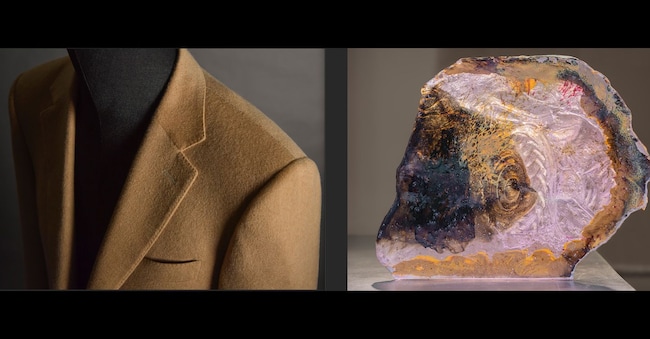
Two very different craft processes illustrate how the quality of an object depends on what cannot be seen: two hundred tailoring steps give shape to a jacket, whilst the lost-wax casting of glass reveals the layers and transparencies of the artistic creation. Two seemingly distant worlds share the same principle: value is built from within. This is the theme of the exhibition staged at the Istituto dei Ciechi in Milan, which opens to the public on 11 November under the patronage of Altagamma, the Chamber of Fashion and the Municipality of Milan. A dreamlike journey featuring a historic ‘Made in Italy’ brand and an eclectic artist, capable of blending artistic languages, traditional techniques and conceptual art.
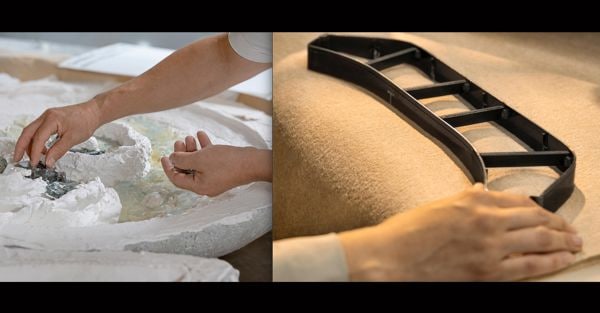
Under the Surface – Shaping the Unseen is an international project which, following stops in Beijing and New York, is coming to Italia, just before its final stop in Mumbai on 27 November. Four artists are involved: Brian Rochefort in the United States, Lihuai Qian in China, Thukral & Tagra in India and Diego Perrone in Italia. For the Italia instalment, curated by Cloe Piccoli, Perrone has created three glass sculptures which are displayed alongside the cashmere and vicuña blazers from Canali’s Autumn–Winter 2026 collection.
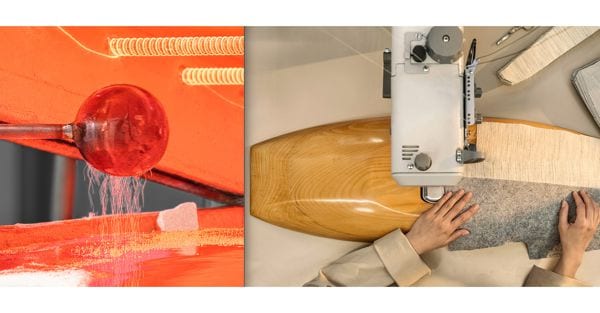
Have you ever taken a jacket out of your suitcase after a trip and found it was almost crease-free? A garment’s ability to regain its shape after being folded and stored is not just a question of the fabric. It depends on what happens inside it – on a construction made up of layers, seams and finishes that are invisible but determine how it behaves. Canali, a Lombardy-based bespoke tailoring firm founded in 1934, describes this quality as the jacket’s ‘memory’. It is the result of around two hundred steps that transform an initially flat fabric into a three-dimensional structure.
It is precisely this craftsmanship that takes centre stage in the exhibition. “What remains hidden within our garments determines their shape, balance and durability,” explains CEO and Chairman Stefano Canali. “The interlining and stitching remain hidden, but their effect is evident in the way the garment drapes over the body, follows its movements and regains its shape, even after a journey.”
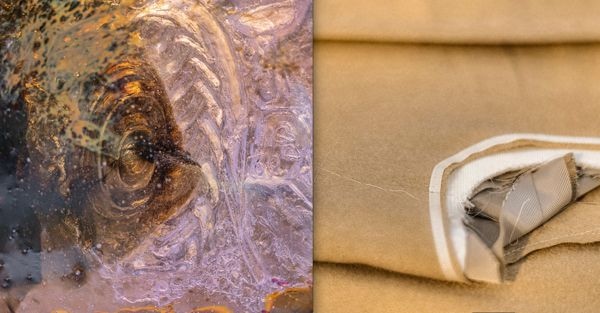
Diego Perrone takes a different and complementary approach. For his three new works, he has used a casting technique reminiscent of the ancient lost-wax bronze casting method, which was already practised in Greek and Roman sculpture, rather than resorting to traditional Murano glassblowing. ‘Part of my practice stems from an ongoing dialogue with glass, a material as fascinating as it is complex, which demands technical precision, experience and a deep artisanal sensibility”, he explains. During the casting process, the glass develops layers, opacities and transparencies that only become fully visible once the work is complete. Thus, the invisible becomes visible, and vice versa.

