Space

Artemis II, countdown to return to earth: ditching at 2:07 am

The NASA mission that will prepare the return to the Moon comes to an end. With not a few scientific novelties as spoils
by Leopoldo Benacchio

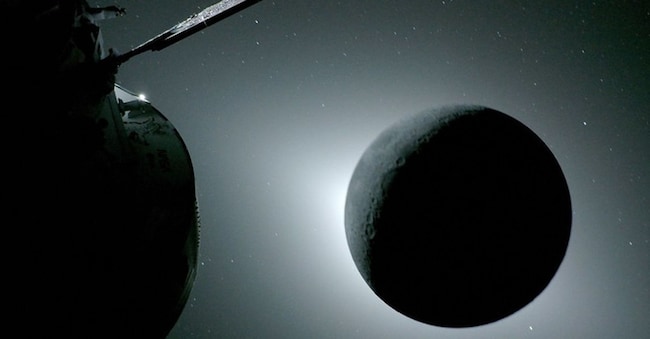
Una delle foto scattate dagli astronauti della missione Artemis II

5' min read

Translated by AI
Versione italiana

5' min read

Translated by AI
Versione italiana

InArtemis II everything went very well. Meanwhile, the dreaded takeoff, postponed several times due to technical problems, after adjustments that took a few days showed all the power of the main and auxiliary engines of the SLS, which rose and with its almost 100 m height took to the skies. Now, however, it is a matter of facing the last, dangerous part of the journey: the 13-minute re-entry into the atmosphere and then the embarkation. It will all take place while it is 2:07 a.m. on 11 April.

For the first part of the mission, the first eight minutes of flight at Nasa still held everyone in suspense, because these are the ones where any small fuel leak or a malfunction of some gasket can lead to catastrophe, as has unfortunately already happened twice, with that very type of launcher when it carried the Space Shuttle into orbit.

Loading...

Instead, the entry into the parking orbit was perfect, all the on-board equipment was tested for a day around the Earth and then off, with the ignition of the second stage engines, towards the Moon. The trajectory was virtually perfect right from the start and the small corrections made to the capsule by the module's engines were minimal.

The Moon has gradually approached, while the European Service Module, in the construction of which Leonardo, with its subsidiary Thales Alenia Space, was also involved, has always provided the essential services for the astronauts' lives: water, oxygen, electricity.

There were a few little problems on the flight to the Moon, but in the end it seemed as if it was done to make the audience laugh and sympathise with the astronauts, who were seen fiddling with a toilet that didn't work, which is no small matter in space, and then with the electronic mail, a problem that, sooner or later, afflicts all mankind. It helped, these minor inconveniences solved, to raise the public's interest, probably because we all come across such things sooner or later.

The whole mission has raised interest, especially in the USA and Europe, if not to a planetary extent as in the Apollo flights to the Moon, certainly to an unhoped-for level, after months and months of space having nothing but problems in store for us: space junk, too many satellites obscuring the stars, military use. All stuff that worries the man in the street.

The magic touch was the fleeting yet unexpected entry of a jar of a famous spreadable cream, which one of the astronauts had brought along as comfort food, a common practice on these flights. This triggered both sympathy and rather absurd criticism from those who find problems even in the packaging of Swiss chocolates.

For the most important part, the overflight of our satellite, it was she, our beautiful Moon, who took centre stage. While the four astronauts beat the previous record distance from Earth of 6,606 kilometres, avalanches of beautiful images were taken, which were also important from a scientific point of view, to detail the areas of possible lunar landings and the moon geology. For the first time, NASA had the astronauts use top-of-the-range smartphones, certifying that the difference between cameras and these is now practically non-existent. It is difficult to choose the most beautiful, between the one of the Earth seen from the Moon and the one, for which the writer votes, of the solar eclipse seen from Orion, while on the other side of the Moon.

The four were able to see the far side of our satellite, the one that very few can claim to have seen, with all its mystery, as it is truly different from the side facing us, which always looks the same. The four declared themselves well aware of the privilege they had received, for which they had trained for long months, and also endured nerve-wracking delays.

The Moon provided them with a gravitational boost, with the so-called slingshot effect, which put them back on the arrival trajectory. After a day of relaxation, the astronauts, at the time of writing, prepared for the delicate phase of re-entry into the atmosphere. As they approach the atmosphere Orion undocks from the Deep Space Network - the network of large antennas that covers the entire globe and in which our own Telespazio also collaborates - and control is taken over directly from Houston, while the capsule is also separated from the Service Module and Orion tackles the last run alone. To get an idea of what awaits the astronauts in those 13 minutes, we can only say that Orion arrives in the atmosphere, about 100 kilometres above the ground, at 40,000 kilometres then. The splashdown, that is, when the capsule hits the ocean waves in front of the city of San Diego, USA, occurs at 27 kilometres per hour.

Orion re-enters following a hypersonic profile, aiming for a very intense aerodynamic deceleration, in simple terms from that crazy speed for us the atmosphere and the interaction between capsule and increasingly dense layers slows it down.

Although Nasa has modified the re-entry trajectory to the best of its ability, the main problem is the heat shield, made of plates of a material called Avcoat, made for the Apollo programme and renewed for Artemis, basically composed of epoxy resin with glass fibres and microspheres. This is the critical element of the re-entry, which divides the opinions of many experts, since it had given problems with Artemis I, the first flight without astronauts.

At an altitude of about 100 kilometres, the shock wave is generated and plasma appears around the capsule, aerodynamic drag begins to brake the vehicle and heat up the heat shield, which, from the very first moment, was turned towards the direction of descent to protect the capsule.

When reaching speeds similar to those of sound, the special parachutes, three of them, are opened for ditching, braking up to the speed of an electric city bike. The impact is still considerable, but bearable for humans. At now transonic and subsonic speeds, the parachutes are deployed until ditching in the Pacific Ocean.

Aboard the spacecraft at the end of a ten-day journey around the Moon will be NASA astronauts Reid Wiseman (commander), Victor Glover (pilot), Christina Koch (mission specialist) and Canadian Space Agency astronaut Jeremy Hansen (mission specialist). For those who feel like staying up late, the final stages will be seen live on Nasa.gov - well worth the effort.

The next missions will have to take a lot of account of this new human adventure, because the game becomes more and more complex: building a city on the Moon is no joke. Perhaps that is why it is worth doing.

Copyright reserved ©
Loading...

Brand connect

Loading...

Newsletter

Notizie e approfondimenti sugli avvenimenti politici, economici e finanziari.

Iscriviti