Space

Artemis II, the human species never so far from Earth

The four astronauts of the Artemis II mission are preparing to reach the maximum distance from Earth ever touched by human beings.

aggiornato il 6 aprile 2026 alle ore 10:50

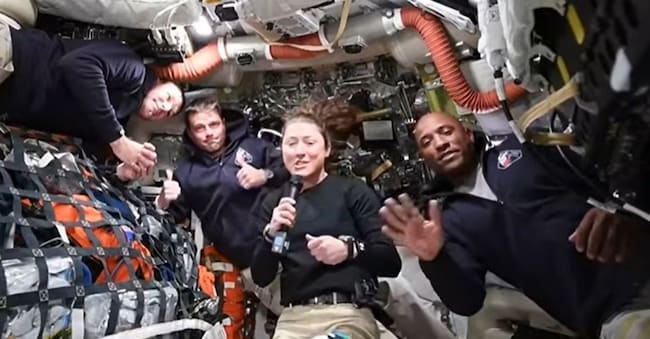
Foto IPP/Reid Wiseman/Nasa/Planet Pix via ZUMA Press Wire nella foto I membri dell'equipaggio della missione Artemis II della NASA, Jeremy Hansen, Reid Wiseman, Christina Koch e Victor Glover, rispondono alle domande dei giornalisti durante il primo evento di downlink della loro missione. Le immagini sono state diffuse il terzo giorno della prima missione dal 1972 a portare l'uomo intorno alla Luna. missione Artemis II della NASA sulla luna 16878

3' min read

Translated by AI
Versione italiana

3' min read

Translated by AI
Versione italiana

It is the day of the close passage to the Moon and also the day of records, as the four astronauts of the Artemis II mission prepare to reach the maximum distance from the Earth ever touched by human beings. The 1970 Apollo 13 mission's record for the greatest distance from Earth has already been broken. The three Americans Christina Koch, Victor Glover and Reid Wiseman, and Canadian Jeremy Hansen have gone more than 400,171 kilometres into space, NASA announced. Apollo 13, 56 years ago had reached that point after having to change trajectory following an in-flight oxygen tank explosion, with the astronauts uttering the famous phrase 'Houston, we have a problem'

At around 7 a.m. Italian time on Monday, NASA astronauts Reid Wiseman, Victor Glover and Christina Koch, with Jeremy Hansen of the Canadian Space Agency CSA, performed the final manoeuvre to fine-tune the Orion shuttle's trajectory towards the Moon ahead of its close passage, scheduled to take place when it is 1.02 a.m. in Italy on Tuesday, 7 April.

Loading...

They also performed a re-test of the pressurised suits and, after a few hours' rest, the control centre in Houston woke them up at 16:50 (Italian time) to continue preparations.

 At 18.41 Italian Orion will enter the Moon's sphere of influence, i.e. lunar gravity will become the dominant force on the shuttle's trajectory in view of the close passage.

It will be an intense day, with a rhythm marked hour by hour by the control centre but which, of course, could be subject to change.

Here are the key dates, in Italian time:
at 19:56 is expected to break the record for man's maximum distance from Earth, at 400 thousand kilometres, set in 1970 by Apollo 13;
at 20.45 the overflight of the lunar surface begins, with the start of the observation campaign; when the shuttle passes behind the Moon, communication with Earth will be interrupted for about 40 minutes ;
and it is at this time, exactly at 1.02 that Orion is expected to approach the lunar ground at 6.550 kilometres; five minutes later the shuttle is expected to set a new record for the maximum distance from Earth, at 405,000 kilometres;
at 1.25 the resumption of communication with Earth;
at 2.35, when the Moon passes in front of the Sun, the astronauts will see an eclipse;
at 3.20 the conclusion of the lunar flyover.

The diary of 5 April

Yesterday, 5 April, during the fourth day of the flight, the astronauts on board Orion went over plans to study the Moon during the next flyover and are currently practising manual control of the spacecraft.

"The crew of the Artemis II mission aboard the Orion capsule," the space agency's website further reads, "completed a manual piloting demonstration and reviewed the lunar flyover plan, concluding their third full day in space. Nasa Christina Koch and Canadian Space Agency (CSA) astronaut Jeremy Hansen took turns at the controls of the spacecraft to test its performance in deep space. For 41 minutes, the two tested two different propulsion modes'.

Subsequently, 'commander Reid Wiseman and pilot Victor Glover will repeat the demonstration on the eighth day of the flight, Wednesday 9 April, to provide the ground teams with as much information about the spacecraft as possible'.

Capsule toilet problems solved

Yesterday, the mission's astronauts had to deal withsome problems with the Orion capsule's toilet, which had stopped working after liftoff on Wednesday and had been experiencing intermittent problems ever since. Engineers suspect that theice may have clogged the tube that prevents urine from being completely discharged into space. Mission Control has instructed the astronauts to use additional spare urine bags until the problem is resolved.

The ground control team eventually managed to devise a solution, devising a plan on Saturday afternoon. The strategy involved orienting the capsule in such a way as to expose the shaft to sunlight, so as to melt the frozen material. The manoeuvre unblocked the system, allowing liquids to be expelled outside again and effectively restoring the functioning of the on-board bath.

Artemis II, astronauti senza toilette: è intasata e non funziona

The three American astronauts and the canadesem then, will reach their destination on Monday, photographing the mysterious hidden side of the Moon.

This is the first crew to visit the satellite in over 53 years, picking up where Nasa's Apollo programme left off. "The Earth is quite small and the Moon is definitely getting bigger," reported pilot Victor Glover.

Copyright reserved ©
Loading...

Brand connect

Loading...

Newsletter

Notizie e approfondimenti sugli avvenimenti politici, economici e finanziari.

Iscriviti