Space

Artemis II, first mission around the Moon since 1972 successfully returned

The spacecraft that carried four astronauts into lunar orbit ditched near San Diego after a complex manoeuvre at very high temperatures
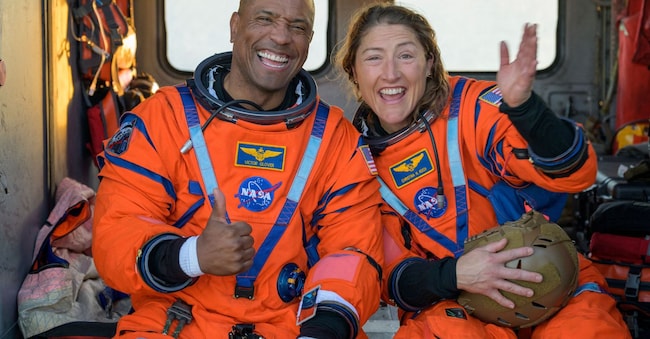
by Marco Valsania

L'astronauta della NASA Victor Glover, pilota di Artemis II, e l'astronauta della NASA Christina Koch, specialista di missione di Artemis II, reagiscono mentre sono seduti su un MH-60 Seahawk della Marina Militare appartenente all'Helicopter Sea Combat Squadron (HSC) 23 sul ponte di volo della USS John P. Murtha dopo che loro e i compagni di equipaggio sono stati recuperati dalla navicella Orion in seguito all'ammaraggio nell'Oceano Pacifico al largo della costa della California, Stati Uniti, il 10 aprile 2026. NASA/Bill Ingalls/Handout via REUTERS    QUESTA IMMAGINE È STATA FORNITA DA UNA TERZA PARTE via REUTERS

3' min read

Translated by AI
Versione italiana

3' min read

Translated by AI
Versione italiana

The four astronauts of Artemis II, the first crew to complete a mission around the Moon since 1972 during which they flew to record distances from Earth, are in "excellent condition". This was confirmed directly by NASA. "What a trip" was the first comment of Artemis II's commander, Reid Wiseman, just after the successful ditching of the Orion spacecraft off the coast of California.

Artemis II, rientrata sulla Terra la capsula con gli astronauti: il video dell'ammaraggio

A journey that broke the previous record set by Apollo 13 in 1970, arriving 252,756 miles from Earth, 4,100 miles further. The astronauts were also able to study a part of the Moon never before observed and witness a 53-minute solar eclipse.
Loading...

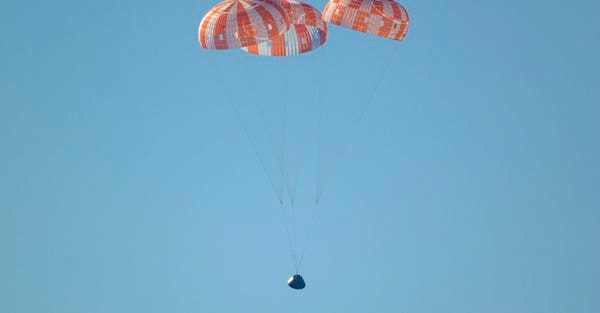
Una foto fornita dalla National Aeronautics and Space Administration (NASA) mostra la navicella spaziale Orion della NASA, denominata «Integrity», mentre scende con il paracadute nell’Oceano Pacifico, il 10 aprile 2026. La missione, con a bordo gli astronauti della NASA Reid Wiseman (comandante), Victor Glover (pilota) e Christina Koch (specialista di missione), nonché l'astronauta della CSA (Agenzia spaziale canadese) Jeremy Hansen (specialista di missione), ha completato un sorvolo della Luna ed è tornata sulla Terra. EPA/BILL INGALLS / NASA HANDOUT SOLO PER USO EDITORIALE/NON IN VENDITA

The ditching took place unhindered at 6.07 a.m. local time (2.07 a.m. Italian time) on Friday in the Pacific Ocean near San Diego. NASA personnel and specialised naval divers quickly boarded small boats and docked the Orion spacecraft, which floated upright, opened the hatch, carried out initial medical checks and helped the astronauts out to be transported, one by one, by helicopter to the nearby support ship. Orion was then towed and hoisted aboard the ship, the USS John P. Murtha,

where they are greeted by NASA Director Jared Isaacson. The astronauts, upon completion of further checks, will then be transferred to the Johnson Space Center in Houston.

La navicella spaziale Orion della NASA mentre le squadre di recupero lavorano per metterla in sicurezza prima del trasferimento dei membri dell'equipaggio di Artemis II sulla USS John P. Murtha nell'Oceano Pacifico al largo delle coste della California, il 10 aprile 2026. NASA/Joel Kowsky/Foto fornita tramite REUTERS QUESTA IMMAGINE È STATA FORNITA DA UNA TERZA PARTE. È OBBLIGATORIO CITARE LA FONTE.

The historic mission lasted ten days, or to be exact nine days, one hour and 32 minutes from take-off to re-entry. It represented a crucial step for the return of astronauts to also tread the lunar soil, an adventure planned by Nasa for 2028 and which, in the government's plans, is a prelude to the construction of a real base. Orion encountered some problems in communication and in medical services, but key, life support and propulsion systems passed the tests promising new missions.

The Orion spacecraft is built for the space agency primarily Lockheed, but with the service module (electricity, propulsion and vital systems) built by the European Space Agency. It is equipped for deep space exploration, part of the Artemis programme to the Moon and beyond. In contrast, the Crew Dragon of Elon Musk's SpaceX, smaller, agile and primarily assigned to a kind of space taxi service, for low orbits and connections with the International Space Station. Orion, 57% larger than the original NASA Apollo spacecraft, is in particular capable of withstanding extremely high temperatures on re-entry into the Earth's atmosphere.

Capsula Orion ammarata, missione compiuta per Artemis II

Photogallery20 foto

The stages of landing

The mission crew consisted of the Americans Christina Koch, Victor Glover and Reid Wiseman (the commander), together with the Canadian Jeremy Hansen. The re-entry took place in a complex procedure called 'skip reentry'. This is a two-stage operation in which the spacecraft enters the atmosphere, ascends slightly and then re-enters again. This reduces stress on the astronauts and improves trajectory accuracy with controlled deceleration. In the final stage, the parachutes then opened, three last ones, to allow ditching into the ocean.

Eight minutes "of fire"

The most delicate moment is considered to be the impact with the atmosphere. The capsule reached a speed of close to 40,000 kilometres per hour (to be exact a maximum of 24,661 miles per hour, second only to that of Apollo 10 in 1969), or almost 11 kilometres per second, generating a plasma cloud with temperatures of up to 2,700 degrees. The protective shield built for the mission is charged with dispersing this heat for about eight minutes, the duration of the most critical phase in which all communication with the mission headquarters in Houston, Texas, is also cut off. Once the most delicate moment has passed, at an altitude of about 7,500 metres the braking parachutes, which brought the capsule to a re-entry speed of less than 30 km/h on impact with the water, will open.

Copyright reserved ©
Loading...

Brand connect

Loading...

Newsletter

Notizie e approfondimenti sugli avvenimenti politici, economici e finanziari.

Iscriviti