
Arteparco and Vulcana: contemporary art in its summer guise
Artistic initiatives that are particularly appealing to collectors and sponsors; the experience unfolds at a leisurely pace, in harmony with the exceptional nature of the venues

During the summer, our passions and obsessions don’t go on holiday; on the contrary, they come on holiday with us. So contemporary art, too, leaves the sweltering cities behind to seek refuge by the sea or in the mountains. Over the past weekend, two examples perfectly illustrate this trend: “Arteparco” in Pescasseroli, Abruzzo, and “Vulcana. Sublimation” on the island of Stromboli. These are places where contemporary art takes on deeper meaning by engaging with issues such as local development and environmental protection, thereby becoming particularly attractive to companies that have generously supported both initiatives.
In the mountains of Abruzzo
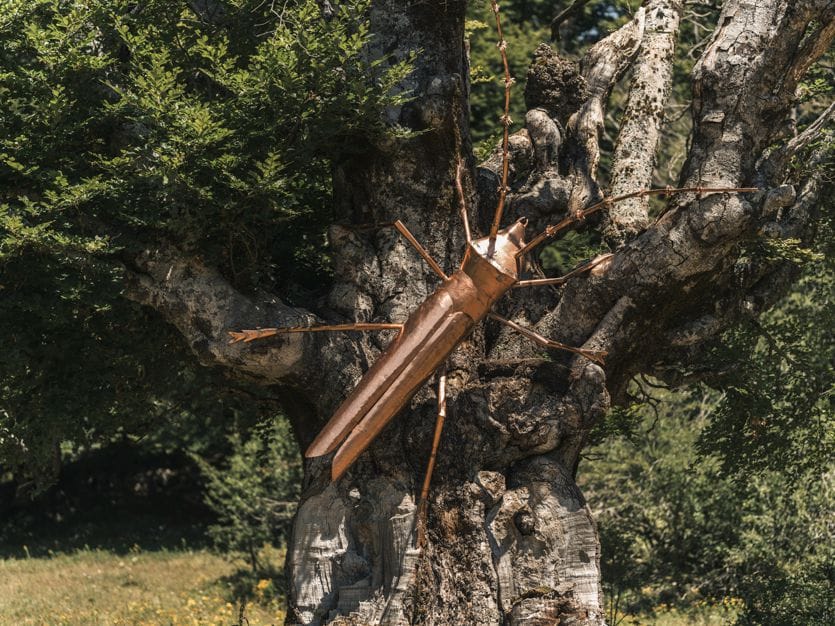
Pescasseroli is a couple of hours’ drive from Rome; it is home to the administrative headquarters of the Abruzzo, Lazio and Molise National Park, one of Italy’s oldest and most important nature reserves and, of course, the area’s main attraction. In 2018, Arteparco was launched on the initiative of Paride Vitale: each year, an artist is invited to conceive an installation that will become a permanent feature of the Park, set amongst the mountains, trees and meadows. The first artist was Marcantonio, followed over the years by Sissi, Valerio Berruti, Matteo Fato and many others. This year, for the ninth edition, the chosen artist is Hilario Isola, with the work ‘Santa Rosalia’, which also serves as a reflection on the relationship between the individual and their ecosystem. A tribute to Rosalia Alpina, a harmless blue-tinged beetle that inhabits beech forests. The insect takes the form of a large bronze sculpture clinging to a tree; its colour will change over time as it oxidises in the open air, reflecting the constant transformations of every natural landscape. The artist’s works are valued at between 15,000 and 50,000 euros; his representative galleries are Guido Costa Projects and Valentina Bonomo.
Among the many visitors during the opening weekend – not to mention wolves, bears and porcupines, of course – were the President of the Abruzzo region Marco Marsilio with his wife, the painter Stefania Fois, the television presenter Victoria Cabello and the new editor of *La Stampa* Alberto Leonardis. Also present was a host of corporate partners enough to make any trade fair jealous, including the BMW Group, the first to have believed in the initiative many editions ago, and which, through its arm dedicated to corporate social responsibility, SpecialMente, has been developing projects dedicated to social inclusion, culture, education, sport and sustainability for 13 years. Arteparco, in its festival format, will continue until the end of August with various participatory events; Hilario Isola’s artwork will remain as a permanent feature of the park, for as long as Mother Nature allows.
Art in the Aeolian Islands
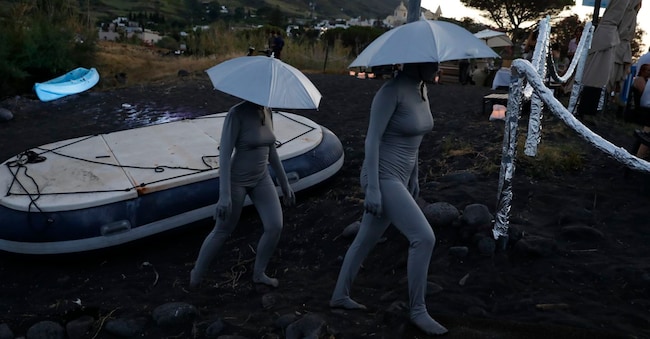
During the same period, the island of Stromboli came alive with the second edition of “Vulcana. Sublimation” (17–19 July), a multidisciplinary exhibition founded by Manuela Morandi and curated this year by Cornelia Mattiacci and Niccolò Gravina, curators at Fondazione Prada. The common thread linking the works of around ten artists scattered across the island was the contemporary obsession with taming the future through predictive data and automated calculations – an obsession of decidedly relative value on an island home to one of the world’s most active volcanoes. Among the artists featured is Marco Pio Mucci, who exhibited a series of paintings in a space evoking alien observation posts; his drawings and canvases are priced between 1,000 and 10,000 euros, with Matta in Milan serving as his main gallery. There was also space for video works, in an evocative setting such as the Nassa terrace, featuring a multimedia installation by the duo Désirée Nakouzi De Monte & Andrea Parenti – alias Collezione Delroi – where a film shot on the island is screened, featuring dialogue written in collaboration with the local inhabitants. Their works are valued at between 5,000 and 25,000 euros at the Galerie des Bains in London. Lizz Glynn, on the other hand, presented a performance on the beach inspired by geological time – as impetuous as a volcanic eruption or as inevitable as the stratification of the Earth’s crust; her works are valued at between 6,000 and 325,000 dollars and she is represented by the Paula Cooper Gallery in New York. The artistic experience permeated every aspect of the festival: from the culinary creations, the furnishings and the tableware to even the staff uniforms, thanks to the duo Forniture Pallotta, the Milan-based studio that transformed the catering into a sensory immersion. Vulcana is intended not merely as a weekend event to cater to hit-and-run tourism, but as a genuine cultural outpost on the island that will endure well beyond the opening: many of the works were created on site through artist residencies, some supported by Nicoletta Fiorucci Foundation, as in the case of Compagnia Mòra and Liz Glynn, whose work will remain on the island in the coming months, as will Mucci’s exhibition.
Many collectors and well-known figures have been spotted on the slopes of the volcano over the last few days, keeping themselves extremely busy with diving and artworks, parties and performances: Anna and Gianluca Perrella, Diego Cassina, Luciano Giorgi, Massimo Addario, Caterina Antonacci of Società delle Api and the film director Paolo Sorrentino. And, as with Arteparco, there was no shortage of corporate support, particularly from state-owned companies. Despite their limited economic impact, these initiatives serve a purpose within the system by fostering cross-sector collaborations and representing socio-cultural value for their communities; above all, they offer a more relaxed way of enjoying art, far removed from the claustrophobia of art fairs or the compulsiveness of social media.

