
Artificial intelligence, Datapizza
Training. The Milanese start-up closed its first balance sheet at 450,000 euro now aims at two million. Co-founder D'Odorico: we help find programmers to hire, act as a bridge with companies

3' min read
3' min read
All thanks to a conversation on data science and artificial intelligence among friends over a pizza. The rest was almost natural: the birth of the Community and the start-up that closed its first financial year with a turnover of 450,000 euros and now, in its second year, is aiming for 2 million. All this with a growth rate worth +20% turnover per month with a clear objective: to enhance Italian resources and skills, following 'Olivetti's example with computers'.
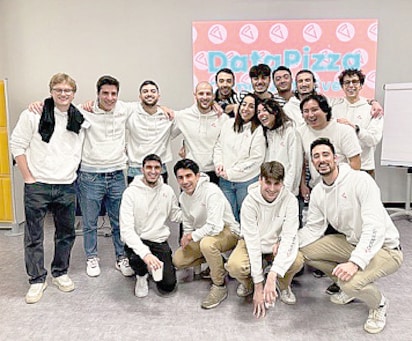
Writing this story is Milan-based Datapizza, which was created by exploiting the wave and opportunity of artificial intelligence led by an under-30 team.
"While I was at university in Padua, I realised there was a problem,' says Pierpaolo D'Odorico, 26 years old and founder of Datapizza together with Alessandro Risaro. 'Among students, there was talk of two paths to follow after graduation: the first was to go and work abroad in companies dealing with artificial intelligence, the second was to settle for a low-level job in Italy. It was there that something different was thought of'. A sort of third way to make the most of existing skills. Then the degree, a temporary job and the birth of the first Community with the intention of bringing together 'people in the sector'. Then the project launched on social media and 'exploded in our hands'.
"The initial idea was to call ourselves Data Science Italia, then, since pizza well represents Italy but also the sense of community and the place where ideas and information are exchanged, we opted for Datapizza,' he adds, 'also because the idea was born right in front of a pizza.
Hence the start-up becomes a kind of bridge between companies and programmers. "Our business," the founder argues, "is to help companies attract and hire programmers, experts in data science and artificial intelligence. There is no shortage of support for the candidate. "Let's say that when a profile comes up,' adds D'Odorico, 'we support the candidate by trying to find a suitable profile and helping him or her to get the best conditions, both economic and work-related'. Then there is another aspect that the start-up takes care of, and that concerns the training of companies. An aspect that is intertwined with the average age of the employees: 25.

