
Artificial intelligence in the fields increases productivity and sustainability
AgriFood Future, three days of study in Salerno, is an event dedicated to analysing the benefits that Ai can bring to agriculture, from decreasing fertiliser use to predictive models to curb the effects of climate change to reducing waste

4' min read
4' min read
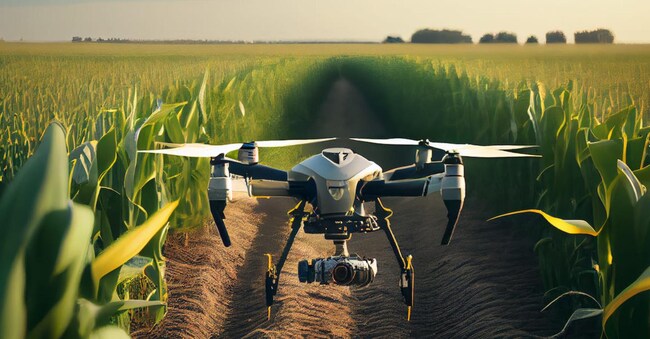
Monitor the different fruits on the conveyor belt by distinguishing them according to sugar content and thus different degree of ripeness, or put together the complex information coming from drones flying over a wheat field to manage the efficient distribution of water and pesticides together with weather stations.
These are two examples, among many, that testify to what artificial intelligence can concretely do in agriculture, implementing the various tools made available by technological innovation and fostering a quantum leap in the double digital and environmental transition of Italian agriculture.
A package of application examples of artificial intelligence in agriculture realised by Google as part of the project"AI for Made in Italy", a broader path that involves not only the agro-industry but also other key sectors of the Italian economy: mechanics, clothing, and furnishing, will be at the centre of AgriFood Future, a three-day event (in Salerno from 8 to 10 September) organised by Unioncamere and the Salerno Chamber of Commerce. A rich programme of speeches, workshops, and opportunities for discussion, located in different locations in the Campania city and dedicated to crucial topics for the future of the Italian agro-industry with - obviously - technological innovation as the lowest common denominator. All with an eye on the next G7 Agriculture meeting scheduled at the end of September in Ortigia (Syracuse).
"We decided to organise this event in Salerno," explained the president of Unioncamere and the Salerno Chamber of Commerce, Andrea Prete, "because it is a province with a strong agrifood vocation. Thanks to the presence of the canning and tomato processing industry, one of the poles of production of Mozzarella di Bufala Campana, and IV Gamma fruit and vegetables in the Sele Plain, it is the sixth Italian province for agrifood exports and the first south of Bologna. It is also the area where, during his stay in Pioppi, the American nutritionist Ancel Keys theorised the Mediterranean Diet in 1975. For these reasons, AgriFood Future is proposed as a national reference point to provide companies with concrete tools to innovate their production processes, through the integration of advanced technologies such as artificial intelligence, which allow them to optimise the use of fertilisers, improve animal welfare and reduce environmental impact. In a context in which the decline in agricultural productivity is aggravated by extreme climatic events, AgriFood Future aims to guide companies towards a sustainable and competitive future, enhancing Italian excellence and projecting it into international markets.
"Whoever designs and then implements new technologies applied to the agro-industrial sector often operates in contexts that are very different from the Italian one,' added the scientific director of AgriFood Future, Alex Giordano. 'With this in mind, one of our first objectives is to link innovation with the made-in-Italy tradition. Above all, however, we want to reduce the gap between the world of research and the business world by favouring the comparison and exchange of opinions and, in this way, the dissemination of innovations that go towards solving the real needs of the production world within a sector that represents one of the country's economic engines".


