
Artificial intelligence must be governed (or we will suffer it)
Ai risks and opportunities in 'The future is not an algorithm', the new book by Fabio De Felice and Roberto Race

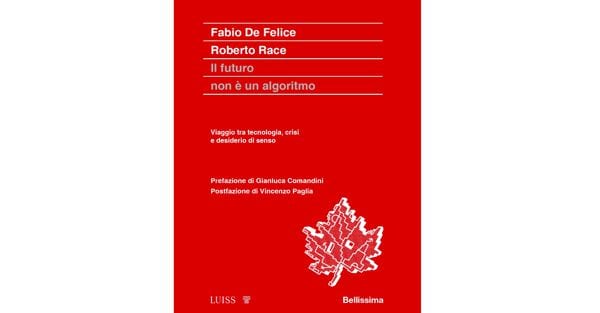
Is innovation progress? Should it be accepted without reservation or are there limits beyond which man risks becoming a passive instrument of technology? The Future is not an Algorithm, the new essay by Fabio De Felice and Roberto Race on the great challenge posed to mankind by artificial intelligence (Luiss), while not claiming to say conclusive words on the dilemma of dilemmas of our age, offers a guide for those who wish to find their way through the quagmire of proposals that daily call into question the society of work, lifestyles, the ethical and political dimension of our being together, and human identity itself, hybridised by robotics mixed with Ai.
De Felice and Race, already authors of The New World, in which the investigation of Ai was more oriented in a philosophical-anthropological key, take their cue from Kranzberg's analysis to highlight the fundamental role of man in directing technology. Governing it means selecting its evolutions according to the needs and vocations of a humanity that still intends to give meaning to its existence, refusing to disperse in the meanders of a dizzying race towards the useless, virtuality that cancels out thought, time that is reduced to connection, the app container that replaces the content, taking away space for reflection.
Artificial intelligence is the most effective litmus test for experimenting with this approach and the authors embark on a journey through the various application modes of Ai, from education to healthcare, from justice to smart cities, from 'augmented' art to civic participation.
Progress cannot be stopped because it improves the quality of life and The future is not an algorithm describes optimised crops with reduced use of water resources or insecticides, intelligent traffic lights that reduce traffic flows, roads that are lit only when needed, digital coaches that help people stay healthy by minimising the risks of disease, judicial loads that are disposed of quickly, platforms that allow citizens to participate in the planning of new neighbourhoods, personalised education that helps reduce social gaps. An itinerary that crosses the entire planet earth, each time also recalling Italian best practices.
But not all that glitters is gold. The life connected via smartphone, as is the case with so many young people, accustoms us to reacting rather than reflecting, the proliferation of information messages often distracts us from our initial research objectives, the pervasive control of our behaviour by technology ends up directing or influencing our intentions, the very finalization of technology towards an exclusive productivity dimension prevents us from slowing down to give quality to the experience of reality, to include those who lag behind, to avoid losing inner freedom and awareness of what we do.

