
Artificial intelligence runs fast, but leaves half the world behind
Microsoft's new report photographs a two-speed technological revolution: 1.2 billion users in three years, but four billion people still excluded. Italy at 25.8%, above the global average but distant from European leaders

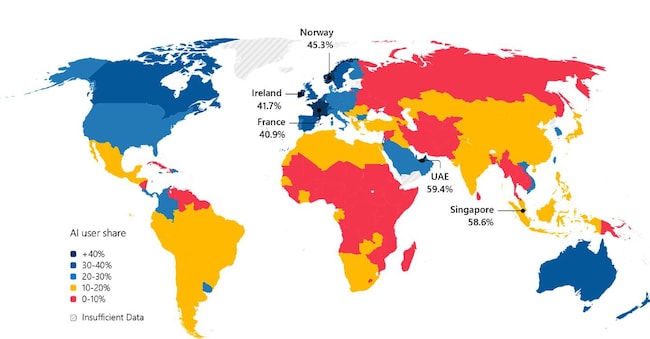
Artificial intelligence is officially the fastest growing technology in human history: in less than three years it has reached 1.2 billion users. This is an unprecedented rate of adoption: faster than the smartphone, the home computer and the internet itself. This is certified by the first AI Diffusion Report published by the Microsoft AI Economy Institute, which analyses AI penetration in over 100 countries across three dimensions: who develops the most advanced models (Frontier builders), who owns the computational infrastructure (Infrastructure builders) and where AI is actually used (Users).
The picture that emerges is of a two-speed technological revolution. In the global North, AI adoption is about twice as high as in the global South. WhileArab Emirates (59.4%), Singapore (58.6%) and Norway (45.3%) lead the world rankings, half of the global population - four billion people - still lacks the basic requirements to access artificial intelligence: reliable electricity, internet connection, basic digital skills.
Adoption of AI and Italy's position
AI is not a novelty relegated to techies and start-ups: it has already entered the daily routines of one in four workers in many advanced countries. With an adoption rate of 25.8% of the working-age population, Italy is slightly above the average of the global North (23%) and in line with the United States (26.3%) and Germany (26.5%). However, the gap with its European neighbours remains significant: France (40.9%), Spain (39.7%) and the United Kingdom (36.4%) show much higher penetration rates, driven by public investment, solid infrastructure and already high digitisation rates.
The report highlights how successful adoption does not necessarily require the development of proprietary models. Only seven countries in the world - The US, China, France, South Korea, the UK, Canada and Israel - host organisations that create frontier AI models. The example of Singapore, which achieves adoption rates of 58.6% without developing its own models, shows how targeted investment in infrastructure, training and coordinated policies can accelerate deployment even in the absence of advanced research capabilities.
The concentration of computational power
The infrastructure needed for AI remains highly centralised. The US and China together control 86% of global data centre capacity, with the US leading with 53.7 gigawatts, followed by China with 31.9 GW. Europe as a whole barely reaches 11.9 GW, with the EU accounting for only a fraction of global computing capacity.

