
Artificial intelligence, young people want to have a say
Stanford University detects a concentration of power over Ai. And the younger generation wants a say
Stanford's AI Index Report 2026 tells of an outsized acceleration, but the most striking fact is not technical, it is political. 73% of AI experts expect positive effects on work, only 23% of citizens share this expectation. Fifty-point gap between those who build the future and those who live in it. It is not a communication problem but a power gap.
High performance
The report's numbers tell us that the adoption of Ai in organisations is now close to saturation, that generative has spread faster than the speed with which the internet and personal computers spread, and that the most advanced models have outperformed humans in several cognitive tasks. All this alone, however, does not tell us where we are going, because the point is not what machines can do but who decides what they should do, for whom, and according to what idea of society.
Whoever governs the algorithms also governs, indirectly, the field of possibilities. It decides which answers come first, which priorities are made visible, which correlations become choice criteria. Artificial intelligence, we know, is not neutral: it works on data sedimented in the past and tends, by its very nature, to return the world as it found it. Thus the bias become predictions, the predictions guide decisions, and the decisions end up consolidating the very arrangements they were only supposed to describe. It is here that efficiency risks becoming conservation disguised as innovation.
Power Concentration
The Stanford University report shows a very relevant fact: the most advanced part of development is increasingly concentrated in the hands of large private players. We are not just witnessing a technological leap, but a redefinition of power. A power that is less visible than traditional political power, but no less incisive for that. On the contrary: the more it penetrates the invisible architectures that organise reality, the more we struggle to recognise it as such. And yet, just as power becomes concentrated, something is moving in the opposite direction.
Young people want to have their say
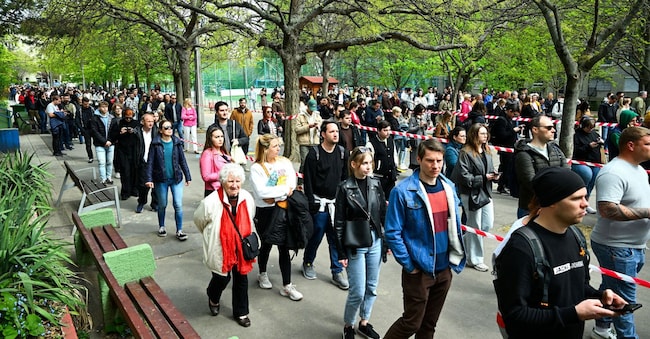
In Hungary, the vote on 12 April 2026 marked the end of the Orbán era with a record turnout of around 80%, also driven by youth mobilisation. In Italia, a few weeks earlier, the referendum on justice recorded an unusually high turnout of close to 60%, showing that the demand for involvement is by no means exhausted. Outside Europe, Iranian women and young people continue to represent, albeit under very harsh conditions, a demand for freedom that no longer accepts to be postponed.

