

Artificial skin arrives: will improve the effectiveness of prostheses and wearable devices
Discovery by the Scuola Superiore Sant'Anna in Pisa opens up new perspectives in bionics and collaborative robotics thanks to a bio-inspired neuronal network that replicates the sensory mechanisms of the nervous system
2' min read
2' min read
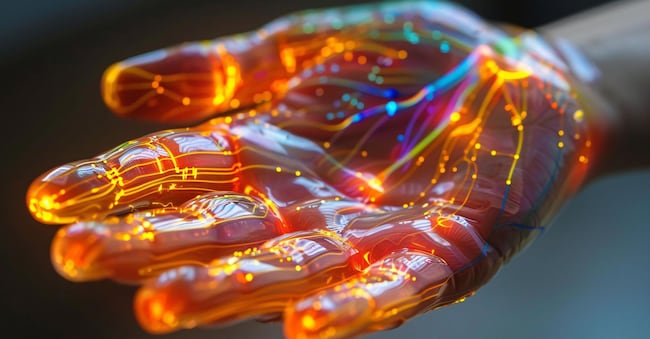
An artificial skin that emulates the morphological characteristics and tactile functionality of human skin thanks to innovative sensors and artificial intelligence algorithms inspired by the neuronal structures that convey and process tactile information. It was developed, for multiple applications, by a group of researchers at the Scuola Superiore Sant'Anna in Pisa, coordinated by Calogero Oddo, Associate Professor of Bioengineering.
The Studio
.The study, resulting from a collaboration between the Neuro-Robotic Touch Lab of the Biorobotics Institute of the Scuola Superiore Sant'Anna and the Federal University of Uberlandia (Brazil), was published in the international journal Nature Machine Intelligence: in addition to offering a fundamental contribution to the understanding of the mechanisms of human touch, the research, as explained by Sant'Anna, 'opens up new perspectives in the fields of bionics and collaborative robotics for the development of smart wearable devices, prostheses capable of returning information on tactile interaction, and sensors that allow robots to perceive their surroundings'.
'Touch perception is an essential function for humans: it allows them to recognise and locate physical stimuli, explore the environment and interact safely with the outside world. Artificially reproducing this complex sense is one of the main challenges in the design of collaborative robots and bionic prostheses,' says Calogero Oddo.
The biomimicry of sensorised skin
.The technology developed by the Scuola Sant'Anna reproduces not only the sensitivity of human skin, but also replicates the logic by which the brain interprets and localises touch stimuli. The heart of the innovation is a wide-area artificial skin equipped with fibre-optic sensors capable of detecting pressure and touch in real time. Making this skin 'intelligent' is a bio-inspired computational architecture for processing tactile information, a network of spiking neurons designed to mimic the mechanisms of the human nervous system.
"The spiking neural network consists of two layers: the first simulates human type 2 mechanoreceptors - slow and rapid adaptation -, the second reproduces a somatotopic map analogous to that generated by neurons in the cuneate nucleus, a key region in tactile perception. This approach allows the artificial skin to identify the point of contact and decode the intensity of the stimulus,' says Mariangela Filosa, researcher at the Institute of BioRobotics of the Scuola Superiore Sant'Anna and first co-author of the study.

