
Artprice: the market in 2025 consolidated
The study analyses the auction results, which reached USD 11.11 billion (+12% over 2024) thanks to the recovery in the second half of the year

Time for analysis. In addition to the report by Art Basel and Ubs came out the one by Artprice, which returns a similar snapshot of the year 2025, although it only considers auctions, unlike the former, which also looks at dealers. The past year was, also pr Artprice, a year of adjustment, a transitional phase, in which, after a difficult 2024, the sector settled down.
Contraction in the first half of the year
In the first part of the year, the market continued to contract (-34% year-on-year), especially at the high end: no lots exceeded the $50m threshold and vulnerability emerged even above $10m. Confidence, the fuel for the art market, was lacking and sellers were reluctant to deliver their masterpieces. Moreover, some established names no longer triggered the usual bidding wars, while more restrained estimates kept the bidders' appetite alive. To maintain activity in the prestige segment, guarantees played a crucial role: according to Artprice, auction houses have shown that they have now understood the cyclical nature of the market, adapting their calendars, estimates and strategies as the market is becoming more demanding: more reflective, more strategic, prioritising stability over spectacle.
Recovery in the second half of the year
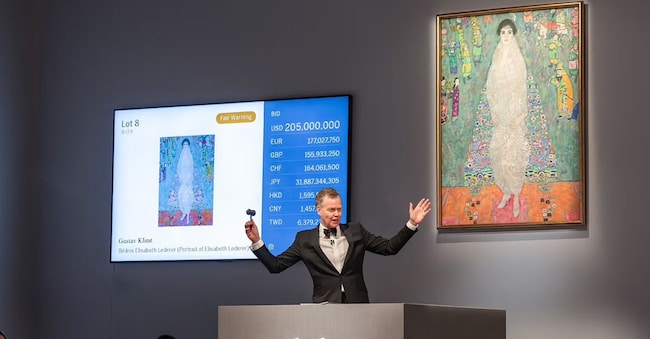
After the summer, however, the high-end art market began to show signs of renewed vigour, closing with +12% to $11.11 billion after three years of decline (it is $20.7 billion according to the other report). The return of large private collections, such as those of the Pritzker family and Leonard Lauder, injected renewed energy and confidence, culminating in the record sale of Gustav Klimt's masterpiece ($236.4 million). So, in retrospect, 2025 seems to have been a year of contrasts, but also of significant development, in which the market was able "to contract without breaking down, to readjust without betraying its core values".
The number of lots sold grew to 867,150 works, i.e. 2,375 lots sold per day. According to the study, in 2025 more than 90% of global art auction results were below $10,000. Far from the image of a market reserved for millionaires, art exchanges today function primarily by virtue of volume, largely driven by affordable works, while the majority of overall values are concentrated on a tiny fraction of masterpieces.
Geography
Geographical performance was very different: the USA - the leading market - grew by 22%; in Europe, France (+26%) and Belgium (+25%) did well. China, the second global player (according to the Art Basel and UBS report, it is the third after Great Britain) continued to struggle, losing 5%, while other Asian markets performed well, in particular India (+71%). Great Britain held steady in third position (+3%).

