
Arturo Benedetti Michelangeli, thirty years later
Remembrance three decades after the death of the great pianist, buried in Pura
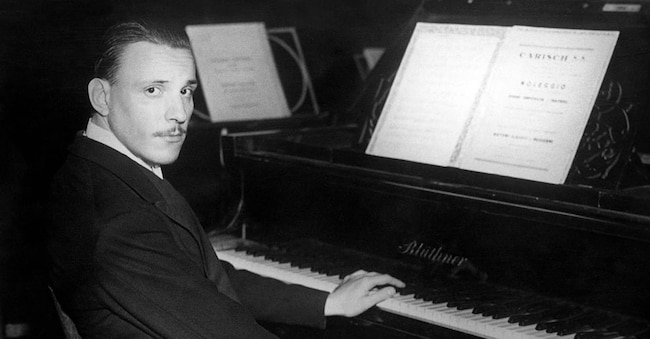
In the small cemetery in Pura, a village near Lugano, a simple wooden cross indicates that a legend has been resting there forever for the past thirty years. Because that mythical, almost mysterious aura still shrouds the figure of Arturo Benedetti Michelangeli (1920-1995), in the memory of those who were able to hear him in live concert, of those who had him as a teacher, in the thoughts of those who knew him, or perhaps will know him, through his (very select) recordings. A piano legend. His hair sculpted by brilliantine, his concentrated gaze, his imperturbable face; his hands elegantly composed, but ready to caress the piano keys, with measured, soft gestures. This is the image of Benedetti Michelangeli that many of us carry in our memories: an austere, black-and-white image, fixed by the television shots of a series of concerts recorded in the RAI studios in Turin, in 1962. Benedetti Michelangeli was then forty-two years old, and already belonged to the dimension of myth.
Search for perfection
It often happens, however, that what is the subject of legend becomes the subject of all too easy labelling. Contrary to what has always been repeated, for example, Benedetti Michelangeli had a wide range of musical knowledge, and such as to belie his supposed unavailability for 20th-century music: few know of his studies of Bartok's Sonata for two pianos and percussion, tackled with Dinu Lipatti, his favourite pianist; and few know of his planned performance of Schönberg's Piano Concerto with Bruno Maderna on the podium. And the same can be said of that relentless pursuit of perfection, especially in the definition of sound, that underpinned his interpretations and that was evident from the very beginning: several have pointed at it as a snobbish eagerness, considering it the inevitable projection of that imperturbable figure, like an old-fashioned aristocrat and a bit of a dandy, who appeared to us seated at the piano. When he himself would say: 'Perfection, a word I have never understood'. Of course, his performances were perfect, difficult to detect any flaws. And the technical mastery, absolute, rigorous, was present from the very first concerts in 1938, combined with a crystal-clear touch, the compelling agility of his fingers. But never was technique, in him, an end in itself; never was it revealed with the ostentation typical of the virtuoso keyboard athlete. 'Playing the piano', he repeated many times, 'is real work, it means feeling your hands and arms aching all over'.
It has often been said, therefore, of the beauty of Benedetti Michelangeli's sound, of his continuous attention to the timbral element, but there was also another equally important aspect of his interpretative style: the sweetness of touch, combined with a singability in stretching the musical phrases according to an all-Italian taste. Hence a sweet and melancholic Chopin, almost decadent, a Brahms that has the sad colour of autumn leaves. And hence the Beethoven of Concertos Nos. 1, 3 and 5, traversed by a noble chant, in total agreement with Carlo Maria Giulini's calm as well as ascetic conducting: we hear him thanks to the recordings (Deutsche Grammophon) made in 1979 at the Musikverein in Vienna, during a series of public concerts filmed by Austrian television. Important documents that also carry a little mystery. Benedetti Michelangeli and Giulini recorded all of Beethoven's Five Concertos, but Concertos No. 2 and No. 4 were never released. It seems that Benedetti Michelangeli, notoriously wary of recording media (incapable, in his view, of reproducing the often delicate balance of the performance), never gave the go-ahead for their publication
The unconditional love of the piano
Beyond the inevitable as well as necessary different moments of an artistic vicissitude more multifaceted than one might think, and thus removed from any schematic labelling, the constant element in Benedetti Michelangeli's life remained his unconditional love for the piano. A love expressed not only in his concert practice, but also in his teaching commitment. He held the chair of principal piano at the Bologna Conservatory (from 1939, immediately after winning the Geneva International Competition), then in Venice and Bolzano, and held almost constant cycles of specialisation courses in Arezzo, since 1953; but students of all nationalities also populated his alpine hut in Val di Rabbi. Little is still said today about Benedetti Michelangeli as a teacher, but being a piano teacher was no less important and exciting for him than being a piano performer. Even if, like a concert, it was a hard work, a considerable commitment for him. Those who were close to him remember that his was not a school of notions, but of very solid principles, all guided by a single motive: rigour. It is no coincidence that one of his main pieces of advice to his students was to always remain totally faithful to the written page. Those rare liberties that might emerge from his interpretations, Benedetti Michelangeli did not allow in his pupils, and in this he was very strict. He spoke very little during lessons, as his nature demanded; he preferred to rely on examples, playing.
Beyond the ways in which he was a teacher, it is important to remember and emphasise his commitment to his young students: he always followed them all indiscriminately, and always with the utmost dedication. There are, moreover, photographs showing the teacher in his Aretine years, playing table tennis with his students, just like one of them. And all this goes against any easy mythologising, and can help us understand Benedetti Michelangeli in his humanity, freeing him from the sometimes too algid colour of legend. In short, he was also a man, in love with his work, a supreme interpreter of the piano and a generous teacher. But he was also a passionate reader of Mickey Mouse, and a lover of sports cars. And a refined harmoniser of mountain songs for the SAT Choir: an act of homage to the much-loved mountains, experienced on long, solitary hikes, often in search of infinite silence. Arturo Benedetti Michelangeli, reserved like few other greats in the world of art: who knows what he would say today about certain of his would-be colleagues who conquer popularity through the web and circus-like exhibitionism? In that simple wooden cross in the Pura cemetery, the reserve and humility of a great musician find their emblem.

