Over to the experts

‘Don’t leave them alone with AI’. Children and teenagers in the age of algorithms

CEOs and founders sound the alarm: urgent need to train teachers in AI. Thrun (Google X): be at the forefront of tech. Liang (Squirrel): new roles for teachers


by Enrico Marro

 Adobe Stock

5' min read

Translated by AI
Versione italiana

Key points

  • Liang (Squirrel AI): don’t leave them alone with the AI

5' min read

Translated by AI
Versione italiana

Will today’s children survive AI?

Are we really so sure that the delicate development of their cognitive processes during childhood and adolescence is not at risk in the Wild West of AI agents? And that tomorrow we won’t have to pick up the pieces of a generation even more lost than that of Gen Z, struck down and sunk by social media?

Loading...

The Edtech missile

The Edtech sector is experiencing skyrocketing growth akin to a rocket taking off: valued at over $187 billion by 2025 (estimates by Grand View Research), the sector will break the sound barrier of $437 billion by 2033, with an average annual growth rate of 10.8%.

But the optimists at Fortune Business Insight project it to exceed $688 billion by 2034 (15.6% CAGR) and Market.us even estimates it will approach 908 billion, with Technavio forecasting an average annual growth rate of 16.2% between now and 2030.

EDTECH: LA CRESCITA MONDIALE NEI PROSSIMI ANNI

In miliardi di dollari

Loading...

A revolution for the global education sector, both in the K-12 sector (from nursery to secondary school) and in university lecture theatres. Driven, ça va sans dire, by the wonders of AI that shatters geographical, economic and linguistic boundaries like a breadstick, bolstered by Big Tech’s infrastructure.


EDTECH: IL BUSINESS PER AREE GEOGRAFICHE

Dati in percentuale

Loading...

From programmes to formats, from feedback to coaching, from nursery school to upskilling and reskilling for the over-50s: the dream of a comprehensive democratisation of knowledge seems within reach.

South Summit è il grande evento tech co-organizzato da Ie University e giunto alla sua 15° edizione: ha calamitato a Madrid 30 unicorni, 600 speaker, oltre duemila investitori, più di 20mila persone. Tra gli speaker, gli esperti che abbiamo intervistato.

But is all that glitters really gold?

We put the question to the founders and investors attending South Summit, the major tech event co-organised by IE University, now in its 15th year, which attracted Madrid 30 unicorns, 600 speakers, over 2,000 investors, and more than 20,000 visitors. The response is explosive.

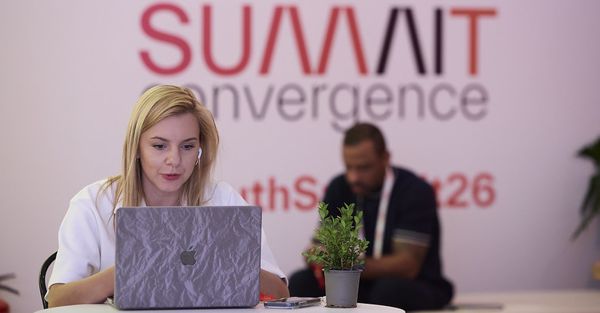
«AI Convergence» è stato il tema centrale di South Summit 2026: ovvero come l’intelligenza artificiale stia accelerando la trasformazione dei settori strategici e definendo nuove opportunità di crescita nel nome appunto della convergenza tra industrie, tecnologie, capitali ed ecosistemi globali.

Liang (Squirrel AI): don’t leave them alone with the AI

“We must not leave anyone aged between 3 and 15 to fend for themselves with AI, as these are the crucial years in which they develop their cognitive skills.” This was stated clearly and unequivocally to Il Sole 24 Ore by Joleen Liang, co-founder and international CEO of the unicorn Squirrel AI, a Chinese giant at the forefront of Edtech.

Joleen Liang, co-fondatrice e ceo internazionale dell’unicorno Squirrel AI, colosso cinese Edtech, sul palco di South Summit con Juan José Guemes di Ie University.

A pioneer in the sector in a country that does not shy away from AI but embraces it with measured enthusiasm, including families.

Squirrel AI beats humans

Founded in 2014 in Shanghai, Squirrel AI owes its success to a hybrid system (part human, part AI teaching) based on billions of ‘nanometric knowledge points’, capable of breaking down the curriculum and mapping the student’s performance with millimetre-level precision.

«L’imperativo ora è insegnare agli insegnanti come usare la GenAI, senza lasciare i giovani da soli in balia degli algoritmi - spiega Liang - . La scuola va ridisegnata da capo a piedi e bisogna fare in fretta».

The result? Squirrel AI’s hybrid system has consistently outperformed human teachers and traditional teaching methods, even earning a place in the Guinness World Records.

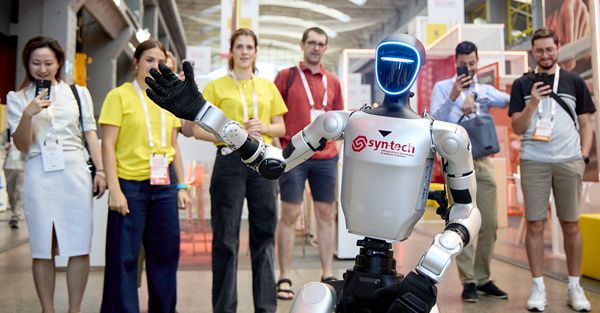
Squirrel AI deve il suo successo a un sistema ibrido (didattica parte umana e parte AI) fondato su miliardi di “nanometric knowledge points”, in grado di mappare la performance dello studente con granularità millimetrica (nella foto, un robot a South Summit).

Complete customisation

“Our strength lies in the complete customisation of our teaching methods,” explains Liang, who looks as though she’s just stepped out of the future in a DeLorean.

‘More generally, the priority now is to teach teachers how to use GenAI, without leaving young people to fend for themselves at the mercy of algorithms. The school system needs to be completely overhauled and we must act quickly, because AI is evolving at lightning speed.”

Universities in an existential crisis

In complete agreement Rafif Srour, Dean of Science & Technology Programmes at IE University, which has long been one of the best in Spain (a sort of Iberian “Bocconi”).

Rafif Srour, Dean of Programs of Science & Technology alla Ie University, da sempre una delle più avanzate in Spagna (una specie di “Bocconi” iberica). «Oggi gli studenti devono evolvere e diventare “pensatori di sistemi”», chiarisce al Sole 24 Ore.

“Universities are in an existential crisis,” he explains, “stripped of their historic role as gateways to knowledge. STEM education used to train ‘vertical’ specialists capable of tackling problems that today are solved by AI: students, consequently, must evolve and become “‘systems thinkers’.”

Fast AI vs Slow AI

The problem is what Ronald Beghetto (University of Arizona) describes in the latest OECD Digital Education Outlook as “fast AI” as opposed to “slow AI”: less gifted students use the tools as convenient shortcuts to get straight to the result, rather than having the process itself explained to them through prompts using Socratic dialogue.

Srour (Ie University): fragile and impatient

“AI can give you results quickly, but it is learning the process that remains fundamental,” emphasises Srour, who has observed that the quality of students is in freefall.

«Impatient, they get bored easily, find it hard to step outside their comfort zone, are emotionally fragile and therefore ill-suited to an entrepreneurial career».

Le “bolle social” hanno cresciuto teenagers che temono di essere giudicati, di affrontare il conflitto. Ora il rischio è che l’AI li appiattisca in “giovani a una dimensione”, carenti in capacità di giudizio, critical skills e analytical skills.

Social media bubbles have raised teenagers who fear being judged and are reluctant to face conflict.

And whilst companies are looking for unique, passionate candidates, there is a risk that AI will instead reduce the younger generation to “one-dimensional young people”, lacking in judgement, critical thinking and analytical skills.

“It doesn’t help that the traditional teaching methods in secondary schools are based on rote learning – concludes Srour – which is now dominated by GenAI.”

Thrun (Google X): ride the tsunami

“Universities are under attack, unable to defend the traditional model centred on the ‘piece of paper’,” explains Sebastian Thrun, the legendary co-founder of Google X, Waymo and Udacity and a professor at Stanford, to Il Sole.

Sebastian Thrun, leggendario fondatore di Google X, Waymo e Udacity nonché docente a Stanford. Ai giovani consiglia: «Be top in AI».

“My advice to young people is: ‘be top in AI’,” he adds, confident that the slowdown in junior recruitment will disappear once the skills gap has been bridged. “Don’t play it safe – learn to ride the AI wave: don’t get swept away, but ride it.”

González-Blanco (IE University): training the trainers

On the same wavelength is Elena González-Blanco, a philologist by training who has gone on to become Head of Artificial Intelligence EMEA at one of the world’s five largest Big Tech companies, as well as a lecturer at IE University.

“The hybrid model works well,” he explains, “but we have an urgent need: that of ‘train the trainers”, creating an enhanced teacher capable of developing critical thinking through the ‘Socratic’ use of GenAI.”

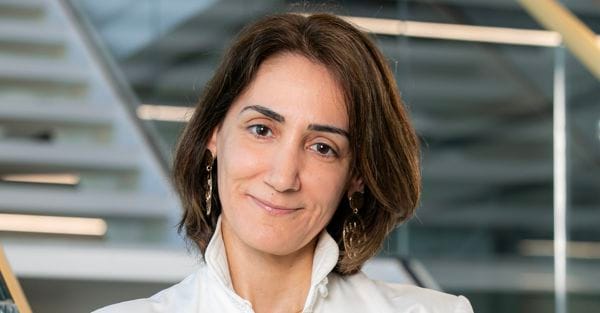
Elena González-Blanco, Head of Artificial Intelligence EMEA in una delle cinque maggiori Big Tech mondiali nonché docente all’Ie University. «Il pericolo è che tutto diventi troppo facile, troppo veloce, senza darci il privilegio di “imparare” la pazienza e la fatica», ci spiega.

Once universities have been restructured (a process that will, in any case, take years) and students’ skills have been brought up to date, entry-level recruitment is likely to pick up again.

«Abbiamo un’urgenza: quella di “formare i formatori”, creando un prof aumentato in grado di sviluppare il pensiero critico attraverso l’utilizzo “socratico” della GenAI», spiega González-Blanco.

The dangers? ‘That with algorithms everything becomes too easy, too fast, without giving us the chance to “learn” the patience and hard work that are essential for achieving great things’.

Liang (Squirrel AI): teachers will become data analysts

The final word goes to Joleen Liang, the most forward-thinking of the lot, who is exporting the Squirrel AI model to North America: «Be careful with data. At Squirrel AI, we have a completely closed ecosystem for training our models. We do not make any data public and we do not take any data from outside sources.”

Tutto da rifare anche per il ruolo dei docenti, spiega Liang: non più specializzati in una singola materia ma «analisti di dati in grado di creare empatia, dare motivazione, sviluppare il pensiero critico».

But the real bombshell concerns teachers. Their role will also change completely, explains Liang: we no longer need teachers specialising in a single subject, history or maths teachers, because vertical knowledge will be handed over to AI, freeing them from the burden of rote learning or marking homework. ‘Instead, there will be a need for data analysts capable of building empathy, providing motivation, and developing critical thinking’.

Copyright reserved ©
Loading...

Brand connect

Loading...

Newsletter

Notizie e approfondimenti sugli avvenimenti politici, economici e finanziari.

Iscriviti