
Assemblages, hybridisations and set designs: the colourful revolution of stacking
Experimental, playful, radical. A far cry from Nordic linearity and minimalism. Berry Dijkstra is a creative driven by a cartoonist’s intuition. Episode 2

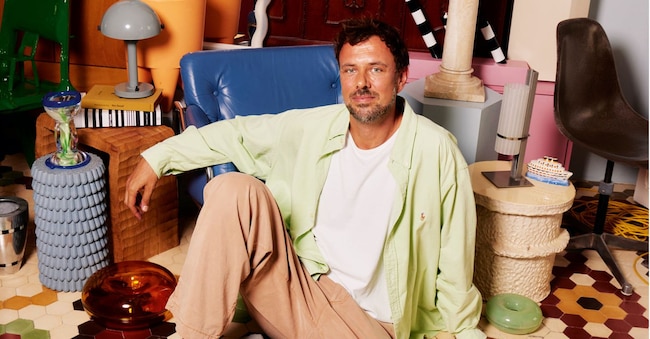
Over the last ten years, Berry Dijkstra has built a rather unusual career. “I usually tell people I’m an artist of composition,” smiles the Dutchman from his home in Valencia. In practice, this means he creates imposing stacks of furniture: wardrobes, coffee tables and chairs piled one on top of the other, with lamps, vases and the occasional Greco-Roman bust nestled within structures that reach right up to the ceiling.
It is stacking, literally the act of stacking, a creative practice which, for him, came about almost by chance. “In my flat in Rotterdam, I used to make small assemblages of objects. Then, one day, I started using larger pieces. I simply began playing around with the furniture,” recalls Dijkstra. His visually striking assemblages have led him to collaborate with brands such as the Polish furniture manufacturer Tylko and the Dutch bed linen brand Suite702. The artist has also created installations for design boutiques and events such as the Rotterdam Design Biennale.
Dijkstra describes his creations as ‘a sort of architecture, similar to an urban landscape, which would, however, appear flat in a photograph. So, in a sense, I paint with furniture. It’s all about colours, materials and composition’, he adds. A stack works ‘when the balance is right, but there’s also a bit of friction between the objects’. This might be, for example, a brightly coloured Oceanic table lamp by Michele De Lucchi resting on a bubblegum-pink chest of drawers by Tylko, or a wall lamp, resembling a sea creature, by the young Irish designer Barry Llewellyn, made from fragments of ceramic and recycled glass, next to a ladder by Malva Office, the Valencian design studio run by Jose Cortés.
Most of these items come from the Dutch artist’s personal collection, which he has been building up for twenty years. It all began with browsing vintage markets: he had a particular passion for Pastoe, the Utrecht-based brand known for its mid-century sideboards with clean lines and, later, for Aldo van den Nieuwelaar’s minimalist furniture. Over time, his focus shifted towards young contemporary designers. The result is an eclectic mix, leaning towards the ‘graphic and minimalist’, he explains.
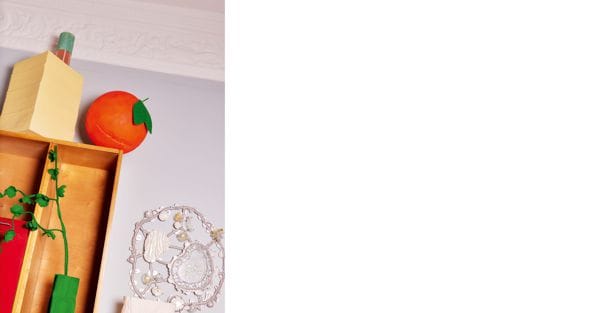
Dutch design remains a recurring feature of his compositions. Among the most recent additions is a vibrant neon-green chair from the Splitted collection, designed by Eindhoven-based designer Teun Zwets and crafted from raw wood finished with a glossy lacquer. ‘Nothing is new in this world, but that piece feels fresh,’ says Dijkstra. Other items from the Netherlands include an elm stool with a textured surface by Kasper Boelens, a neon light by Sabine Marcelis and several houseplants made from wool felt by the Rotterdam-based collective Wandschappen.

