
The astronomical governance of Musk’s SpaceX

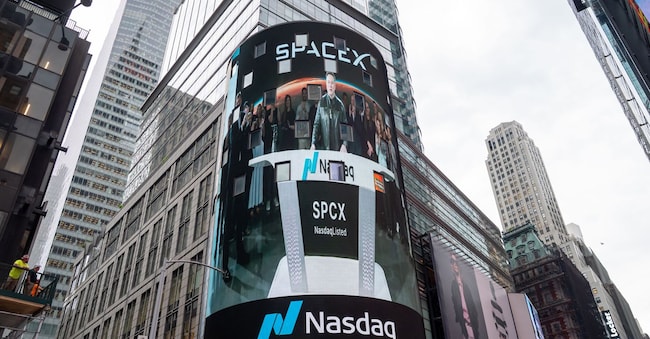
Morgan Stanley, the toughest of New York’s investment banks, said of SpaceX in its report just before the flotation: “Based on our forecasts, it will not achieve positive cash flow before 2035, requiring, on average, $84 billion a year in capital from 2027 to 2034”; the report concluded with the view that the company’s value was double its IPO price (!). This is one of the many things that were said and written about SpaceX and its founder, Elon Musk, at the time of the IPO. familyandtrends is not particularly interested in the valuation, even though 1.8–2 thousand billion dollars is certainly an astronomical figure, but rather in an aspect that seems to have been little discussed during the listing: SpaceX is a ‘controlled company’ with some interesting developments.
A ‘controlled company’ is a listed company in which a founder holds the majority of the voting rights, almost always through multi-voting shares, and which, for this reason, the NYSE, Nasdaq and US regulatory bodies exempt from certain corporate governance rules. For example, there is no requirement for a majority of independent directors on the board, nor for independent nomination and remuneration committees; whoever controls the company decides who sits on the board and how much to pay them. As there is no requirement for independent directors, there is no block voting. Transactions with related parties do not have to be submitted to any committee, and one such transaction was the merger with XAi, the largest related-party transaction in history. The majority shareholder, Musk, is Chairman, CEO and Chief Technical Officer, and only he can replace himself in any of these roles. Furthermore, if a capital increase is carried out, pre-emption rights do not have to be granted, and if the majority shareholder decides to sell their stake, a mandatory public takeover bid is not required. One might think that, under these conditions, perhaps many more Italian entrepreneurs would choose to list their companies.
The most interesting thing is that this is the most advanced and sophisticated financial and stock market in the world: our financial system has always drawn inspiration from – if not bowed to – its rules of corporate governance and the dictates of its academics. And yet, we have overlooked the possibility of having the concept of a ‘controlled company’ within our financial market.
Whilst we were basking in the great strides made by our latest capital markets legislation, SpaceX, as a ‘controlled company’, is breaking new ground with a number of innovative developments. Shareholders forgo the right to bring a class action; they may only seek arbitration. To table proposals for a vote at the general meeting, they must hold 3 per cent – around fifty billion – invested in the company and be able to secure 67 per cent of the share capital, which is currently impossible given Musk’s stake; a 3 per cent holding is also required for liability claims. The exclusive jurisdiction is Texas, which is understandable given that Delaware has called into question the mega stock option of Musk. The articles of association also state that directors may pursue business opportunities, even in competition with the company itself, without having to inform anyone.
For investors who are willing to forgo some of their rights in order to gain access to the enormous potential returns, it is worth remembering SpaceX’s mission: to make humanity multiplanetary; profit is merely a means to that end. Investors are warned: Mars may take precedence over dividends.


