The 2024 report of the Migrantes Foundation

Asylum applications, Syrians first in the EU. Italy rejected 62% of applications examined between January and June

In 2023, some 183,000 people fleeing Syria sought refuge in the European Union. Worldwide 122.6 million refugees and displaced persons

by Manuela Perrone

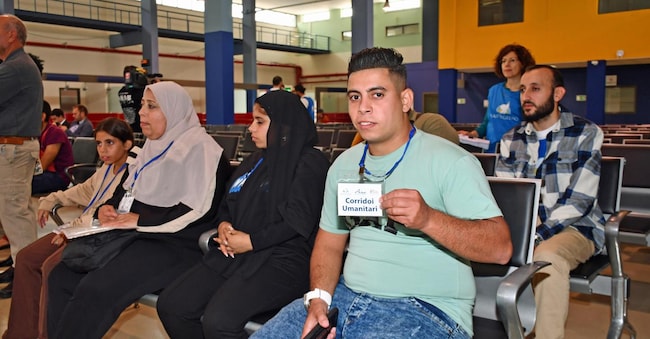
Alcuni rifugiati siriani arrivati con i Corridoi Umanitari. Fiumicino,  ottobre 2024. (Ansa)

5' min read

5' min read

There are 122.6 million people on the run worldwide - refugees, asylum seekers, internally displaced persons. By the end of 2024, according to UNHCR, the UN refugee agency, they will grow to 130 million, of which more than 68 million remain within their own country. But this is an estimate drawn up before the fall of the Assad regime in Syria: the new feared wave of refugees could worsen the balance, which already sees Syrians first, by nationality, to seek refuge in the European Union (around 183,000 applicants in 2023) and second in Italy among those arriving via the Mediterranean route. Last year, most of the unaccompanied minors arriving in Europe also came from Syria.

An up-to-date photograph of diasporas, which continue to increase due to wars and climate change, is contained in the 2024 report 'The Right to Asylum' edited by the Migrantes Foundation and now in its eighth edition.

Loading...

The delays of institutions and governments

.

The book, presented today in Rome, takes aim at "the mad arms race" and denounces the delay of institutions and governments in combating the root causes of forced migration. The introduction includes a sentence by Pope Francis pronounced during the General Audience of 28 August 2024, considered inspirational for the entire report: "It must be said clearly: there are those who work systematically and by every means to repel migrants. And this, when it is done with conscience and responsibility, is a grave sin'. The hope of the director general of the Migrantes Foundation, Monsignor Pierpaolo Felicolo, is clear: "We hope that this work can help to realise who are the people towards whom true crimes of "lesa umanità" are being carried out, as the Pope defined all forms of modern slavery, in particular human trafficking, at the beginning of this month. These are people to whom we have a duty to restore justice and humanity'.

Displaced or refugee now one in 67 inhabitants of the world

The numbers of 'global displacement' have been growing uninterruptedly for twelve years. Displaced or refugee is now one in 67 of the world's inhabitants. In 2013 it was one in 142. The monitoring project "Missing Migrants" of the International Organisation for Migration (IOM) estimates that more than 68,000 people have lost their lives or otherwise been missing during migration routes over the past ten years.

In Europe 4.461 million refugees from Ukraine

.

The Russian invasion of Ukraine has devastated Europe. The EU enlarged to include Switzerland, Norway, Iceland and Liechtenstein as of June 2024 was hosting 4.461 million refugees from Ukraine with the benefit of temporary protection that was extended until March 2026. Germany hosts more than one million, Poland slightly less, Spain almost 210,000, Italy 165,000, France 61,000. And the share of Ukrainians who trust that they will be able to return to their homeland is falling sharply: in one year alone it has dropped from 77 per cent to 64 per cent.

In the EU in eight months 449,000 asylum seekers, in 2023 one million

In all, in the first six months of 2024, the number of asylum seekers in the EU was around 449,000, down from 475,000 in the same period of 2023. In the whole of last year, they exceeded 1 million (+20% compared to 2022). The first country by number of applications is Germany (329,000), followed by Spain and France. Italy is only fourth. Also in 2023, the EU granted protection to 409,500 people. The resettlement target (one of the existing instruments to provide protection and support to some particularly vulnerable refugees) was missed: it was supposed to cover almost 16,000 people, only 14,035 were accepted.

From Syrians 183,000 applications, first in the Union

The main countries of origin of those applying for international protection in the EU are Syria (around 183,000 applicants in 2023) and Afghanistan (101,000). For Italy it is different: in 2023 Syrian, Afghan and Venezuelan asylum seekers accounted for less than 2% of applicants, even though Syrians are second, after Bangladeshis, among migrants arriving by sea (12,029 out of 63,664 landed from January to 9 December, according to the latest Viminale data). But the uncertainty over the country's fate could cause a new wave of thousands of refugees here too. In the meantime, on Monday many European countries, including Italy, announced the freezing of procedures for examining applications for international protection submitted by Syrians. In any case, it should be remembered that Syria is not on the list of 19 countries considered 'safe' by the Italian government and included in the decree recently converted into law by Parliament, so those arriving from Syria cannot be subjected to the fast-track border procedures for quick returns.

Italian reception system 'coarse and unfair'

The Migrantes Foundation's report is not tender with the decrees that have redesigned the Italian reception system, which accommodates about 138,000 asylum seekers, refugees and migrants (as many as 100,000 of them in first reception centres and Cas) and which is defined as "fragmented, coarse and unfair". In the crosshairs ends first of all the restyling of the Sai, "relegated to a marginal role, accessible only to specific categories of beneficiaries and subordinated to the voluntary adhesion of the municipalities", but also the "policy of emergency and security management" focused on the construction of new hotspots and detention centres for repatriation, which tends to isolate migrants in large centres far from the cities. There is no lack of an exercise in 'counting the damage' caused by the Cutro decree (law 50/2023) that introduced the accelerated border procedures for those arriving from countries considered safe and the 'detention' practices repeatedly rejected by judges. Nor is there any mention of the situation of unaccompanied foreign minors, who too often end up in adult centres.

January to June, 62% of asylum applications rejected

.

At the end of 2023, Italy was hosting around 298,000 refugees in the broad sense, fewer than Germany, Poland, France, the United Kingdom or Spain. On 1 January 2024, just under 414,000 non-EU citizens with residence permits for protection and asylum reasons lived in Italy, 0.7 per cent of the entire population. In the first eight months of the year, the people who requested protection in Italy were 109,000 (+32% compared to the same period in 2023, when there were almost 136,000 in the whole year). Among the ten main countries of origin of asylum seekers from January to June there are four states that are in the last positions of the Global Peace Index: Pakistan, Burkina Faso, Mali and Nigeria. In the same six months, the territorial asylum commissions examined about 37,400 applications, recognising about 3,000 refugee statuses, 5,000 subsidiary protection and 6,000 'complementary' protection (special protection and for medical treatment). There were 23,400 refusals, 62% of all applications examined. A figure that is growing over time.

Central Mediterranean, fewer migrants but more victims

In the first eight months of 2024, irregular flows of arrivals to Europe via the Mediterranean still fell by 39% compared to the same period in 2023, but entries on the West African routes to the Canary Islands (+123%), the Eastern Mediterranean (+39%) and the Eastern land border (+193%) are on the rise, albeit on a much smaller absolute scale. It is striking, however, that in the central Mediterranean for the second consecutive year the number of migrants losing their lives at sea is on the rise: the number of victims at the end of August 2024 is estimated at 1,342. The risk is one case for every 40 arrivals, it was one for every 63 in 2023 and one for every 75 in 2022. The number of people the report does not hesitate to call 'deported' by the Libyan Coast Guard is also increasing: there were 16,220 detained between January and August, compared to 17,190 for the whole of 2023.

Balkans top for rejections, in Hungary only 25 asylum applications accepted

The Balkan EU member states continue to distinguish themselves by the volume of rejections at the border, in the face of weak asylum systems in at least three states: Croatia, Slovenia and Hungary. In Viktor Orban's country, only 25 out of a total of 30 asylum seekers were granted protection in 2023. More difficult was the test for Bulgaria, which found itself handling over 40,000 applications between 2022 and 2023; positive verdicts amounted to just under 6,000.

Copyright reserved ©
Loading...

Brand connect

Loading...

Newsletter

Notizie e approfondimenti sugli avvenimenti politici, economici e finanziari.

Iscriviti