
At Design Week, materials take centre stage: traceable supply chain, low-impact processes and durability
At the Salone and Fuori Salone, there is more than mere greenwashing and a growing awareness of guaranteed provenance, innovative low-impact production processes, the use of vegetable or biobased components, and the circular reuse of waste from the construction industry or other production sectors

6' min read
Key points
6' min read
Never as much as this year, hand in hand with an increasingly mature reflection on the theme of sustainability (which seeks to go beyond mere greenwashing approaches), the materials (innovative, modern or traditional) with which furniture, modules and coverings are made have been the undisputed protagonists of Salone del Mobile 2025 and Fuori Salone with Design Week and satellite events.
Visiting the stands in the pavilions of Rho Fiera as well as meeting designers and companies in the many Milanese 'salons' set up with installations and events, we have gathered insights and reflections that prove a point. More than in the past, companies, designers, developers are paying attention to the quality, origin and value chain behind "what a product is made of". This is a sign of a new sensitivity, driven perhaps also by EU regulations and also in Italy by CAM (the minimum environmental criteria to be respected for supplies in public tenders) as well as by green requirements that are increasingly demanded even by purchasers (more prepared than in the past). Traced supply chains, guaranteed provenance, innovative low-impact production processes, durability as a new value, use of vegetable or biobased components or circular reuse of waste from the building supply chain or other production sectors are the key terms in a storytelling that has united several interviews conducted for this article and on these pages. Places and installations - in many cases - did not end with the Salone del Mobile day but are still visible or permanently open.
A Journey Between Innovation and Tradition
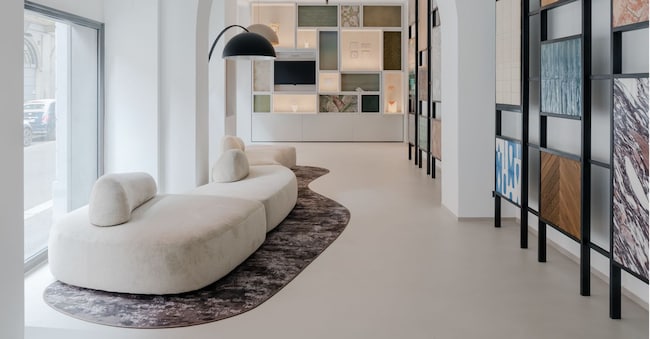
The starting point is Materia 2.0, a Como-based company specialising in the supply of high-end materials for architecture, which has inaugurated a 500 square metre space dedicated to research, design and the culture of matter in Via Marco Polo 9, Porta Nuova area. Inside, matter has voice, soul and memory: 1,200 samples, 5,000 exhibits and more than 15,000 products in the catalogue tell the story of Italian manufacturing companies and craftsmanship realities that work together to shape the design of the future, focusing on advanced research, sustainability and valorisation of the material heritage. "Materia 2.0," explained Fabio Pecora, founder general manager, "is the meeting point between traditional materials and the advanced innovation with which these same traditional materials are reproposed. We are talking about a knowledge and training hub, also organised to allow rapid interaction with visitors, thanks to the display of standardised samples in 20x20 cm format, easy to handle even for surfaces with significant thicknesses, and accompanied by information panels and QR codes to access technical details and variants". Among the partners working on high quality are Marca Corona, Cp Parquet, Botteganove and I Conci.
Between academia and industry
Henning Larsen in collaboration with the Material Balance Research Lab of the Milan Polytechnic, with the support of the Ramboll Foundation, presented 'Growing Matter(s)' at Terrazza Bonardi (via Bonardi 9), a pavilion composed of 80 mycelium spheres, each with its own organic form, bearing witness to the variability and vitality of bio-based materials. Each element of the installation - from the organically textured mycelium surfaces to the recycled scaffolding structure - reflects a new aesthetic approach that embraces the variability and intelligence of natural systems. "It is," the organisers explain, "a glimpse into a future where design breathes, adapts and evolves, and creative processes redefined by mycelium, in fashion and furniture, acoustics and architecture. A place yet to be discovered, because it will still be open to visitors these days and until Easter.
Moving from natural materials to cement - which, although a high-impact material, remains the basis for our cities and infrastructures - this industry has also made and is making huge strides and progress that cannot be taken for granted. In particular, during the Fuori Salone, IIC The Italian Cement Industry, a magazine active since 1929, presented 'ConcretaMente. Oltre il Materiale, Dentro le Storie' (Beyond the Material, Inside the Stories), in collaboration with Federbeton, an unprecedented (in this case, finished) exhibition that revealed to those who visited it what cement and concrete are through an immersive and interactive path that also explained their merits and opportunities for a greener future.
Brand connect


Newsletter RealEstate+
La newsletter premium dedicata al mondo del mercato immobiliare con inchieste esclusive, notizie, analisi ed approfondimenti
Abbonati