
At the Osaka Expo, the Italian Pavilion is still at the top for visitors
Long queues for access and initiatives with strong regional representation

2' min read
Key points
2' min read
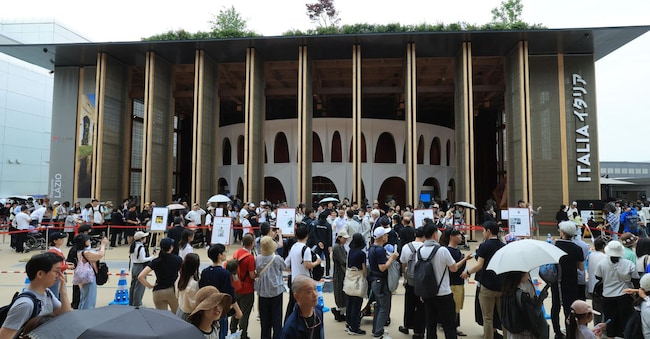
Every day now, the Expo authorities publish a fainting bulletin. The heat does not spare Osaka either. The elevated ring that with its sinuous elegance runs around the entire perimeter of the exposition is less and less populated, the visitors preferring to stay all underneath, sheltered by the wooden beams that support it, to escape the sun's rays. And yet, the queues - even of three hours - to see the Italian Pavilion do not seem to diminish. They simply move to the shade, where the hostesses have lately also begun to distribute water bottles, as well as regulating the flow of the entrances.
The Winning Ingredients
.The sultriness of the Japanese summer does not stop Italy's success, its pavilion continues to play for the podium of the most popular, at loggerheads with China and the United States. This is not the result of Italian parochialism, but of polls published by some of the most authoritative Japanese newspapers, such as the Nikkei Shimbun and the Josei Jishin. And it matters little if next to the Caravaggio and Tintoretto paintings on display in the pavilion stands a giant picture of the Messina bridge that is not there yet. The recipe for its high popularity lies not only in the works of art, among the winning ingredients is also the choice of ambassadors. The latest, happy intuition was the brothers Yuki and Mayu Ishikawa, captains of the respective Japanese national volleyball teams, the men's and women's, but both also top players in the Italian Serie A: Yuki in Perugia, with Sir Safety, his sister Mayu in Novara, with Igor Gorgonzola.
But the Italian Pavilion at the Osaka Expo is also a place to do business and attract investment. The latest announcement was only a few days ago, when the Japanese group NSC chose the Italian Auditorium to launch an 80 million euro investment for the renovation and expansion of a furnace at its plant in San Salvo, in the province of Chieti, where it produces glass for the automotive and construction industries. The company has been present in Abruzzo since 2006, when it took over the plants that used to belong to Pilkington. Thanks to the new investment announced in Osaka, glass production will increase by 14%.
Regions at Expo
.The week dedicated to Liguria has just ended at the Italian Pavilion, during which, among the many partnerships reached, a five-year cooperation agreement was signed between the Italian University of Genoa and the Japanese Tohoku Gakuin University of Sendai on hydrogeological risk, health, and logistics. In Osaka, Liguria focused above all on the theme of the Blue Economy, the economy of the sea: from high-tech shipbuilding to marine scientific research, passing through nautical tourism, green ports, and the enhancement of the coastal heritage. Until tomorrow, however, in the regional alternation that characterises the pavilion's programme, it is the turn of Molise, which has chosen to bring to Osaka five traditional costumes on display at Muves, the Museum of Clothing in Campobasso. In addition to the exhibition, the programme also included a comparison between the dress of the Molise bride and the Japanese bridal kimono.


