

At least 80 ships from Russia’s shadow fleet are sailing in the Mediterranean
Compared with 2024, the volume of crude oil and LNG handled by ships has doubled. The Strait of Sicily and the Ionian Sea are the preferred routes. Between 40 and 50 incidents of transponders being switched off are reported each month

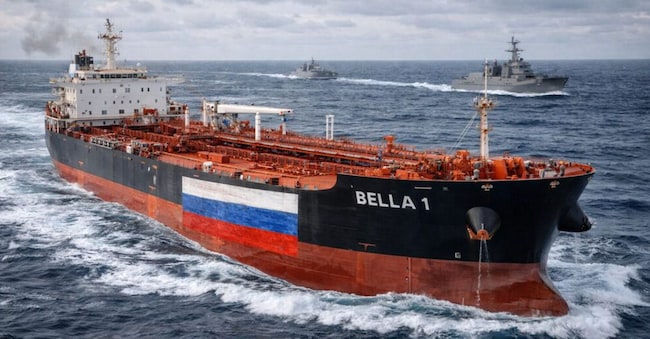
The global maritime logistics landscape has undergone a profound structural transformation, as analytically documented by international records and European safety monitoring systems. Over the past two years, the size of the so-called Russian shadow fleet has stabilised at an estimated figure of between six hundred and one thousand operational vessels worldwide, of which a permanent contingent of between sixty and eighty is consistently operating within the Mediterranean basin. This critical mass of vessels transports a volume of hydrocarbons amounting to over one million seven hundred thousand barrels of crude oil per day, in addition to substantial cargoes of liquefied natural gas. This is why it makes the news when one of these ships is detained by a Western country. The most recent incidents involved the UK in the English Channel and France off the Balearic Islands. There is much more to the story than meets the eye.
The operation of this network is underpinned by specific operational and administrative pillars. In terms of registration, the vessels systematically fly flags of convenience provided by maritime registers that have historically been opaque or lacking in technical oversight structures, such as Gabon, Panama, Liberia, the Comoros and Cameroon. From a legal and corporate perspective, formal ownership of the vessels is fragmented through a dense network of shell companies and special-purpose vehicles with registered offices located in the United Arab Emirates, Hong Kong, the Seychelles and the Russian Federation itself. These legal entities operate as a series of nested companies to shield key assets from sanctions, changing their company names and legal representatives on average at intervals of less than six months. In terms of routes, the declared voyage plans are falsified at source through the issuance of altered bills of lading, whilst the actual voyage involves systematic geometric deviations from optimal commercial routes, necessary to obscure the cargo’s origin from Russian terminals on the Black Sea, such as Novorossiysk, and on the Baltic Sea, such as Primorsk and Ust-Luga. Furthermore, there is the legal issue. ‘On the high seas, the principle of freedom of navigation enshrined in Article 87 of the UNCLOS Convention prevails, whilst Article 92 recognises the generally exclusive jurisdiction of the flag State. Essentially, a ship cannot be detained simply because it is included on a list of sanctioned entities,’ explains Andrea Giardini of Zunarelli Law Firm. <The situation changes when the vessel is in waters subject to the sovereignty or jurisdiction of a coastal state”.
The network
During 2025 and the first five months of 2026, the total volume of crude oil and liquefied natural gas handled via these operations in the Mediterranean doubled compared with the levels of the previous two years, settling at a monthly average of over twelve million barrels transferred. The logistics involve the use of Aframax-class shuttle tankers which load the products at their Russian ports of origin and, once they reach international waters, alongside large Very Large Crude Carrier (VLCCs) using high-strength pneumatic fenders and flexible hoses to transfer the cargo. The technical rationale behind these transfers meets two requirements: economic optimisation and regulatory circumvention. From a logistical perspective, the operation allows cargoes to be concentrated on vessels with greater carrying capacity, reducing transport costs over long distances to Asian markets. From a sanctions perspective, transhipment on the high seas breaks the documentary continuity of the supply chain, enabling brokers to blend Russian crude with consignments of hydrocarbons from other geographical regions, thereby obtaining certificates of origin that appear to comply with international import requirements and the price caps set by Western countries.
The technological cornerstone for maintaining anonymity during these operations consists of the deliberate and systematic deactivation of Automatic Identification System (AIS) transponders, a radio device that is mandatory under international conventions for the safety of life at sea. During 2025 and in the early months of 2026, European maritime control centres recorded a consistent average of between forty and fifty incidents per month of abnormal signal loss within the Mediterranean, concentrated mainly in the international waters of the Strait of Sicily and the southern Ionian Sea. Analysis of these events reveals recurring patterns: Aframax- and Suezmax-class oil tankers switch off their devices a few hours before entering areas designated for cargo transfers, creating a window of information blackout ranging from 36 hours in the Strait of Sicily up to a maximum of 120 consecutive hours for VLCC-class supertankers in the Ionian Sea.
Technologies
To combat this information gap, coastal surveillance systems and maritime intelligence agencies have integrated radio tracking with advanced real-time satellite monitoring. Detection now relies primarily on synthetic aperture radar from European satellite programmes, which emit electromagnetic pulses capable of penetrating cloud cover and detecting the physical presence, length and outline of vessels even in total darkness. This data is then cross-referenced with orbital radio-frequency sensors, which are capable of picking up emissions from ships’ on-board navigation radars; even when a vessel has switched off its public tracking system, it must keep its internal navigation radars active to avoid collisions with other vessels or the coastline.

