Scenario

Automotive enters a new era of connectivity, AI and software at MWC 2026

by Federico Cociancich

6' min read

Translated by AI
Versione italiana

6' min read

Translated by AI
Versione italiana

At the Mobile World Congress 2026 in Barcelona, in addition to witnessing a fascinating speed record, we were able to understand the direction in which connected vehicles are heading: intelligent nodes within increasingly hybrid networks, capable of communicating even via satellite, sharing data in real time and updating themselves like an operating system.

There is a common thread linking the innovations presented at MWC 2026 in the automotive field: the convergence of telecommunications and mobility is no longer a future promise, but a process undergoing concrete acceleration, driven by the maturation of standalone 5G and the integration of artificial intelligence into in-vehicle systems.

Loading...

Technologies for Global Connectivity

- Satellite network and mobile phone talk to each other

Cubic3, a company specialising in software-defined vehicle solutions, together with partners such as Qualcomm and Viasat have realised the first real-time voice call for connected vehicles transmitted via satellite over a 3GPP-compliant network. The technology is based on a next-generation 5G automotive modem and allows voice and data connectivity to be maintained even in the absence of terrestrial cellular coverage, overcoming one of the structural limitations of the current mobile infrastructure. Together with Skylo Technologies, a provider of non-terrestrial network services, it also officially unveiled the world's first automotive connectivity solution that integrates cellular and satellite networks through a single sim, operational in over 200 countries and ready for commercial deployment. Enabled features include integrated emergency voice services, remote management solutions, and support for connected vehicle programmes on a global scale, all without requiring any additional on-board hardware, facilitating rapid adoption by car manufacturers.

- 5G, V2X and GPS in one module
LG Electronics, through its Vehicle Solution Company division, unveiled a next-generation solution that integrates a telematics control unit (TCU) and antenna capable of simultaneously receiving 5G, GPS, V2X and satellite signals in a single module. The system replaces separate component solutions, eliminating signal losses at connection points and simplifying cabling. The compact design also allows the removal of the traditional 'shark fin' antenna on the vehicle roof, with aesthetic and aerodynamic benefits.

LG's vision goes beyond the Software-Defined Vehicle concept towards the 'AIDV era', or Artificially Intelligent and Defined Vehicle, a paradigm in which artificial intelligence is no longer an optional extra, but the architectural core of the vehicle itself.

- AI is already inside the modem

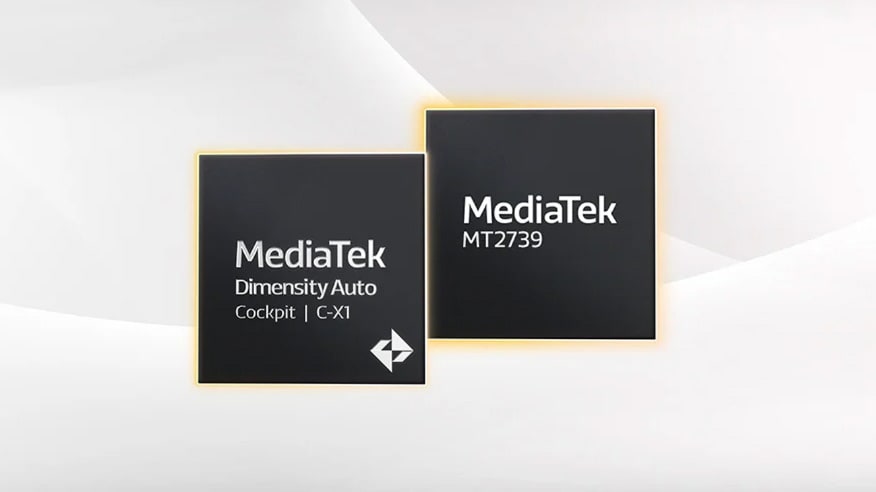
MediaTek presented the MT2739 chip, which supports 5G-Advanced and integrates an AI module directly into the modem. The solution enables automatic and transparent switching between cellular and satellite networks (NR-NTN), optimising connectivity according to available coverage without intervention from the vehicle's central system.

Alongside the MT2739, MediaTek also demonstrated the Dimensity Auto C-X1, a scalable smart cockpit platform designed to handle multiple displays, AI voice assistants and enable convergence between smartphones and in-vehicle infotainment in a single software architecture.

- Memory ready for autonomous driving

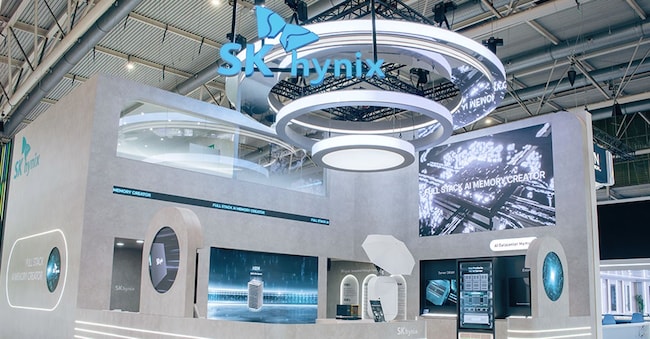
Among the automotive players at MWC 2026 is SK Hynix, which has set up an area dedicated entirely to vehicle memory solutions in Barcelona. The sense of this presence is all in the numbers of autonomous driving: as the level of autonomy increases, from simple assistance to completely hands-free driving, the volume of data that sensors, radar and cameras must process in real time grows exponentially. The new memories reduce energy consumption by 20 per cent compared to the previous generation, while increasing the available bandwidth by 50 per cent.

Security Technologies

- Millimetric radar to see where the eyes cannot reach

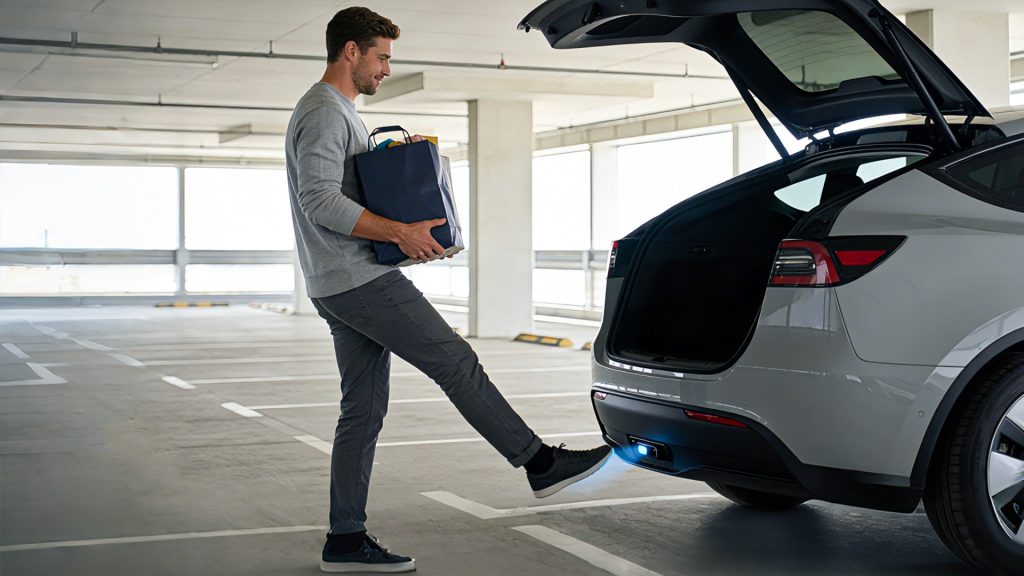
Quectel Wireless Solutions brought a range of millimetre-wave radars for automotive applications to Barcelona, with live demonstrations on the trade fair floor. The forward collision warning system detects targets more than 220 metres away and tracks up to 40 dynamic objects simultaneously, extending to two-wheelers. Also on show were a kick-to-open tailgate radar, a blind spot detection system and two digital key solutions, all combined with a 5G telematics control unit.

- Cars share what they see

One of the most visionary announcements at MWC 2026 bears the signature of Aptiv and its subsidiary Wind River, in collaboration with Verizon. The companies presented a proof-of-concept in which a vehicle's environmental perception data - radar, cameras, ADAS sensors - are transmitted in near real-time to other vehicles via Verizon's 5G edge network. In practice: a car can 'see' obstacles that its sensors have not yet detected, thanks to what is transmitted by a nearby vehicle. The solution has the advantage that it does not require direct interoperability agreements between car manufacturers, but exploits hardware that is already common in modern vehicles.

New Gadgets

- Android Auto wireless certified

Motorola has unveiled the new MA2 wireless Android Auto adapter. Developed in collaboration with Google, it is so far the only Android Auto adapter with official certification from the Mountain View giant. The device connects to the car's USB port, pairs with the smartphone via Bluetooth and manages the connection entirely wirelessly via the 5 GHz Wi-Fi band, thus eliminating the inconvenience of cables. The new MA2 has two physical buttons: one for power on and off, the other for switching between smartphones, a function that is particularly useful in cars shared by several drivers.

- Protection for large displays on board

The proliferation of large displays in cockpits, central touchscreens, digital instruments, passenger panels, has opened up a parallel market that at MWC 2026 found space with a concrete proposal: the Fast Skin Car by SBS. This is an on-demand service for applying protective films to infotainment displays, available directly at the dealership or at home. A simple idea in form, but significant in context: as on-board screens grow in size and value, with solutions that in some models cover the entire dashboard, their protection from scratches, fingerprints and everyday wear and tear stops being an optional extra and becomes a necessity.

World Two Wheeler

- Satellite security and connectivity for two-wheelers

Harman Automotive, a subsidiary of Samsung, has unveiled two complementary innovations. The first is a collaboration with Viasat to integrate satellite voice calls into the Ready Connect TCU hardware: a solution designed as a safety complement to mobile phones for drivers on rural or remote roads, with a plan to expand to messaging, emergency SOS and remote diagnostics.

The second innovation is called Ready Ride: a connectivity platform designed specifically for the two-wheeler market. The system combines an IP69-certified telematics chip, a software stack, cellular connectivity and an OEM backend in a single solution. Based on the Qualcomm Snapdragon Digital Chassis chip and compatible with OTA updates, Ready Ride aims to close a significant market gap: according to Berg Insight, less than 5% of global motorbikes are connected today.

Driving at 157 km/h from 3,300 km away

The most spectacular demonstration of the entire MWC 2026 week did not take place in the halls of the Fira Gran Via, but on the track. As part of the CircuitX showcase organised in parallel with the congress, the European mobility company Elmo set a new world record for high-speed remote driving at the Circuit de Barcelona-Catalunya, the same track as Formula 1: 157 km/h in a road-legal Nissan Leaf.

The first run, at 150 km/h, was driven by remote driver Risto Parri from a first-generation remote driving station positioned trackside. Shortly after, Enn Laansoo Jr., the CEO of Elmo, drove the same vehicle from the company's headquarters in Tallinn, 3,300 kilometres away, reaching 157 km/h: the maximum speed allowed for that vehicle. All this on a commercial 5G live mobile network, without dedicated infrastructure, in collaboration with Telefónica for local connectivity and Nokia for real-time network performance monitoring.

The previous record of 115 km/h has been far surpassed. The demonstration is not just a matter of a record, but confirms that commercial 5G networks are already capable of supporting high-speed telematics with sufficient latency to ensure safe control. Unlike fully autonomous vehicles, Elmo's platform keeps a human operator in control in real time. An approach that opens up new scenarios for logistics, urban mobility and applications in critical environments.

The underlying trend: the car as an intelligent node of a larger ecosystem

Looking at MWC 2026 as a whole, the most significant trend is not a single product but a structural transformation: the automotive industry is abandoning the model of the vehicle as a closed system and embracing that of the vehicle as a node in a network. A node that communicates with neighbouring vehicles, road infrastructure, low-orbit satellites and the driver's personal devices; a node that, thanks to artificial intelligence, updates, optimises and learns.

Copyright reserved ©
Loading...

Brand connect

Loading...

Newsletter

Notizie e approfondimenti sugli avvenimenti politici, economici e finanziari.

Iscriviti