The White House

The cream of the US tech industry attended the dinner for Xi: Musk, Huang and Altman. The first ladies stole the show

As is always the case on such occasions, the style and attire of the hosts and guests of honour were one of the central themes of the state dinner held to mark the Chinese leader’s visit to the US. The evening also highlighted the dependence of many major American companies on Chinese manufacturing

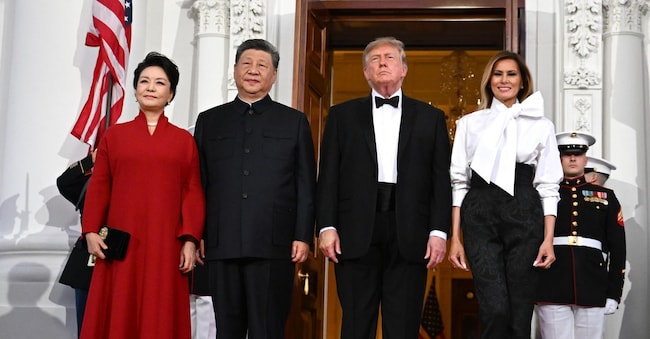
 Il presidente degli Stati Uniti Donald J. Trump (al centro, a destra) e la first lady Melania Trump (a destra) salutano il presidente Xi Jinping (secondo da sinistra), della Repubblica Popolare Cinese, e la signora Peng Liyuan (a sinistra) sul Portico Nord della Casa Bianca a Washington, DC, USA, il 24 settembre 2026.  EPA/Annabelle Gordon / POOL EPA

4' min read

Translated by AI
Versione italiana

4' min read

Translated by AI
Versione italiana

From the race for artificial intelligence to supply chains, right through to the tech giants barred from the Chinese market: the state dinner hosted at the White House in honour of President Xi Jinping brought together some of the key players in the increasingly complex relations between the United States and China. In the East Room, seated alongside Xi and President Donald Trump, were some of America’s most prominent chief executives, a testament to how closely the world’s two largest economies remain intertwined even as they compete for supremacy in emerging technologies.

Among the guests were the top executives of some of the companies at the heart of the global race for AI. The CEO of OpenAI Sam Altman attended alongside the company’s president, Greg Brockman, whilst Elon Musk was present in his capacity as the founder of Tesla, SpaceX and xAI, and an ally of Trump. Also in attendance at the dinner were the CEO of Nvidia Jensen Huang and the former White House adviser on AI and cryptocurrencies David Sacks.

Loading...

Their positions also reflect the divisions within the US industry regarding the approach to AI development. Altman and Musk have argued for the need to slow down the development of the most advanced systems in certain cases and to strengthen safety measures, whilst Huang and Sacks have rejected the most alarmist scenarios and insist on the need to accelerate innovation. Nvidia, in particular, has pushed to retain access to the Chinese market and has secured the administration’s approval to sell certain advanced chips in China, a decision that has drawn criticism in the United States.

The evening also highlighted the dependence of many large American companies on Chinese manufacturing. For Apple, represented by Tim Cook, China remains one of its key markets and the centre of its manufacturing operations, despite the gradual shift of part of its production to India. Tesla, too, continues to rely heavily on China for production and sales: before the dinner, Musk described the Shanghai factory as a “jewel”.

Melania and Liyuan in the spotlight

As is always the case on such occasions, the style and attire of the hosts and guests of honour were one of the main talking points at the state dinner held at the White House for the Chinese presidential couple. With Donald Trump in a tuxedo and Xi Jinping in the traditional ‘Mao suit’ – the Mao Zedong-style outfit – the American and Chinese first ladies stole the show. Melania Trump wore a white cotton poplin blouse by Saint Laurent, a black silk headband by Dolce & Gabbana and black brocade trousers with a peony pattern by Dolce & Gabbana, as well as her beloved black Christian Louboutin pumps. Peng Liyuan, on the other hand, wore a fiery red long-sleeved gown with a mandarin collar, a small V-neck and a flared skirt, in keeping with tradition: in Chinese culture, the colour red symbolises good luck, happiness and prosperity.

Silicon Valley is very well represented

As well as top executives from US hi-tech companies, the guests also included the founder of Amazon, Jeff Bezos. The platform relies heavily on Chinese sellers and manufacturers, and many of the goods sold by Amazon have been affected by the tariffs introduced by the Trump administration.

Also present at the table were the heads of companies that remain largely exempt from China’s so-called Great Firewall. Google’s CEO Sundar Pichai, co-founder Sergey Brin and Meta’s CEO Mark Zuckerberg represent companies whose main services are blocked or severely restricted in the Chinese market. Google withdrew its search engine from mainland China in 2010 following years of controversy over censorship, whilst Facebook, Instagram and WhatsApp remain inaccessible.

The Chinese delegation comprises only political and institutional leaders

The delegation accompanying Xi was of a completely different calibre, comprising almost entirely Chinese political and institutional leaders. Seated alongside the President and his wife Peng Liyuan were Cai Qi, a member of the Standing Committee of the Political Bureau of the Communist Party of China and one of Xi’s closest confidants, Foreign Minister Wang Yi, and Deputy Prime Minister He Lifeng, Washington’s main point of contact in economic and trade negotiations.

The delegation also included Zheng Shanjie, Chairman of the National Development and Reform Commission; Wang Wentao, Minister of Commerce; Lan Fo’an, Minister of Finance; Ma Zhaoxu, Deputy Minister of Foreign Affairs; and Xie Feng, Chinese Ambassador to the United States. Also present were senior officials from the Party apparatus and the Presidency, including Tang Fangyu, Director of the Central Policy Research Office, and Zhou Hongxu, Director of the Central Security Office.

Loading...

A clear discrepancy in the official list of attendees

The contrast with the American side was striking: no major Chinese business leaders featured on the official guest list, whilst the White House had brought together a significant proportion of the US industrial and financial elite. As well as Altman, Musk, Huang, Cook, Zuckerberg, Bezos and Pichai, those present included Satya Nadella of Microsoft, Lisa Su of AMD, Michael Dell, Jamie Dimon of JPMorgan Chase, Larry Fink of BlackRock, Stephen Schwarzman of Blackstone, Jane Fraser of Citigroup and David Solomon of Goldman Sachs.

Vance, Rubio and Hegseth were also at the table

The dinner was also attended by key members of the administration involved in policy towards Beijing, including Vice-President JD Vance, Secretary of State Marco Rubio, Secretary of Defence Pete Hegseth, Secretary of the Treasury Scott Bessent and US Trade Representative Jamieson Greer. Also present were the President’s daughters Ivanka and Tiffany, his son Eric and his granddaughter Arabella Kushner, who, during a visit by Xi in 2017, had sung in Mandarin in front of the Chinese leader.

Finally, among the guests were Chief Justice John Roberts and Justices Amy Coney Barrett and Brett Kavanaugh, as well as several Fox News personalities and David Ellison, Chief Executive of Paramount Skydance. The audience brought together figures from the worlds of politics, technology, finance and the media around Trump and Xi, at the end of a day organised by the White House to try to stabilise a bilateral relationship characterised by both strategic competition and deep economic interdependence.

Copyright reserved ©
Loading...

Brand connect

Loading...

Newsletter

Notizie e approfondimenti sugli avvenimenti politici, economici e finanziari.

Iscriviti