
In the factory, the key focus will be on physical AI
Taisch (PoliMi): ‘AI is being integrated into objects.’ Humanoids will not replace cobots designed for a single task

Key points
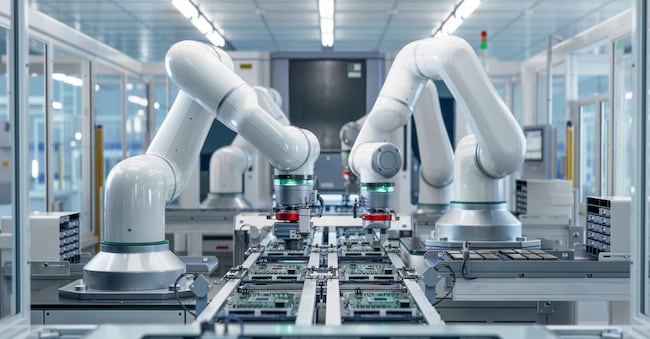
There are times when a technology seems to arrive out of the blue, and others when one realises that its arrival was inevitable. The introduction of artificial intelligence into factories and humanoid robots has its roots in the 1990s. Now the focus is on so-called ‘physical AI’, that is, artificial intelligence applied to industrial production.
Marco Taisch, Full Professor at the Politecnico di Milano, where he teaches Advanced & Sustainable Manufacturing and Operations Management, is quick to point out that we should not confuse the enthusiasm of the present day with reality. “My first scientific article on neural networks in the manufacturing sector dates back to 1996,” he explains. The technology is not new, but it has been brought to maturity by two recent enabling technologies: computing power and the availability of large amounts of data. This is the springboard for the real leap forward that we are now beginning to see in factories.
What will change compared to Industry 4.0?
With Industry 4.0, explains Taisch, we had learnt to connect machines and display data: dashboards, indicators, the ‘yellow and green arrows’ that signalled the status of a plant. However, the interpretation of that data was still left to humans. With physical AI, intelligence no longer resides solely in the cloud, but is brought ‘on board the machine’, inside the physical object. The machine no longer merely diagnoses what is happening; it goes on to make a prognosis and, in its ‘agent-based’ form, takes action to resolve the problem.
Taisch uses a striking image: ‘We are shifting the centre of gravity in manufacturing from “working with our hands” to “brain-based manufacturing”’. Whilst the robotics of the 1970s replaced arm muscle power, physical AI works alongside the brain and intervenes where decisions are cognitive but repetitive. However, it is still up to humans to provide the spark of creativity, intuition, risk-taking and non-repetitive decision-making. “It is you who decide where to draw the line, what to entrust to the algorithm and what to keep for yourself,” emphasises Taisch.
Taisch (PoliMi): ‘It’s not just humanoids in the factory’
With regard to humanoids, Taisch acknowledges that Italia, too, is fascinated by them, but for now we are still in the testing phase. He adds, however, that ‘in a factory, humanoids won’t be the only ones needed. We will continue to mill, move objects, and work with collaborative and traditional robots’. According to the professor, many tasks are nevertheless performed better by a robot designed for a single task – a cobot – which remains stationary in front of a machine and requires neither legs, eyes nor arms. In his view, when humanoids become widespread, the reason will be more to do with demographics than with technology. Indeed, in an ageing country, robots will be needed to replace workers who are no longer available.

