
At the Piatti tennis centre, where Sinner trained: a project tailor-made for players
In the Bordighera Academy today there are 63 tennis players. Jannik stayed there for seven years, before choosing Simone Vagnozzi (and then Darren Cahill)

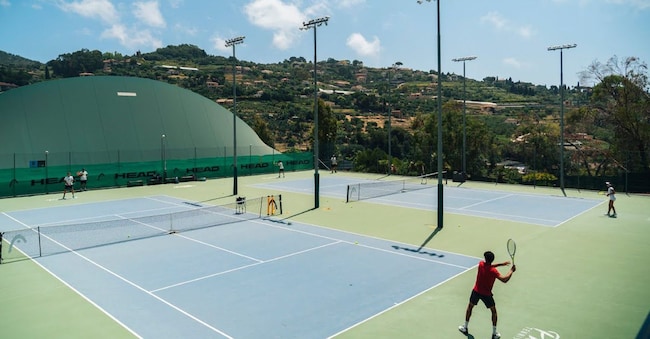
Don't expect a phantasmagorical structure with thirty courts, restaurants, swimming pools and who knows what else. The Piatti tennis centre is a bit like its inventor: all substance, pragmatism, hard work. Seven courts are enough - four owned, fast courts and the three clay courts of the Bordighera tennis club - but with as many as twenty-eight instructors and ten athletic trainers who take care of the 63 players in detail. A made-to-measure, tailor-made tennis: whoever lands there is a project to be carried forward, with goals to be achieved. And therefore progress to be assessed, tournament performances to be observed, improvements to be made. Jannik Sinner, who spent seven years there before turning to Simone Vagnozzi (who was joined by Darren Cahill), is the most accomplished example.
Today, says the centre's general manager Federico Andreani, 80% of the players are foreigners: they come from India, China, Brazil, Iran, Canada as well as Europe (Slovenia, Croatia, Denmark, Bulgaria, etc.). They are between 13 and 18 years old. "We make an admission selection: you are assessed for a couple of weeks and then admitted on the basis of technical, character and family requirements. We also offer counselling, which can be one day, one week or packages of several weeks. Over the course of a year, about a thousand players pass through here". The youngsters who decide to spend a season at the centre (costing between 30 and 35 thousand euro a year, in addition to board and lodging and tournament fees) have the option of staying in a residence attached to the academy, Villa Sorriso. Italians come from all parts of the country. "They go to school in the morning, train in the afternoon: that's our light formula. The intensive includes two gym sessions and two tennis sessions for a total of six hours a day. The foreigners, having solved the visa complication, come here and attend the school online'. Riccardo Piatti is not always present, he lives in Monte Carlo and is there from time to time to supervise or follow players sent to him by the French federation. The challenge was to make the Piatti method viable without its founder. On each court, there are two players with a master, and a 'super master' who coordinates everything straddling the two playing rectangles side by side. Important, in addition to the canonical exercises on the court, are the 'video analyses, also comparative: the player looks at himself and how a champion performs the same shot, realising what needs to be corrected'. Then there is tournament management. A crucial chapter, because 'for us the priority is not to score points or win a cup, but to put into practice what we have done in training and to check how it went from a physical, tactical and mental point of view' (in the centre there is a mental gym in collaboration with Formula Medicine, the structure of Riccardo Ceccarelli, mental coach - among others - of Sinner). "Our players are accompanied in tournaments by a teacher, there is one for every four athletes. The teachers themselves follow a training course in order to be able to move up a level and keep up with an increasingly high-performance and fast-paced tennis. Finally an interesting fact: 'Often the top ten who live in Monte Carlo ask us to send ours as sparring, or they come here: needless to say, it is a remarkable experience'.


