Venice

At the Glass Rooms the art of Murano between the two Wars

At the Island of San Giorgio the second chapter of the cycle of exhibitions dedicated to Murano glass and the Venice Biennale
by Silva Menetto

3' min read

Key points

3' min read

Venice, glass, Biennale: a trinomial that makes all the difference for glass art enthusiasts. From the moment Murano glass began to be presented, in its own dedicated space, within the International Art Exhibition in Venice, the value and quality of works born of refined artistic flair and great craftsmanship were officially and universally recognised.

It was 1932: the construction of the Venice Pavilion dedicated to the decorative arts, in the Giardini della Biennale, represented a clear change of pace for the history of Murano glass.

Loading...

Realised thanks to the synergy between the Biennale organisation and the Istituto Veneto per il Lavoro, the new Pavilion immediately became the privileged showcase where the Murano furnaces could present their best production to the general public. A production that in those years availed itself of the collaboration of extraordinary personalities such as Tomaso Buzzi, Carlo Scarpa, Vittorio Zecchin and Napoleone Martinuzzi. We are between the two world wars: Italy is going through a complicated period, but in Venice, for the glass industry, the moment is golden.

Il vetro di Murano alla Biennale di Venezia che fece storia

Photogallery6 foto

Marino Barovier

The decade from 1932 to 1942 is recounted in the second chapter of the cycle of exhibitions that the Stanze del Vetro, on the island of San Giorgio, dedicated to the presence of Murano glass at the Venice Biennale, again curated by Marino Barovier - one of the greatest scholars of art glass - assisted once again by Carla Sonego.

With a layout that is renewed from time to time, while always remaining highly engaging, the new exhibition reconstructs the historical settings through giant photographs of the period, rigorously in black and white; it documents the growing importance that the Biennale assumed in those years on the artistic scene - with so many official visits by princes and monarchs - and bears witness to the moment of great ferment and creativity of the Murano furnaces.

Completing the itinerary is the 'memory gallery' as Barovier calls it, with films from the Istituto Luce that take us back to the Venice of almost a century ago.

These were the years in which glass began to be used to produce elements that no longer responded solely to the needs of the table or lighting, but tested new techniques, shapes and processes to give life to objects that became works of art and design.

Contributing to the increased experimentation with material and colour were the collaborations with artists and designers that the companies increasingly engaged: the painter Dino Martens, Mario De Luigi who signed his works for Salviati & C. under the pseudonym Guido Bin, the architect and designer Carlo Scarpa.

Magical years for Murano glass, therefore, which prompted the Venice Biennale to dedicate an entire pavilion to the so-called 'decorative' arts, emphasising above all the Venetian production of glass, lace and mosaics. The prominence and international echo that Murano glass received from this moment onwards in terms of market and public appreciation, triggered a continuous competition between glassworks to bring the best of their production to the Biennale art exhibition.

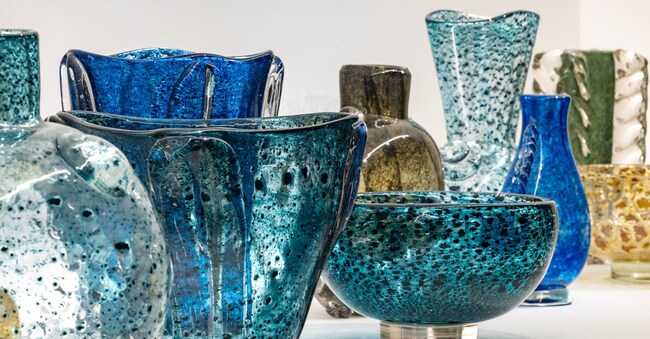
Of this fantastic decade, between the inauguration of the Venice Pavilion and the forced interruption of the Biennale in 1942, 160 works speak to us, many of them on loan from American museums and private collections: a sort of encyclopaedia of manufacturing companies and execution techniques, from Napoleone Martinuzzi's glass-paste figures, to Tomaso Buzzi's "Turquoise and Black" cups and vases for Venini, to Guido Bin's (Mario De Luigi) experiments in mosaic glass for Salviati, which also led to the creation of a unique and exceptional piece, "Il bagno" (1932), a mosaic with glass-paste tesserae made with his friend Carlo Scarpa.

An entire room is dedicated to the massive 'gemmated' and 'twilight' glass created by Ercole Barovier for the 1936 and 1938 Biennales; but there is also room for the lightness of the transparent blown glass created by Vittorio Zecchin for AVEM (1932).

An exhibition that in the intentions of its promoters - Pentagram Stiftung and the Giorgio Cini Foundation - would like to bring artistic glass production back into the limelight at the Biennale, to continue to create art and beauty through such an extraordinary material as glass, to which an increasing number of contemporary artists are also turning.

1932-1942 Murano Glass and the Venice Biennale, until 23 November 2025 at Le Stanze del Vetro, Island of San Giorgio, Venice. Free entrance.

Copyright reserved ©
Loading...

Brand connect

Loading...

Newsletter

Notizie e approfondimenti sugli avvenimenti politici, economici e finanziari.

Iscriviti