
At the Greek Theatre of Syracuse 'Alcesti' by Euripides and 'Antigone' by Sophocles
The 61st edition of the open-air shows kicks off with Paolo Fresu playing soprano flugelhorn

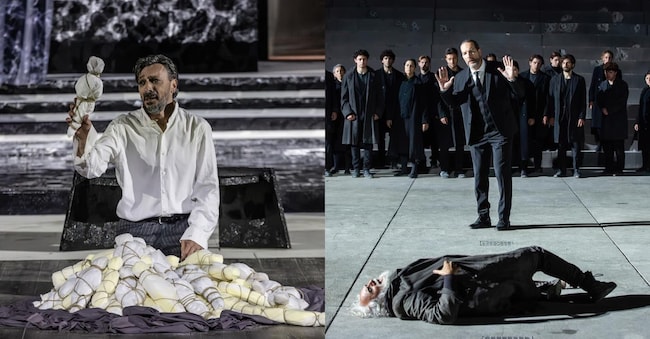
It is called INDA, Istituto Nazionale per il Dramma Antico (National Institute for Ancient Drama), but given the contagious success with which it attracts young people, hundreds of them, enthusiastic from all over Italia, realistically it could be updated as Istituto Nazionale per il Dramma Junior. This is the sixty-first edition of the open-air performances, on the historic stones of the Greek Theatre of Syracuse: the season has just begun, with the two opening titles, 'Alcesti' by Euripides and 'Antigone' by Sophocles. For both tragedies, the card of present-day appeal is cleverly played: in the first there is Paolo Fresu, author of the music, also making his debut in attendance, as he descends from the steps playing the soprano flugelhorn, yet another mutation of his jazz trumpet, which becomes an ancestral sound, spaced out, evocative of silences; in the second, on the other hand, Robert Carsen returns, the number one director on opera stages today, who here completes a memorable Theban trilogy. In 2022 he makes his debut in the confrontation with the classic with "Oedipus Rex", last year he returns for "Oedipus at Colonus", and now he triumphs with "Antigone", which deserves the crown as performance of the year.
Replicas
The reruns, until 5 June, are all sold out. It's worth a try: some seats, on the 4500 seats in the stands packed to the brim, may be found. If anything, you can console yourself with the TV replay, on Rai5, which is fortunately being shown. It would have been a crime to lose this memory. Carsen seems to have drank from Sophocles' sublime text, drawing emotional lymph from it, to revive a language that on stage recently we found as always highly constructed, but as corroded by the file of cynicism, of disenchantment. In need of winks to the present, with a presence of mobile phones, television sets, useless fashionable competitions, mirroring an emptiness of thought. Tragedy leads him to veer into another dimension: rooted in absolute themes, more than 2,500 years distant, he speaks to the present. The students hear it with their eyes shining, seated in the cavea, in a silence held for two hours on the same breath. The words come direct, thanks also to the new translations, by Francesco Morosi for 'Antigone', by Elena Fabbro for 'Alcesti'.
Carsen works here with his usual iron team: the scene is dominated by the gigantic staircase of Radu Boruzescu's set design, a common element in the trilogy. The steps, however, are now fewer, 'only' 27 (a challenge, however, for the actors to descend each time), and it was the war that demolished the highest ones, marking those left behind with bullet holes. The wounds bring history closer. And it is no coincidence that the director puts the pedal to the choral narrative: there are 91 of them on stage, a crazy number. Because apart from the eight soloists, the eighty-two are responsible for the rhythmic scope of the tragedy: fantastic young people, most of them students from the local Accademia d'Arte del Dramma Antico (theatre cannot be done without paideia) prepared by Marco Berriel in the exact movements, now geometric, now emotional. Giuseppe Di Iorio's lights expertly weave the shadows. The choral weeping over the sacks of the dead gives temperature to the whole drama. The concentric circles where the hymn to man is distilled by relay fragments, in a wheeling passage from one chorister to the next, while the others, holding hands, only silently move their lips, represent an invention never before encountered. Touching, impressive, meaningful.
Uniting the two tragedies is the father-son theme and the sacrificial will of the woman who rises as heroine above the humans. The actors are all Palme d'Or winners: from Paolo Mazzarelli, the defeated (but seductive, see how Carsen makes him tie his shoelaces) Creon, to Camilla Semino Favro, petite Antigone, the perfect rebellious teenager. When she strips off her grunge boots and black coat, and remains naked to wear the voluptuous white, in Luis Carvalho's costumes, recovering her mother Jocasta's dress - and the same black belt with which she was killed in Oedipus Rex - we know what end she is plotting. Gabriele Rametta has in his voice the tint of wisdom of his father's best son, Graziano Piazza returns as Tiresias (and really does not see, blinded by apposite lenses in his eyes) and upsets with the most bitter prophecies, the almost lightning-strike throwing of Zeus.
There are smiles (also) in "Alcesti", which Filippo Dini plays on the edge of comedy, exaggerating the heartbreak of the death of her, Deniz Ozdogan, who chooses to die in place of her husband, Admeto, very convincing Aldo Ottobrino in the ambiguous role of the opportunistic male. Weak-skinned, after his wife's funeral he finds nothing better than to let off steam on the gym equipment, unfailing in Gregorio Zurla's modern stage house, swimming pool and full-window wardrobe, the clothes (very elegant, by Alessio Rosati) for men only. Stroke of genius transforms Heracles, the irresistible Denis Fasolo, into a Venetian always at the bottle, paradoxical and comic drag. The duo with the servant of the house, Bruno Ricci, who speaks Apulian, becomes a pearl of humorous theatre. The audience laughs, the audience of the Stabile del Veneto, where 'Alcesti' will be repeated, will laugh even more.

