On show

At the home of artist William Kentridge: the thousand contradictions of Johannesburg

Just turned 70, the best-known living South African artist opens the doors of his studio: a journey through prints, films and sketches, which speak of resilience.

by Monica Mark
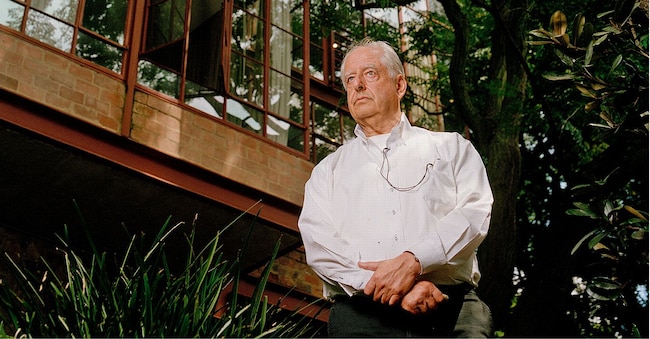
 Kentridge fuori dal suo studio. © Kent Andreasen

8' min read

8' min read

In the streets around William Kentridge's house, north of Johannesburg, there are trees of super-abundant beauty: jacarandas, eucalyptus and plane trees form bright green tunnels. The light in the city of gold, so named for the mineral mines on which it is built, is always stunning, even if the landscape is rather austere. As I pass a sharp curve with my car, the sun's rays acquire shades of colour that would have made the American painter of light, Thomas Kinkade, envious. I pull over to take a photo and am immediately struck by the sight of a man barely dressed in rags. I happened to stop right in front of Kentridge's house. The work of the greatest living South African artist is deeply rooted in the city where he lived for most of his life. The contrast between the affluent street and the unfulfilled promises of a metropolis grappling with poverty, homelessness and ineffective services is a constant thread in his poetics, from charcoal drawings of stylised figures to experimental animations depicting post-apartheid South Africa.
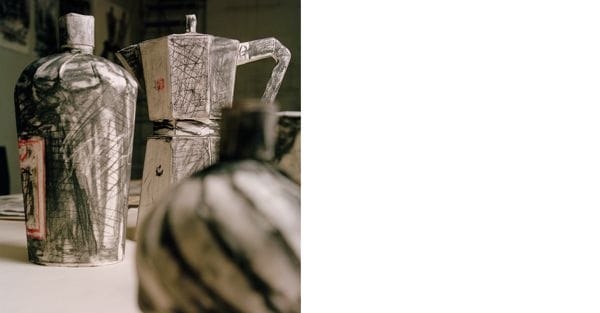
Due opere di William Kentridge : un vaso e una caffettiera in carta e cartone, disegnati a carboncino. © Kent Andreasen

I walk up the driveway of his English-style house, where he has lived with his wife Anne Stanwix, a rheumatologist, for over 40 years. Sitting in his brightly-lit studio, we start talking, and Kentridge explains to me that the deep political vein that runs through his work is not always intentional: "It surfaces in ways I'm not even aware of," he says. White-haired, with thick eyebrows and an impeccably white Oxford shirt, Kentridge has the air of a professor. Although he has never thought of his work 'as the history of Johannesburg, watching my films back to back, you can reconstruct the events of the city'.

Loading...
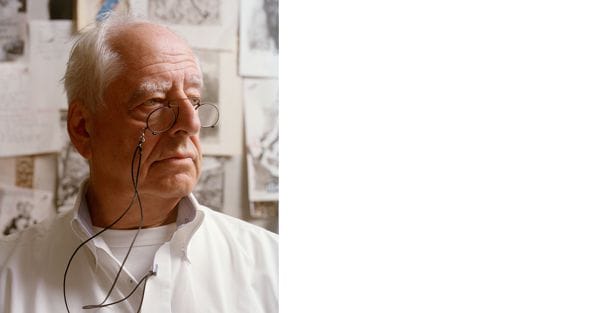
William Kentridge nello studio della sua casa diJohannesburg. © Kent Andreasen

His house, designed by English architect Frank Emley and partner Frederick Williamson in the early 20th century, is the one he grew up in and inherited when his parents moved to London in the 1990s. Here he keeps 'cupboards full of memorabilia from the 1960s: my father's military uniform, my mother's wedding dress', to which he has added a significant collection of prints, including an etching of a rhinoceros by Dürer and one by Edward Hopper, puppets from his theatre productions, his drawings and sculptures. One wall of the living room is decorated with several small bronze sculptures, the symbols of his artistic expressiveness: a pair of open scissors, a gramophone, a walking horse. Tapestries, carpets and canvases cover the walls and floors, and there is no shortage of traces of his grandchildren's presence, such as the tree house in the perfect English garden. Next to a mature belhambra are jacarandas, which lay a carpet of purple flowers in spring, and cacti. "We put a lot of work into it because our daughter wanted to get married in the garden," she says. "What was supposed to be a six-month project lasted 10 years and continues to this day."
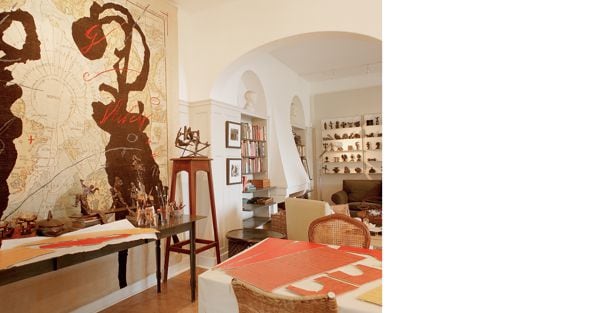
Alcune opere della serie “Paper Processions” in fase di realizzazione nella sala da pranzo della casa dell’artista, utilizzata come studio. Sulla parete a sinistra è appeso“North Polar Chart” (2005), sotto, sul tavolo, “Four Figureson a Bridge” (2001), e sulla consolle “Commendatore Naso” (2008). © Kent Andreasen

Kentridge also has another studio, an art centre that he runs together with Botswana-born visual artist Bronwyn Lace: it is called The Centre for the Less Good Idea and is a place where multidisciplinary experimental art and theatre projects are realised in collaboration with local artists. The name comes from a Setswana proverb, 'if the good doctor cannot cure you, find the less good one', and reflects Kentridge's constant desire to remain connected to his homeland. From 28 June to 13 July, the centre will be hosted at the Spoleto 68 Festival dei Due Mondi by the Fondazione Carla Fendi and Mahler & LeWitt Studios: the project includes the exhibition Unhappen Unhappen - Pepper's Ghost Dioramas, a residency programme and related events, including a lecture by Kentridge on 9 July.
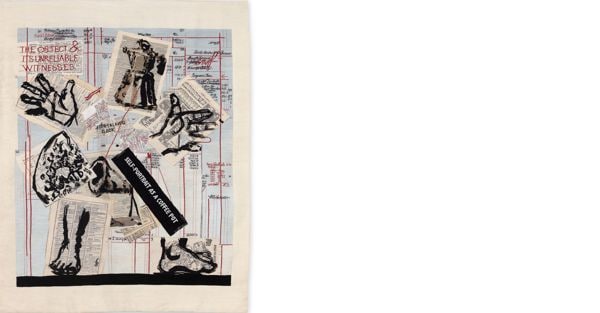
“Self-Portrait as a Coffee-Pot III”, 2012. ©WILLIAM KENTRIDGE, COURTESY OF THE ARTIST AND HAUSER & WIRTH/THYS DULLAART

His works go beyond the chronicle of a major African metropolis. One can also read traces of the events that have defined the evolution of South Africa: the Sharpeville massacre in 1960, in which the police fired on peaceful black protesters, the 2021 countrywide uprisings against the ruling party, the ANC. "The amazing thing about William's work is that it is undoubtedly political, but at the same time highly personal and philosophical, and transcends our history," says Liza Essers, owner of the Johannesburg-based Goodman Gallery, which has represented him for more than 30 years. "It has enormous resonance for people all over the world."
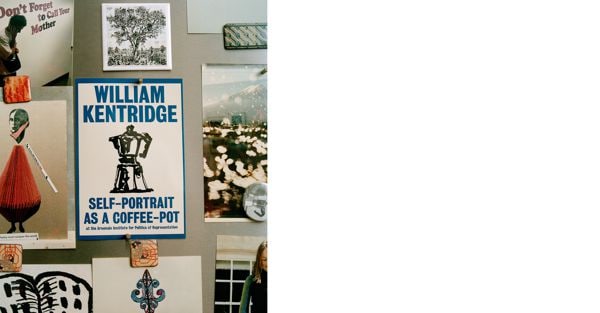
The artist reached the pinnacle of his career through what one critic described as a 'darkly imaginative circus' of prints, drawings, theatre, animation and music: a body of work that has been exhibited everywhere from the Louvre to the Met. Today, Kentridge's works on paper sell for an average of EUR 80,000, while his record is over EUR 1 million for a bronze sculpture. The best way to describe him is to consider him a master of impressive and fascinating total works of art that combine illustration and animation with theatre and dance.

Una cartolina per la mostra “Self-Portrait as a Coffee-Pot” del 2024 a Venezia. © Kent Andreasen

Just turned 70, Kentridge, although already a highly regarded artist, is now experiencing a renewed and unexpected moment of interest. On 1 May, he inaugurated at Hauser & Wirth in New York his first exhibition in the city with the gallery, A Natural History of the Studio: a series of 9 episodes of 30 minutes each, Self-Portrait as a Coffee-Pot, launched last year on the streaming platform Mubi, as well as sculptures and drawings used in their creation. In June, he will open The Pull of Gravity at the Yorkshire Sculpture Park, his first major sculpture exhibition outside South Africa. The quarantine due to the pandemic was the driving force behind the work at Hauser & Wirth. "Not to travel for so many months, to be able to spend all that time alone in the studio - it was fantastic. In Self-Portrait as a Coffee-Pot he talks to himself as he explores the creative process in the studio: we witness the continuous erasing and overlapping of charcoal images that transform: from a cup to a fish, from a vase to a word. "You want to draw a masterpiece," he sighs during the work, in a moment of self-pity, "but you end up drawing... a coffee pot." Today, recalling that passage, he explains that 'it was about finding meaning in the world outside the studio. The studio was like an enlarged head, where thoughts echoed'.

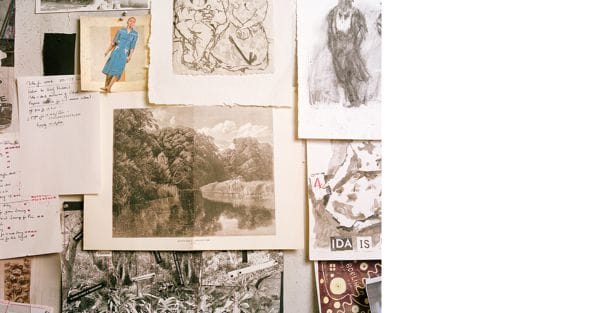
Appunti, immagini e altri oggetti appesi a una parete nello studio di Kentridge. © Kent Andreasen

"William's exploration of the human body's memory, history and experience is extraordinarily powerful and poignant, especially at a time of such global precariousness and uncertainty," says gallery owner Iwan Wirth. "It brilliantly expresses human vulnerability and resilience, the impact of trauma and the possibility that there is hope."

At the Yorkshire Sculpture Park, The Pull of Gravity will instead deal more explicitly with the theme of politics. The exhibition was conceived in the wake of the war in Eastern Europe. "It had been a few weeks since the invasion of Ukraine and we were both horrified," says Clare Lilley, the gallery director. "This prompted us to put the theme of arrogance at the centre of the exhibition." There will be horse sculptures and bronzes more than 3 metres high, and walking figures with megaphones for heads.

Around Kentridge's studio, however, one can see rehearsals for another upcoming work. On the ground floor, his team has assembled a miniature, realistic replica of the opera house in Glyndebourne, Sussex, where his production of Monteverdi's L'Orfeo will be staged in 2026. "We always make big prototypes to see how the projections will look in the final version," he says as we listen to the contralto's haunting voice in Jordi Savall's arrangement of the opera. "The final part will include the orchestra and the singers, the set and the projection. There are many aspects to consider, we have been working on it for two years,' he explains. Upstairs, in a room carpeted with Persian carpets, two assistants are working on editing the remake of Faustus in Africa! by Kentridge and theatre director Lara Foot, which will be presented at the Edinburgh International Festival. The original debuted in theatres in 1995, a year after South Africa freed itself from the shackles of apartheid, and used puppetry, animation and the legend of Goethe's Faust to explore the bonds that arose in post-colonial Africa. If the questions he raises (without providing answers) seem to be reflected in the big questions of today, 'it is not because they are universal', Kentridge clarifies, 'but because they return'. The ebbs and flows of history.

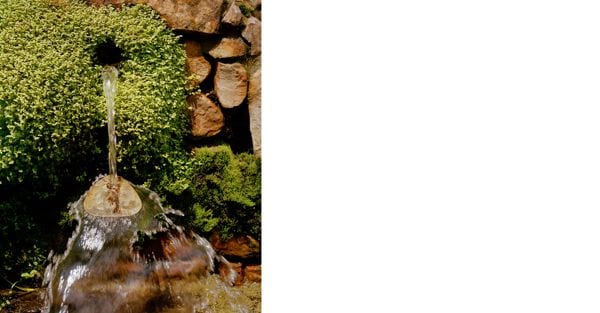
La fontana del giardino fuori dalla finestra della cucina. © Kent Andreasen

Later, Kentridge took a flight to San Francisco to attend a performance of his chamber opera The Great Yes, The Great No. The fictionalised play recounts the wartime escape from Vichy France of illustrious cultural figures such as André Breton, Claude Lévi-Strauss and Wifredo Lam. As some dogs roam the studio (only one, a happily overweight Labrador, is his, the others are his assistants), I ask him if he plans to slow down, to which he replies: 'Every time I think I have to stop, I get a new idea...'.

Kentridge was born in 1955 into a Jewish family of lawyers who fought against apartheid: his father represented Nelson Mandela. His early years were steeped in politics. In the past, he recounted how, as a child, rummaging through his father's desk for sweets, he came across photographs of the victims of the Sharpeville massacre, whose families his father represented at the trial. He described it as "one of those moments when your understanding of the world changes radically". He studied Politics and African Studies at university before attending art school at the Johannesburg Art Foundation, and in 1975 began directing and acting in theatre productions. After a short stint in Paris to study mime, he realised that he would never become an actor. Upon his return to Johannesburg, he turned to film production: "I told my wife that we would have our first child once I made my first feature film," he says. "Luckily she didn't listen to me, otherwise we would still be childless. Instead we have three, and still no feature film on the horizon." His third life as an artist began in his early thirties: a series of animations drawn in charcoal, 9 Drawings for Projection, was first published in 1989 and earned him international recognition. Today, his works are part of the collections of the Tate Modern, MoMA and the Centre Pompidou.

Un plastico del set per “L’Orfeo”, realizzato in collaborazione con Sabine Theunissen. © Kent Andreasen

Kentridge invites me to stay for a cup of tea and a few slices of fresh mango. His staff gathers for a break and the room is filled with the gentle buzz of conversation, his labrador snoozes by the table. Although his output is prolific, he confides in me that he always questions the sense of creative fulfilment: 'The hardest part of being an artist is that you always need to have a void, a lack,' he says. "If you are satisfied, if you are fine the way you are, then you can just get on with your life. You don't need to keep doing all these millions of...," he says scribbling in the air the same quick, decisive strokes of his animations. "The first idea that comes to mind when you're working on a project seems clear, good, and then, as you go on, it's not. At that point you can either become more and more confident and strident, or you can accept that it doesn't work and you have to start again, finding new ideas even from the cracks,' he confesses. It is the urge to create 'something that goes beyond oneself and remains when one moves away from it'.

Copyright reserved ©
Loading...
Loading...

Newsletter

Notizie e approfondimenti sugli avvenimenti politici, economici e finanziari.

Iscriviti