
At the Museo del Genio the irony of Ugo Nespolo's inflatable installations
The site-specific exhibition presented in Rome is "a festive fair of forms that brings light-heartedness and joy to visitors of all ages"

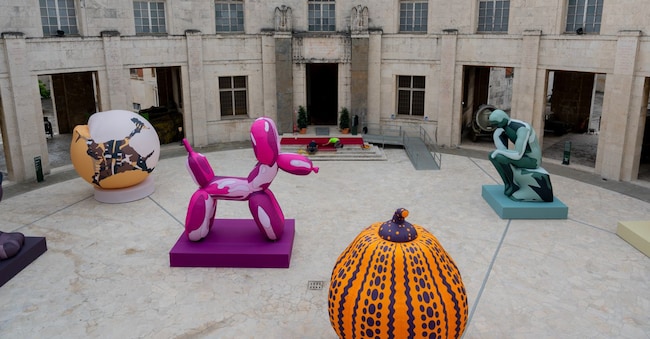
The effect of an architectural shock is assured when, among the Art Nouveau and even Umbertine palazzine of the Quartiere Vittoria, one finds oneself in front of the Tiber at the floating wooden piles, home of the oldest Capitoline rowing sports clubs, the rationalist colossus of the Museo del Genio. Conceived in the 1930s by architect Gennaro de Matteis from Matera, who was awarded the military valour for his services in battle to such an extent that he was promoted to the direction of the Ministry of Defence's Projects Office, this building has the shape of a slender exedra on its façade, escorted by two fortified towers. Often the protagonist of recent series and films dedicated to Fascism, it was actually built to house the collection of the Museum of Military Engineering first assembled in Castel Sant'Angelo, then merged into the Historical Museum of Military Engineering and initially housed in the Piave Barracks.
The splendid stained glass windows
The splendid stained-glass windows designed in the Chapel-Sacrarium by the talented artist and sublime craftsman Duilio Cambellotti, whose hands could juggle ceramics, woodcuts and engravings as well as advertising graphics and object design with equal finesse, contribute to smoothing out its severe and austere air. Above all, with the recent reopening after decades of closure, it is the colourful inflatable installations of Ugo Nespolo's Pop Air project (on display until 15 February) that disrupt the rigour of these spaces balanced between rationalism and neoclassicism, created using mainly travertine marble. Certainly, Guglielmo Marconi's original radiotelegraphic equipment, the display case containing one of the very first telephones invented by Antonio Meucci, including field telephones and military switchboards, the various optical devices, aesthetically appealing and decidedly functional, together with the dismountable forts and models of Italian cities - the models of the bridges are very precise -, as well as the endless collection of historical photographs impress even those who feel very distant and estranged from the res militaris.
Ugo Nespolo
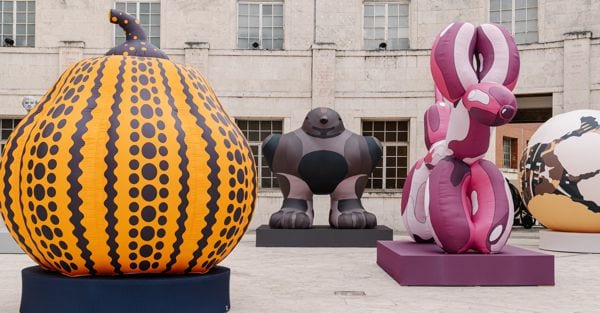
So, the irony of Ugo Nespolo and his helium-filled sculptures is welcome, responding to an inspiration that the artist himself considers an act of thinking lightness, in which matter is emptied to accommodate air, volume becomes ephemeral, and monumentality opens up to movement. In practice, a way of giving form a smile without dissolving its substance. Almost as if they were ready to leap and take flight into the Roman sky despite being anchored to the pavement, the great cucurbit made iconic by Yayoi Kusama, the Thinker inspired by the work of Auguste Rodin, Jeff Koons' homage to the Balloon Dog, certainly the most jaunty works in this site-specific exhibition presented in Rome as a world premiere as a personal reinterpretation of universally known works, reveal the taste and art of play perennially pursued in his creations by the artist born 85 years ago in the Biella region of Italy, capable throughout his life of traversing epochs and languages without ever losing his own expressive signature. The switching on of the first lights in the early evening, despite the fact that the museum managed by Difesa Servizi on behalf of the Ministry of Defence closes at a rather early hour, enhances the lightness of the sculptures, gigantic yet soft, lying in the courtyard with their arched, embracing, yet bare, minimalist silhouette. In front of Andrea Modigliani's Woman's Face, next to Giò Pomodoro's Sphere, under Louise Bourgeois's Spider and next to Milo's Venus, one feels small but at the same time lifted into a floating dimension. Perhaps the only bird by Fernando Botero 'pumped' by Ugo Nespolo can boast shapes closer to the original cast by its Colombian author who loved redundant figures. Otherwise, it is like witnessing a festive fair of forms that brings light-heartedness and joy to visitors of all ages.
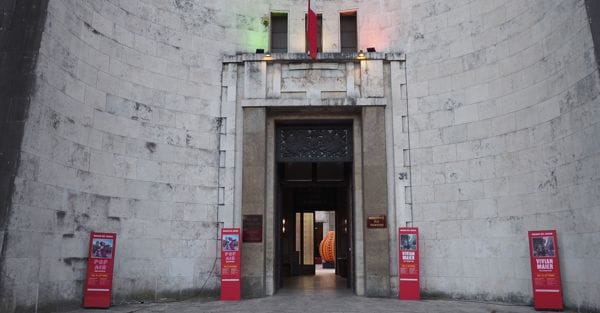
Vivian Maier was also "invited" to the return to the museum scene of the Museo del Genio - the full name of this space, which also contains a specialist library and the historical and iconographic archive, would be Istituto Storico e di Cultura dell'Arma del Genio dell'Esercito Italiano -: the New York nanny who always went out on the streets in her free time accompanied by her inseparable Rolleiflex camera is present with two hundred shots found by chance in her trunks.

