
Between clashes of civilisations and falling figures
While some authors praise translation, the art of making the other resonate within oneself, on a different stage an Islamophobic collective speaks

5' min read
5' min read
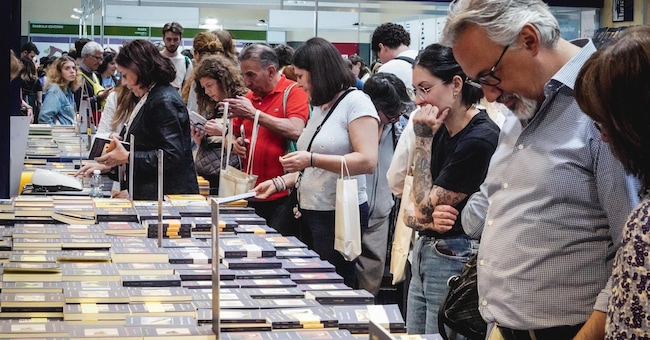
"I translate at all hours of the day and night, even when I'm dreaming," says Nicola Crocetti, the translator and publisher who for decades has been bringing the voices of poets from all over the world to Italy, as well as discovering Italian ones. And then he is moved when speaking of someone who, at three thousand metres above sea level, had carved on a rock the phrase 'Please read poetry'. 'I translate, therefore I am' even says Jhumpa Lahiri, author of Why Italian (Einaudi). Translating as a political and existential stance - making the other resonate within oneself -, reading, cultivating rational and aesthetic intelligence, empathy, escaping the fallacious logic of control, these are the leitmotifs that one hears repeated in the small conference rooms of the Turin Book Fair, rarely full, despite the fact that the public does not seem to have diminished between the stands and in the squares.
Outside, at the gates of the Salon, we learn that pro-Pal demonstrators have been truncheoned. Inside, but elsewhere, on a stage of the Salon, the regional councillor for Welfare, Maurizio Marrone, presents the racist French collective, self-styled 'right-wing feminists, above all right-wing feminists', who claim that the greatest danger to women is mass immigration and lament the spread of Islam in Europe. Unlike the feminist encounters or encounters with female authors that we have been able to attend - where the audience was made up almost essentially of women (a room only half full, and with only two men present, at the meeting with Luciana Castellina) - in this case the audience is made up 95% of men, who applaud vigorously and virulently in unison at the various political statements of the three representatives of Némésis. Called by name only: Anaïs, Mathilda, Astrid, without any contradiction from Valentina Menassi, editor of the 'Giornale' who gives them the floor, they recount their terror at moving around in a France populated by rapist immigrants where, they claim, an attempt is being made to impose the veil on women in public space in order to 'invisibilise' them.
The mood among book professionals is gloomy. Figures from the Italian Publishers' Association show the intensification of the decline in the book market in the first four months of 2025. Novels and essays lost 3.6% in value compared to the same period in 2024 and the drop in copies sold was 3.2%: almost one million fewer books purchased out of a total of 29.2 million. The large publishers are holding out, but the crisis of the medium-sized publishers (those who sell books worth 1-5 million) is very serious: they are losing 13.1%; the small ones are losing 7.3%. A hard blow for bibliodiversity and the circulation of new, different ideas, to which small and medium-sized publishers substantially contribute.
"It is not enough to change the things you say, you also have to change the way you say them, if you want to change the world," said writer Davide Longo at a meeting to celebrate the first 50 years of The Periodic System, an autobiography in twenty-one short stories by chemist Primo Levi, reflecting on authors such as Beppe Fenoglio and Levi himself, who "knew how to find a new language, capable of freeing us from the rhetoric that had brought fascism, and who thus tried to change the present". 'Changing the way to change the world' sums up the concept with a play on words Domenico Scarpa, literary consultant of the Primo Levi Study Centre in Turin.
"I am afraid that with my next book they will no longer allow me to return to Hungary," says the Hungarian-born German writer Terezia Mora - a finalist for the European Strega Prize, to be announced this afternoon with La metà della vita (translated by Daria Biagi, Gramma Feltrinelli) - after anticipating to the audience that this one will be about her home country and its politics. Half a Life is the first volume of a trilogy in which she deals with the feminine. The protagonist is an intellectual, an independent woman who, however, becomes dependent on a man. She sinks into devotion to a violent and anaffective person. For the author, this is the first novel in which the protagonist is a woman, and the first written in the first person: "A story like this can only be told in the first person, there cannot be a third person judging, or making comments". However, Mora realised that even so, while giving body to her protagonist, she was judging her. "So for a month I reversed the parts: he became the victim she became the executioner. I recognised my misogyny, the misogyny I had introjected, with this book,' says the author, 'and perhaps I overcame it. Hopefully you become better with your books'.


