
Echoes of 'The Name of the Rose' can be heard at La Scala
The writer's masterpiece makes its debut in the temple of opera, in an opera commissioned by the theatre from Francesco Filidei. And the literary critic who has studied it most tells us about the intertwining of music and novel

7' min read
7' min read
The fact that a criminal investigation is staged on the prestigious stage of La Scala, and that this investigation is based on evident dramaturgical chiaroscuros, may appear in the eyes of the exercised spectator to be a stretch, an easy concession to the sensationalist taste of the times. To fully understand the significance of the event, however, it is necessary to remember the exceptionality and, if you like, the plasticity of a novel like The Name of the Rose: once the manifesto of Italian postmodernism, a periodizing and watershed work, from (almost) the very beginning destined to involve millions of readers worldwide, then transposed into a jumble of expressive forms: film, theatre drama, miniseries for the small screen, board game, role-playing game, video game, newspaper supplement, teaching tool advocated by lay pedagogues and professors.
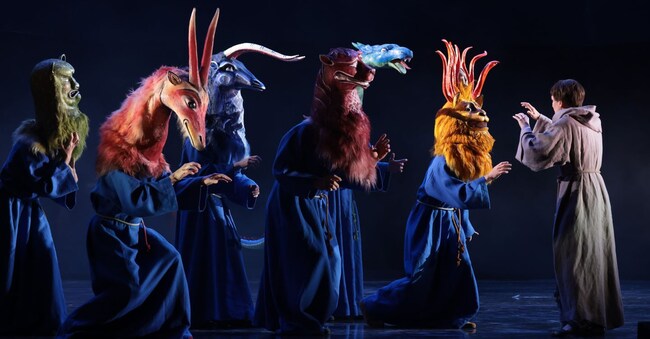
In many ways the torrid affair between William of Baskerville and the young Benedictine Adso of Melk has been offered to us, and it was only natural that at some point - 45 years after its debut in the bookshop - this same affair should try its hand at opera.
Umberto Eco was no stranger to the language of music. On the contrary, he cultivated it, first as a self-taught musician, then as a shrewd scholar determined to situate it among the foundations of his artistic theorisations. Even as a young boy he practised the recorder, and soon afterwards he developed a strong passion for the trumpet; between 1958 and 1959 he collaborated with Luciano Berio on the drafting of Thema, a sort of electro-acoustic piece based on James Joyce's Ulysses. (...)
The opera libretto prepared by Filidei and Stefano Busellato with the collaboration of Hannah Dübgen and Carlo Pernigotti (La Nave di Teseo editore) takes due account of all these, let us say genetic, characteristics. On the contrary, it distils them, bringing them to a tuning fork of rhythmic and harmonic effectiveness.
Let us take the prayerful aspect. This is a devotional line that in the novel is missing or fades away already after the first chapters, and that the libretto instead strengthens, making the stylistic feature identified by Eco one of the expressive constants of the opera we are about to witness.

