From text to work

Echoes of 'The Name of the Rose' can be heard at La Scala

The writer's masterpiece makes its debut in the temple of opera, in an opera commissioned by the theatre from Francesco Filidei. And the literary critic who has studied it most tells us about the intertwining of music and novel

by Bruno Pischedda

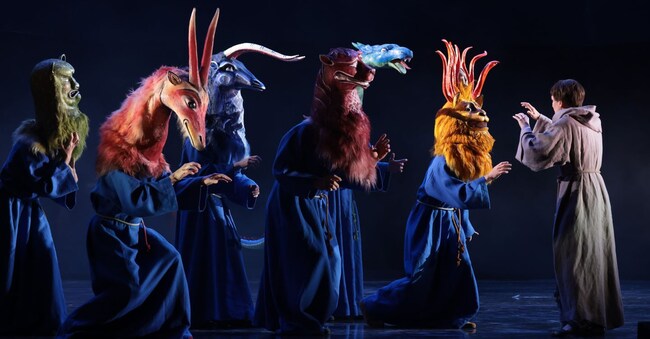
Prova generale. Un momento delle prove dello spettacolo liberamente ispirato al romanzo di Eco che debutta questa sera alla Scala. ©Teatro alla Scala

7' min read

7' min read

The fact that a criminal investigation is staged on the prestigious stage of La Scala, and that this investigation is based on evident dramaturgical chiaroscuros, may appear in the eyes of the exercised spectator to be a stretch, an easy concession to the sensationalist taste of the times. To fully understand the significance of the event, however, it is necessary to remember the exceptionality and, if you like, the plasticity of a novel like The Name of the Rose: once the manifesto of Italian postmodernism, a periodizing and watershed work, from (almost) the very beginning destined to involve millions of readers worldwide, then transposed into a jumble of expressive forms: film, theatre drama, miniseries for the small screen, board game, role-playing game, video game, newspaper supplement, teaching tool advocated by lay pedagogues and professors.

In many ways the torrid affair between William of Baskerville and the young Benedictine Adso of Melk has been offered to us, and it was only natural that at some point - 45 years after its debut in the bookshop - this same affair should try its hand at opera.

Loading...

Umberto Eco was no stranger to the language of music. On the contrary, he cultivated it, first as a self-taught musician, then as a shrewd scholar determined to situate it among the foundations of his artistic theorisations. Even as a young boy he practised the recorder, and soon afterwards he developed a strong passion for the trumpet; between 1958 and 1959 he collaborated with Luciano Berio on the drafting of Thema, a sort of electro-acoustic piece based on James Joyce's Ulysses. (...)

The opera libretto prepared by Filidei and Stefano Busellato with the collaboration of Hannah Dübgen and Carlo Pernigotti (La Nave di Teseo editore) takes due account of all these, let us say genetic, characteristics. On the contrary, it distils them, bringing them to a tuning fork of rhythmic and harmonic effectiveness.

Let us take the prayerful aspect. This is a devotional line that in the novel is missing or fades away already after the first chapters, and that the libretto instead strengthens, making the stylistic feature identified by Eco one of the expressive constants of the opera we are about to witness.

We find a powerful trace of this already in the First Day, Stanza 1, where the Apocalypse of John is set to music in several voices, which will be the background to the entire investigation conducted by William; or again in the Second Day, Stanza 5, which moves us to church and makes us listen to the monks' choir in B-flat. Of the same nature appear the duets, the trios, the dialogued scenes with a collective character, often set according to a responsorial technique, capable of translating lists and erudite descriptions into a well cadenced score.

Consider in this regard Day One, Room 3: we are now in the Scriptorium, the assistant copyist Berengar is illustrating the library catalogue, while William attributes the appropriate author to each title. And as for the great collective scenes, here is the Third Day, Room 10, in which Salvatore proposes the recipe for "casio al pastelletto" in front of the hostile chorus of cooks and servants.

Or again on the Fifth Day, Stanza 17, concerning the great brawl in which the meeting between the two legations convened is resolved, and where a protracted confrontation takes place between the Frenchman Jean D'Anneaux ("illiterate rascal") and Ubertino da Casale ("keg-burning friar!"). What emerges in such situations is the comic and grotesque dimension of the libretto, which at this juncture is in open opposition to the prayerful and devotional chorality intended to structure the opera musically.

Undoubtedly, then, the descriptive "airs" are to be considered, as Eco wanted; and with the "airs" the interrogations that feed the enquiry, the polemical and sapiential confrontations arranged at a distance: Stanza 3, the first clash between the venerable Jorge and the Franciscan scholar regarding the lawfulness of laughter; Stanza 23, the seventh and last day, where the two contenders cross paths conclusively and the true nature of the laughter to which the text refers comes to light. For this is the point: not fat laughter, popular comedy, but subtle laughter, irony, as it emerges from Jorge's mouth: 'laughter is blasphemy, laughter is corruption, laughter is sterile flesh, laughter is vain folly. But here - and he bangs his hand on the second book of Aristotelian Poetics - he is praised, here he is elevated to art: the doors of a perverse theology are opened to him'. Then the monk compulses its pages with moistened fingers and poisons himself, fulfilling the Book of Revelation to the letter.

The opera libretto retains an adventurous, exploratory quotient: Finis Africae is as good as the temple in which Indiana Jones gets lost. But the Gothic accentuation that Filidei and associates imprint on the dictation is clear; an accentuation that is perhaps also Shakespearean, if we look at Day Four, Room 14, set in the abbey stables, where Salvatore is preparing a magic potion with concoctions of various and repellent origins.

More respectful, and even punctilious, is the relationship with the fictional original as far as the intertextual level is concerned, relating to the co-presence of texts, true or supposed, that in the course of the set work converse with each other. The fundamental opposition between the Second Book of Poetics and the Book of Revelation (of the Apocalypse) remains evident: that is, between subtle reason and millenarian catastrophism. But the libretto - while adhering very closely to the text - also stages a deeper confrontation between Eros and Thanatos, pleasure impulse and death instinct, i.e. the Canticle of Canticles and Historia fratris Dulcini Haeresiarcae, in which, through inevitable didactic inserts, Adso comes to light on the figure of the Novara-born rebel Dolcino and on the atrocious torture he had to endure together with his followers.

The elements of most fertile innovation, indeed, are introduced on two further and distinct planes: the linguistic - or plurilinguistic - plane and the plane in which we can grasp the narrator's voice. The former does not require any effort of intelligence, it is enough to observe the constant intertwining of vernaculars (Italian, oc and oïl, Hispanic, High German, British), and the similar convergence of liturgical Latin and ancient Greek. Already Eco had recognised in the multi-code mixture with which Salvatore expresses himself a useful expressive criterion; the libretto, however, also in this case insists, deepens with even inordinate skill, in search of a universal super-language that can lend itself to an equally totalitarian harmonic configuration (the musical keys that characterise each stanza).

The Name of the Rose as it was originally conceived then had a relatively simple discursive framework: the elderly Adso restores with all the upsets of the case the story that has seen him as a protagonist since his early youth alongside his master.

The unfolding is linear in character, with no intrusion of the old ego on the scene in which the young ego moves. This is not the case in the libretto, which, on the contrary, contains numerous passages in which both the voice of the character at the time of the story and the voice of the person who exhumes the events that took place close to death are present. And the effect, it must be admitted, is admirable. We find confirmation of this in the Third Day, stanza 11 (theme of Friar Dolcino); and again, appropriately, in the following stanza (theme of the intercourse with the nameless girl).

At this point, however, a question arises: from the novel to the libretto, what post-modern elements are retained? What strategies intended to exalt a shrewd return to genre and plot? Few elements, really: a few quotable scenes, e.g. the one concerning the Brunello horse, taken from Voltaire and later from Conan Doyle (Zadig or Fate, 1747; The Hound of the Baskervilles, 1901-1902); or even a certain mixing of expressive registers, which turn from the religious sublime into the grotesque. What falls into the operatic re-elaboration is precisely the playful and amused, accentuatedly combinatory and desecrating interlude, through which Eco had set out to deliver serious content. In the libretto, this, if we want to say prudential and intellectualistic, cavity is eliminated, so that the serious contents remain on the ground to be considered as such: the fight against fanaticism, the commitment to make the truth laugh, the memory of the many victims left on the ground. And if anything with a clear overlap between sacred and profane, which in the novel resonated less. See in this regard the Last Folio, in which a now senescent Adso returns to the ruins of the burnt abbey, and kneeling before a torso of the Virgin Mary, mindful of the girl, asks himself definitively prostrate: 'Who were you? Who were you? Who are you?"

The opera devised by Filidei and his associates thus concludes, with a chorus of white voices that takes on the task of conveying the now famous but also controversial passage from the poem De contemptu mundi by Bernardo Morliacense (circa 12th century): 'Stat rosa pristina nomine, nomina nuda tenemus'. It is here, after the canonical seven days of creation and destruction, after two acts and 24 stanzas complete with prologue and epilogue, that the curtain finally falls. And the judgement we can draw from the great work the librettists have done is good, but still in need of clarification. What have we witnessed, summed up? To a kind of cantata mass, to a very secular and provocative medieval Passio, which instead of the torments destined for the son of God, envisages the death of those who in various forms and degrees have challenged the earthly heirs of his message.

It is not little, not at all.

Thanks to the Alla Scala theatre for the kind permission.

Copyright reserved ©
Loading...

Brand connect

Loading...

Newsletter

Notizie e approfondimenti sugli avvenimenti politici, economici e finanziari.

Iscriviti