Cycling

The Tour de France kicks off: a long romance turned into a derby between Pogacar and Vingegaard

The Grande Boucle kicks off from Lille and arrives in Paris via Montmartre on Sunday, 27 July. A total of 3338 kilometres with six mountain stages, six valley stages, seven sprinters' stages and two time trials

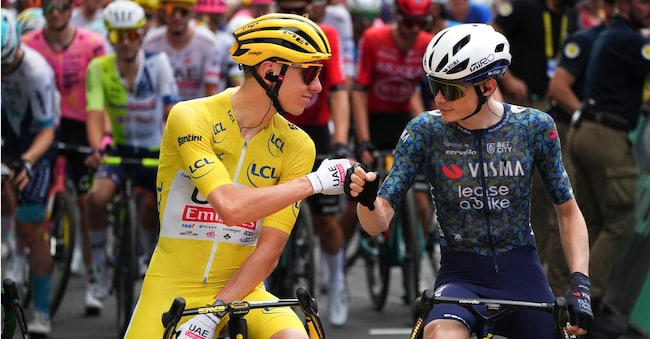
 Lo sloveno Tadej Pogacar e il danese Jonas Vingegaard si battono i pugni prima della dodicesima tappa del Tour de France 2024. (Foto AP/Daniel Cole, File)  Stampa associata/LaPresse

6' min read

6' min read

'Luglio con il bene che ti voglio vedrai che finirà...' sang Riccardo del Turco back in 1969, when Italian cycling, despite the scorching sun, managed to gain respect even at the Tour de France. Those were other times of a Eurocentric and not globalised cycling as now. Four years earlier, in 1965, a very young Gimondi had swept the Grande Boucle, taking the yellow jersey in overall surprise all the way to Paris.

Gimondi, Felice in name and in fact, was the new star, although a few years later an Armageddon called Eddy Merckx, who just in the last few days, on 17 June, turned 80, would arrive to overshadow him.

Loading...

If you say Merckx you inevitably end up talking about Tadej Pogacar, the new Cannibal, the inevitable number one favourite with Jonas Vingegaard in the new Tour de France (112th) which starts in Lille this Saturday, 5 July.

"Pogacar is an extraordinary champion and you can tell by his courage. And I see him as the favourite over Vingegaard this time as well. But compared to me, I have to say, Tadej has fewer opponents...', says old Eddy with a hint of malice, who in his time, despite having won five Tours, always had to be on his toes. The competition was thick and fierce. And ready to take advantage of any slightest sign of tiredness on the part of the Cannibal.

The French have not won since 1985

.

In addition to Gimondi, there were strong opponents such as Spaniards Luis Ocana and Josè Manuel Fuente, Frenchman Bernard Thevenet and many other champions who made cycling and Tour history. Another great who would dominate the scene after Merckx was the legendary Bernard Hinault, the Breton giant who was the last French winner of the Tour in 1985. Since then, no other transalpine rider has managed to conquer the Grande Boucle.

Quite a snub for our cousins who, as we know, have no rivals when it comes to grandeur. The last Frenchman to stand on the podium was Roman Bardet (2nd in 2016 and 3rd in 2017). "I would be really happy for a French rider to take over," explains Hinault, a little irritated at being asked the same question again and again. "Of course I would be happy, I try to be nice, but there is a limit. You'll see that when another Frenchman wins it, then there will be a big celebration and for a while people won't talk about me any more'.

Milan aims to win in Lille

If the French are not doing so well, the Italians are much worse off. At the start of this new Tour we count only eleven. Three more than in the last edition, but still very few. Among them, the most accredited are Jonathan Milan (making his debut) who will lead the sprinters' platoon aiming to conquer the yellow jersey in the first stage of Lille on Saturday. In addition, there is the return of Filippo Ganna who will certainly be looking for some stage successes with an eye, of course, on the two time trials.

We haven't won a stage since 2019. That is also a record in the negative. If we then go to see the last Italian first in Paris, we have to go back to 2014 with the usual Vincenzo Nibali. It's been eleven years now, but there really is no successor in sight here. This was also seen at the Giro d'Italia, surprisingly won by Simon Yates ahead of Mexico's Del Toro and Ecuador's Carapaz.

The first Italian (fifth) was Damiano Caruso, more than seven minutes behind. Seventh was Pellizzari at almost ten. Cheerfulness of shipwrecks, the poet would say. Curiously in cycling and football, the sports where we have always been protagonists, we no longer touch the ball. Question: is this just a coincidence?

But back to this Tour that is about to begin. Starting in Lille (third Grand Départ after 1960 and 1994) and arriving on Sunday 27 July in Paris via Montmartre ('an unnecessary stress' Vingegaard points out). A total of 3338 kilometres with six mountain stages, six valley stages, seven sprinters' stages and two time trials. The first on 9 July with 33 kilometres almost as flat as an ironing board. Therefore suitable for speed purists. Here the minutes can fly and already make a first selection.

Evenepoel, the third man

.

A test especially suited to the Belgian Remco Evenepoel, the third man in this race. Remco is still indecipherable. In the big stage races he is less credited than the two favourites, but his class is beyond question. 'I have to convince myself that it is possible,' Remco says on the eve of the race. He can be an alternative, although in the last week, where the most demanding mountain stages are concentrated, he risks not holding up until Paris.

Well, let us come to the point: will it still be the usual duel between Pogacar and Vingegaard? On paper, which is sometimes disproved by the road, of course it will. It will be yet another derby between two giants. At the moment, the balance (3-2) hangs in favour of the Slovenian, who is both world champion and reigning leader, having won the last edition in 2024. "The Slovenian is magnanimous towards his rival: "I think Jonas is the best climber in the world, or at least he has been in recent years, especially on long climbs. In time trials I'm better, sometimes he is. The battle, however, is open....'.

More practical bettors give Pogacar odds of 1.50. For Vingegaard, on the other hand, they offer double (3.00). The reason for this disparity is quite simple: the Slovenian, after a formidable spring (Strade Bianche, Flanders, Flèche Wallonne and Liège-Bastogne) arrives at the Tour after a long period of preparation in the mountains that allowed him to triumph in the Dauphiné and that should bring him to the start in better shape than even a year ago.

Apparently an even more Martian ready to sign, as soon as he can, the 100th career success. It is useless here to quote Tadej's brilliant CV, we are not yet at Merckx's level (523 victories) but only because these statistical comparisons leave time to be found. In Eddy's time, races were run from February to November. Even less emblazoned races.

Pogacar: 'The media? Better not to follow them'

.

On 21 September, Pogacar will be 27 years old. He therefore does not lack the time to dethrone the great Eddy. In attitude, too, the Slovenian has changed. Before he behaved like a good-natured prince, now like a king who is not always condescending towards his subjects. With the press he has turned sour: 'Since I am less on social media and have stopped following journalists and various media, I live much better, but I am ready to answer your questions with a smile.

When you win, smiling is easy. But at the Tour you have to be on your guard. Every day something happens. And here Vingegaard, who also arrives well prepared and not recovering from a crash like in 2024, can have his say. The great heat, despite being a Dane, does not bother him. And so do the long climbs that will characterise the final week of this Tour. In addition to the two protagonists, the two teams supporting them must also be put on the line. Two flagships worth almost 60 million. Two battleships that do not leave a single coffee to chance. Everything is planned, everything is arranged to ensure that the two captains can give their best. The Uae Emirates, with a few minor exceptions, has a formidable group with two big guns like Adam Yates (twin brother of the Giro winner) and the Portuguese Joao Almeida, fresh winner of the Tour of Switzerland, who in any other team could be captain.

Vingegaard, however, is not bad either. In his Visma-Lease to Bike there are plenty of champions. One is Simon Yates himself who, after what he did at the Colle delle Finestre in the penultimate stage of the Giro, needs no further introduction. The other is that Wout Van Aert who, again at the Giro, while waiting for Simon, allowed the Englishman to take the pink jersey. A tough bone the Belgian who, if he is at the top, can make the difference. In short, the derby between Pogacar and Vingegaard has many variables. The last one is the road, a strict and unappealable judge.

On the numbers, Pogacar's team is favoured (55 wins in 2025) against Visma's 21. But these calculations are good for side-trips. The substance, especially at the Tour, comes out during the race. In the very nervous first nine days, both Pogacar and Vingegaard repeat, accidents and crashes must be avoided. And no one can know what will happen on 22 July (stage 16) on Mont Ventoux. Or on 24 July in the queen's stage (Vif-Courchevel Col De La Loze) with almost 5500 metres of altitude in 171 kilometres. Here you will ride up and down between giants such as the Col du Glandon, the Col de la Madeleine and the Col de Loze. The finish is at 2304 metres, with everything that can happen at that height.

'The Tour is not a ball at Versailles,' goes a saying of the old suiveurs. Certainly there are many other things that cannot always be predicted with artificial intelligence or on-board computers. At least until the year of grace 2025. For the future, let us not venture any predictions.

Copyright reserved ©
Loading...

Brand connect

Loading...

Newsletter

Notizie e approfondimenti sugli avvenimenti politici, economici e finanziari.

Iscriviti

Tutto mercato WEB