
The Vatican brings Hildegard of Bingen to the Biennale. "The ear is the eye of the soul", by Brian Eno and Patti Smith
Twenty-four artists are part of the 'collaborative sound composition'. Presented the Pavilion at the Holy See Press Office, Intesa Sanpaolo main sponsor

Key points
To see sometimes one must first learn to listen. There is something subtly radical about the Holy See Pavilion at the 61st International Art Exhibition of the Venice Biennale. To a time marked by progressive acceleration and instability, on many levels, the Vatican chooses to respond with a gesture in the opposite direction: to stop, to listen, to contemplate. The Ear is the Eye of the Soul, this is the title, is borrowed from the last work of the great German director and writer Alexander Kluge, who died on 25 March 2026 at the age of ninety-four; the overall construction unfolds through two Venetian venues full of history around twenty-four artists, musicians and poets with the figure of a twelfth-century Benedictine abbess acting as a guide, Hildegard of Bingen.
The 'polymath' visionary
Curated by Hans Ulrich Obrist - artistic director of the Serpentine in London and one of the most influential figures in contemporary international curating - and publisher and technologist Ben Vickers, in close collaboration with the Soundwalk Collective, the pavilion does not merely exhibit works: rather, it orchestrates a collective and immersive act of listening. Koyo Kouoh's proposal for the Biennale was to tune in to a quieter frequency of experience. And not without effective intuition, the Holy See put a visionary, healer and composer, proclamation as Doctor of the Church by Pope Benedict XVI in 2012, at the centre of it all. An exceptional spirit for her time, whose work - theological writings, musical compositions, cosmological visions - offers not without reason extraordinarily fertile material for dialogue with the present. Indeed, the main idea of the pavilion is precisely this: to commission a group of artists to create new sound works that respond to Hildegard's songs, writings and images through voice, instruments and sometimes silence itself.
Two locations, starting with the Mystic Garden
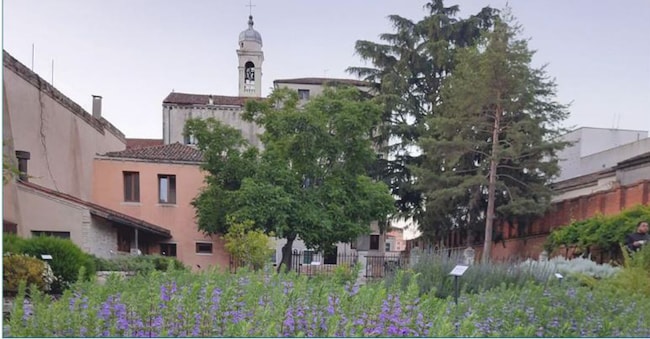
The pavilion is divided into two geographically and symbolically distinct locations. The first is the Mystical Garden of the Discalced Carmelites, in Cannaregio: a monastic green space hidden inside a 17th-century convent, now cared for by the Carmelite community. Here, visitors are invited to put on headphones and listen to the new commissions as they stroll through the vegetation, while a site-specific instrument created by Soundwalk Collective "listens" to the garden in real time, restoring an additional sound dimension to the place. The list of participants is as eclectic as it is revealing of the project's ambitions: Brian Eno, Patti Smith, FKA Twigs, Meredith Monk, Jim Jarmusch, Caterina Barbieri, Devonté Hynes, Suzanne Ciani, Laraaji, Kali Malone, Moor Mother, Otobong Nkanga, Raúl Zurita, Precious Okoyomon, Kazu Makino, Bhanu Kapil, Carminho, Holly Herndon with Mat Dryhurst, Terry Riley and the Benedictine nuns themselves from St Hildegard's Abbey in Eibingen, living guardians of the Hildegardian tradition. The second venue is the Complesso di Santa Maria Ausiliatrice, in the Castello district, which the pavilion transforms into a contemporary scriptorium - the place where, in the Middle Ages, monks copied and mined books. Structured around three main nuclei, the space houses a living archive of Ildegardian texts and research, Ilda David''s artist's books and an unpublished monastic architectural project by Tatiana Bilbao Estudio. Above all, it houses Kluge's final work: a monumental installation of films and images articulated in twelve stations distributed in three rooms, realised before his death and conceived in dialogue with the logic of the industrial restoration underway in the building. It is also to Kluge that we owe the very title of the pavilion, borrowed from his last reflection on art and time.
Cardinal Tolentino: healing the wounds of the present
"Return to serve the rhythm of life, the harmony of creation, and heal its wounds". For Cardinal Josè Tolentino De Mendonça, the Vatican Prefect for Culture and Education, these programmatic words of Pope Leo XIV were the key to the design of the pavilion. The choice of the "protagonist" concerns "a figure who may appear distant, being a 12th century mystic, but who possesses a strongly contemporary voice, capable of illuminating the questions and paths of the present". And this is why "it should come as no surprise that the Biennale dialogues with the figure of a nun, since every artist, even the most distant from the religious horizon, resembles a monk in the intensity of his inner quest". According to the Cardinal, "our time needs new masters, and Hildegard's polyphonic profile can help us as an antidote to the exasperation of monodies, inspiring us in the gestation of new visions".
Coppola: co-responsibility extended to private individuals
The pavilion has Intesa Sanpaolo as its main sponsor. "There is a sort of global co-responsibility, which not only concerns public institutions, the spiritual ones, but has to do with the country as a whole, including the private companies that are part of it," explained executive director Art Culture and Historical Heritage Michele Coppola. "In the invitation to slow down one's pace and better understand what is happening, in this kind of collective and choral sharing, I believe there is a desire if not a need to make one's own small contribution.


