
Athena and pilgrim signs lead to the Vatican
The exhibition at Villa Farnesina showcases finds from excavations in the surrounding area and celebrates the train of Pius IX
Maria Luisa Colledani
Elegant Athena observes the construction of the ship Argo and whispers the epic of the Argonauts. In these two terracotta slabs from the Julio-Claudian age, there is all the balance and composure of the lines of classicism and the eternal time of myth. In the hall of the Villa Farnesina in Rome, where they are exhibited, silence reigns, were it not for the parquet floor that creaks just beneath the visitors' feet. And that noise is itself a sense of time and the beauty that the Sienese banker Agostino Chigi wanted to make the Villa, home of the Accademia dei Lincei and in these months the venue for the exhibition On the ways of the Jubilee. Pilgrims, trains, popes, promoted by the Accademia Nazionale dei Lincei, the Gruppo FS Italiane and the Fondazione FS Italiane, with the support of the Soprintendenza Speciale Archeologia, Belle Arti e Paesaggio di Roma, in collaboration with the Sovrintendenza Capitolina ai Beni Culturali, Anas (Gruppo FS Italiane), the Associazione Archeolog ETS and under the patronage of the Associazione Amici dell'Accademia dei Lincei.
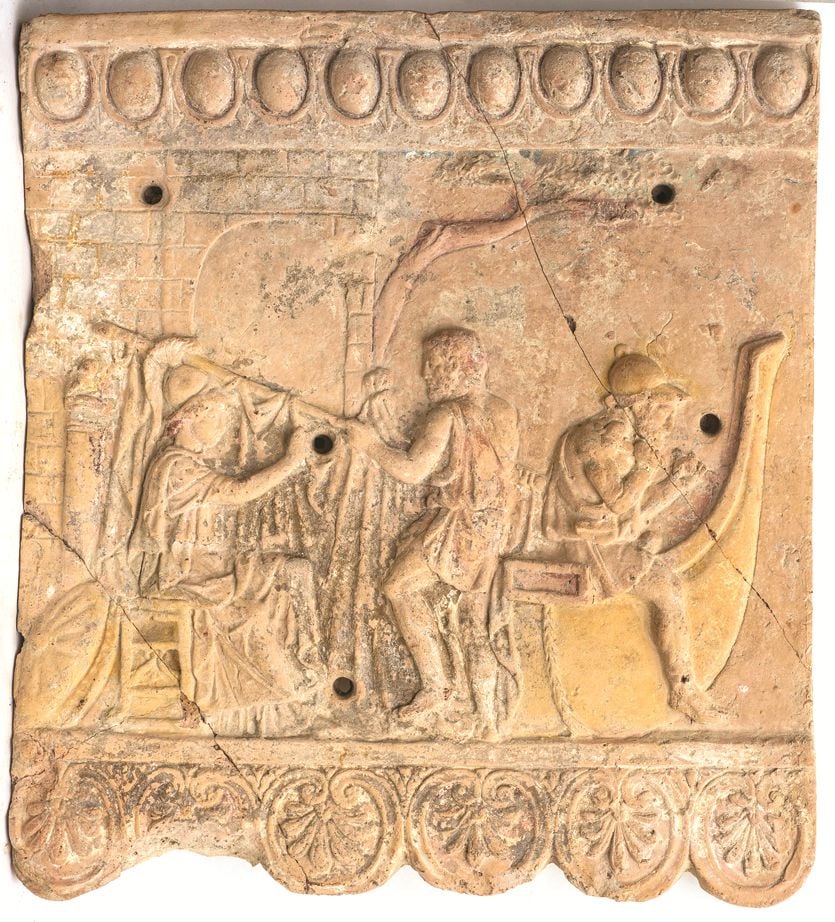
The Villa Farnesina, on the right bank of the Tiber, is located in the Regio XIV Transtiberim that included the Vatican, Janiculum and the Trastevere district, including the Tiber Island. Between the 1st century B.C. and the early imperial age, sumptuous horti had sprung up here, those of Caligula and Nero, of Agrippina, with public and ceremonial spaces, a circus, theatre, long porticoes. They were spaces for otium, then reconverted at Nero's death until Constantine built the Basilica where, according to tradition, Peter, martyred in Caligula and Nero's circus, was buried. History, wealth, tragedy have passed through this area and are witnessed by the discovery of the two slabs - among the most exciting pieces of the exhibition - during the excavations in Piazza Pia, reused as the cover of a sewer system of the Flavian-age fullonica built on the porticoed garden of Agrippina and Caligula, close to the river.
After the imperial splendours, in the early Middle Ages, the area was occupied by the Schola Saxonum, one of the four scholae peregrinorum founded at St Peter's to welcome pilgrims arriving in Rome. Wayfarers began to flock to the city, pilgrimages led to the development of Romanesque art, the streets filled with people coming from all over to adore the tomb of the apostle dear to Christ, and the archaeological excavations at Palazzo de' Penitenzieri, which the exhibition makes the most of, have unearthed among the layers of a probable manufacturing centre moving objects that bear witness to the flow of life: 200 finished and semi-finished bone objects, the remains of a lime kiln, numerous Anglo-Saxon coins and artefacts from northern Europe. And from the layers of the road, dating back to the mid-14th century, two gems have come to light, two signa peregrinationis, devotional objects that travellers carried with them as blessings. One depicts the Holy Face of Lucca and the other the Black Madonna of Rocamadour (France), demonstrating how all roads even then led to Rome. Who knows what a wonder the city must have been, with its palaces and churches. From the top of the Janiculum Hill, just before reaching the Vatican, the pilgrims had before them an endless expanse of art and life, as evidenced by the 12-sheet view made by Giuseppe Vasi in 1765, listing 390 sites and monuments, almost a Baedeker ante litteram of the Urbe.
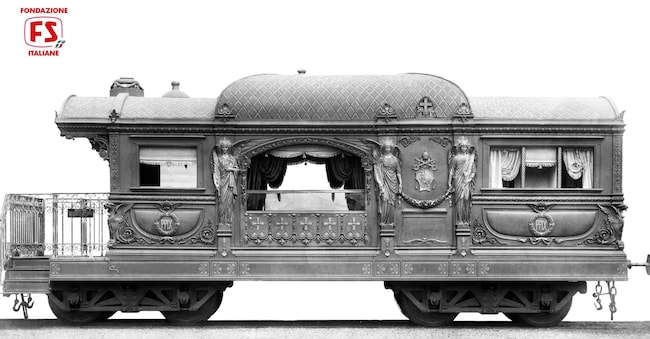
One of the best known streets towards St Peter's was the Via della Lungara, also known as the Via Sancta, confirming its function: it went from the Porta Settimiana, skirted the Farnese-Chigi properties - reminding us that Villa Farnesina is indeed Raphael, Baldassarre Peruzzi and Sebastiano del Piombo with the Loggia of Cupid and Psyche and that of Galatea, but it is also a stratification of epochs -, passed in front of the church of San Giacomo and that of San Leonardo (now destroyed), to arrive at the Porta di Santo Spirito in Sassia (which derives from Schola Saxonum) and, from there, to the Basilica of the Christianity. Since the Middle Ages, pilgrims have changed the face of Europe and journeys have marked the flow of time. As is also shown by the train of Pope Pius IX (1792-1878) that closes, almost like a firework, the exhibition. The uprisings of '48 had forced the pontiff to take refuge in Gaeta and the train journey from Portici to Pagani had marked his curiosity about the new medium. Was it a devilish fire horse or a new opportunity? He was certainly getting into art, and Raffaele Faccioli, Luigi Selvatico and Anselmo Bucci became bewitched by the penumbra of the stations, by the toils of the passengers. In the Papal States, the Rome-Frascati, the Rome-Civitavecchia, the Rome-Velletri-Ceprano and the Rome-Ancona-Bologna for a few hundred kilometres were inaugurated and Pius IX took it philosophically: 'There is always a path to take and a light to follow'.


