First contact

Audi A6 Allroad: how it drives and what it’s like

Now in its fifth generation, it features a different body style for the first time compared with the A6 from which it is derived.

6' min read

Translated by AI
Versione italiana

6' min read

Translated by AI
Versione italiana

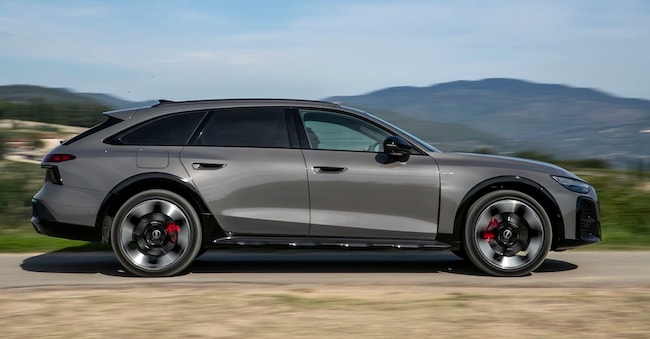
Eleven centimetres. That’s the figure that best sums up the new Audi A6 Allroad. Compared to the A6 Avant, the fifth generation is 11.1 centimetres wider and measures just under two metres without the wing mirrors. Seen from the rear, it almost looks like an RS6 that has decided to lift off the ground and head off down a dirt track. This is by no means a random choice, as the new wide-body design foreshadows that of the future RS6, expected in 2027 and already undergoing development testing.

But the new Allroad has also changed significantly beneath the bodywork. Dedicated air suspension, progressive steering, four-wheel steering on the plug-in model and quattro ultra all-wheel drive make this A6 very different from the standard Avant with just a few centimetres more ground clearance. We test-drove the new 367 cavalli e-hybrid – the first-ever Audi A6 Allroad plug-in – taking it well off the tarmac too.

Loading...

Nuova Audi A6 Allroad, le foto su strada e sterrato

Photogallery39 foto

Audi A6 Allroad, almost two metres wide

The body is 5.02 metres long and 1.99 metres wide, with a wheelbase of 2.93 metres. Compared with the A6 Avant, the track widths have increased most significantly, by 74 millimetres at the front and 70 at the rear. The difference is even more striking when compared with the previous Allroad, with the body being 8.4 centimetres wider. The wheel arches are unique, as are the bumpers, side skirts, underbody protection and vertical air intakes behind the front wheels. Wheel sizes range from 19 inches up to 21 inches, in the latter case fitted with 285/35 tyres. The ground clearance has also changed. In its standard configuration, the Allroad sits 34 millimetres higher than the A6 Avant with air suspension. But this is merely the starting point.

Three screens and more width

Inside, the layout mirrors that of the new A6 range. In front of the driver is an 11.9-inch digital instrument cluster, flanked by a 14.5-inch central touchscreen. A 10.9-inch display in front of the front passenger is available as an option, which can also be used for videos and multimedia content without distracting the driver. The increase in external width is also noticeable inside the car, particularly at the front, where there is ample space between the driver and passenger, whilst there is no shortage of space at the rear either. The V6 TDI offers 466 litres with five seats and 1,497 litres with the rear seats folded down. On the e-hybrid, where the battery takes up additional space, this drops to 404 and 1,423 litres.

How does the new Audi A6 Allroad perform?

It is, however, when you set off that the extra eleven centimetres really come into their own. The wide track, the progressive steering and, above all, the four-wheel steering manage to mask its size and weight effectively. On the e-hybrid, rear-wheel steering comes as standard and can turn up to five degrees in the opposite direction to the front wheels at low speeds, reducing the turning circle to around one metre. As speed increases, the rear wheels turn in the same direction as the front wheels by up to two degrees, enhancing stability and precision.

The difference is particularly noticeable when you select Dynamic mode. The air suspension lowers the body by 20 millimetres, and a saloon over five metres long and weighing more than two tonnes becomes surprisingly precise. The steering is responsive, the front end tracks the line well, and the wider track limits body roll. The weight becomes noticeable when you push the pace too hard, but you never get that sensation of driving a tall, heavy car typical of many SUVs of a similar size.

In Comfort mode, the ride character changes. The shock absorbers allow the bodywork to move more freely, and the Allroad returns to doing what it does best: clocking up the kilometres whilst effectively absorbing potholes and motorway joints.

Lifts the bodywork by 35 millimetres for off-road driving

The air suspension has a total travel of 55 millimetres. In Offroad and Offroad+ modes, the body is raised by 15 millimetres compared with the normal position. Using the Lift function, a further 20 millimetres can be gained, bringing the total increase to 35 millimetres, which can be used at speeds of up to 35 km/h.

We also tested the A6 Allroad on gravel and in light mud. It is not an off-roader, and the road tyres in particular are its main limitation, but the difference compared to a standard estate car is noticeable. In Offroad+ mode, the traction control allows for more wheel slip, the electronic differential intervenes more quickly and the gearbox holds gears for longer.

The quattro ultra all-wheel drive system completes the package. When conditions allow, the system can disengage the rear axle to reduce drag, reactivating all-wheel drive when traction or greater stability is required. In practical terms, this means you can get the wheels and bodywork covered in mud without too much worry, and shortly afterwards be back on the motorway driving as if you were in a standard A6.

Loading...

367 cavalli Audi A6 Allroad e-hybrid

The version we drove combines the 252 cavalli 2.0 TFSI four-cylinder engine with an electric motor integrated into the transmission. The combined power output is 367 cavalli and the torque is 500 Nm, enough to accelerate from 0 to 100 km/h in 5.5 seconds and reach a top speed of 250 km/h.

The battery has a gross capacity of 25.9 kWh and a net capacity of 20.7 kWh. The claimed electric range is up to 95 kilometres, whilst in EV mode it can reach 140 km/h. Charging is carried out exclusively using alternating current at up to 11 kW and takes around two and a half hours to go from zero to one hundred per cent.

On the road, the hybrid system complements the car’s character well. The electric motor ensures smooth acceleration from a standstill and effectively bridges the gaps in the four-cylinder engine’s power delivery. When you put your foot down, the performance is there in full, although the sound certainly lacks the character you might expect from a 367 cavalli estate car.

However, the e-hybrid could well become the preferred choice for company fleets. Under current Italian rules on cars provided for mixed use, the fringe benefit for plug-in hybrids is calculated at 20 per cent of the ACI conventional value, compared with the 50 per cent applicable to non-rechargeable engines. This difference could weigh far more heavily than the €6,300 difference in the starting price compared with the diesel model.

The V6 TDI remains the choice for those who clock up the kilometres

The alternative is the 3.0 V6 TDI M-Hybrid Plus, producing 299 cavalli and 580 Nm. The mild-hybrid system can provide up to 24 cavalli of electric assistance and is also paired with an electric compressor designed to reduce lag at low revs.

It accelerates from 0 to 100 in 5.4 seconds and has a top speed of 250 km/h. The diesel model also features quattro ultra all-wheel drive and air suspension as standard, whilst all-wheel steering – which comes as standard on the plug-in hybrid – is available as an option.

Audi A6 Allroad, prices from 82,350 euros

The range comprises the Business, Business Advanced and S line trim levels. The 299 cavalli A6 Allroad 3.0 TDI quattro starts at 82,350 euro in the Business trim, rises to 88,150 euro for the Business Advanced and reaches 91,350 euro in the S line trim. For the 367 cavalli e-hybrid quattro, prices start at 88,650 euros. The Business Advanced costs 91,450 euros, whilst the S line comes in at 95,250 euros. Available features include up to 21-inch alloy wheels, Digital Matrix LED headlights, OLED 2.0 rear light clusters, a third screen dedicated to the front passenger, a variable-transparency panoramic roof, four-zone climate control, and ventilated seats with a massage function. The new A6 Allroad therefore remains a rather unique vehicle. It costs as much as a large SUV, is almost the same width and, when needed, can even raise itself off the ground. But once lowered and taken onto a winding road, it reminds you why, after more than twenty-five years, Audi still continues to build an estate car that refuses to become an SUV. All this with a style unrivalled on the market.

Copyright reserved ©
Loading...

Brand connect

Loading...

Newsletter

Notizie e approfondimenti sugli avvenimenti politici, economici e finanziari.

Iscriviti