Industry

Audi, Döllner: “The A2 e-tron is the most efficient ever. Europe must take action on plug-in vehicles”

The CEO of the Four Rings clarifies the brand’s future, from a range that will not undergo any further cuts to the fate of the German factories

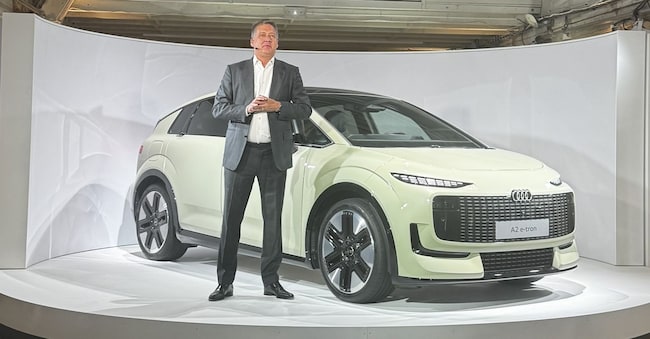
 Foto di Simonluca Pini

6' min read

Translated by AI
Versione italiana

6' min read

Translated by AI
Versione italiana

Not only the world debut of the new Audi A2 e-tron, but also an opportunity to set the record straight amidst the ‘perfect storm’ currently engulfing the Volkswagen Group. Gernot Döllner, CEO of the brand with the four rings, has chosen one of the most challenging moments to answer a series of questions from *Il Sole 24 Ore* that are set to shape Audi’s course in the coming years. From the role of the A2 e-tron to the reduction in the model range, via Chinese competition, the future of the German plants and the need to restore profitability. But also Nuvolari, the AUDI brand developed for China, future electric RS models, the software-defined vehicle, Concept C, range extenders, solid-state batteries and the SSP platform. In the background lies the issue of the competitiveness of European industry, with Döllner calling on the Commission to take action on plug-in hybrids as well.

What role will the new A2 e-tron play within the Audi range? Will it primarily fill the gap left by the A1 and Q2, or will it be aimed at a new customer segment?

Loading...

“First and foremost, the A2 e-tron is further proof of Audi’s transformation and the ongoing modernisation of our product range. The A2 e-tron marks Audi’s entry point into electric mobility. It is positioned at the lower end of the A-segment and therefore represents a new gateway to the Audi brand in terms of electric mobility.”

The Volkswagen Group has announced a major streamlining of its product range. Following the discontinuation of the A1 and Q2, will there be further cuts to the Audi range?

“I believe that, within the structure envisaged by the Group, we have a very strong Audi portfolio. The range of models you see today essentially corresponds to that planned for the future, with a few additions in the area of electric mobility.”

In the compact electric car segment, competition from Chinese manufacturers is growing ever stronger. Why should a European customer choose an A2 e-tron over a Chinese model, and what features make it a true Audi, apart from price and range?

“Although it is the brand’s entry-level model, it is a premium car. We believe that efficiency is one of the key factors when it comes to electric mobility. It is the most efficient Audi we have ever built. At the same time, it is truly premium in terms of materials, space and functionality. What’s more, it features bidirectional charging, so you can integrate the car into your own private ecosystem. All of this makes it a true Audi in every respect.”

Audi’s transformation will inevitably also affect its German plants. What future do you envisage for Neckarsulm after 2030, and can you rule out the end of car production at the plant or the closure of an Audi factory in Germany?

“We are in the midst of the greatest transformation in Audi’s history, but we are moving from the decision-making phase to the implementation phase. What you see with the A2 e-tron is further evidence of our renewal. Audi must become faster and more efficient, and we must also reduce the complexity of our organisation.”

“As regards Neckarsulm, we are beginning to implement a number of measures and to enter into negotiations with the works council on the future of the plant. We believe that, if we can identify the right measures, we will have the basis on which to decide the plant’s future.”

Loading...

Profitability remains one of the key issues. Audi’s operating margin is still some way off its long-term target. How do you intend to bridge this gap?

“We are witnessing a major transformation of the global automotive industry, with changes in China, tariffs in the United States and fundamentals that remain solid in Europe. We must tackle these challenges through our strategy. We are not driven by volumes. We are driven by margins and return on sales. For us, this is a more important indicator.”

The Nuvolari was launched as a limited-edition model, with just 499 units produced. Could it mark the start of a new range of high-end products within Audi?

“It’s a good idea. For the time being, it’s a one-off project limited to 499 units, and we’ll stick to that plan. But it’s a good idea.”

The AUDI brand was created exclusively for the Chinese market, but some cars have already reached Germany via parallel imports. Is there a possibility of official sales in Europe as well?

“No, there are no plans in that regard. We are looking into how these cars ended up in Germany. We don’t think it’s a good idea, because there is no support, no digital ecosystem and no future for these cars.”

Plug-in hybrids are performing well on the European market, whilst Audi continues to work on high-performance electric cars as well. Does this mean that fully electric vehicles remain a viable option for future RS models?

“First of all, this year we launched the RS5, a high-performance plug-in hybrid. I believe plug-in hybrids are a very interesting technology when it comes to efficiency and performance. But of course I also envisage electric RS models in our future. The RS e-tron has shown that electric mobility and RS can go hand in hand.”

One of the most significant technological developments concerns software-defined cars. When will the first Audi model actually developed using this architecture be launched, and what role will the technology partners play?

“We are working intensively with the Rivian-Volkswagen joint venture to develop Audi’s first software-defined car. We will see it on the road by 2028. As far as technology is concerned, we believe that strong partnerships are the right way forward, because technology has become so complex that we need to collaborate with companies that are leaders in their specific fields to offer our customers the best possible solution. From the customer’s perspective, collaborating with other companies is simply the right way to deliver superior solutions.”

Audi has confirmed that the Concept C will go into production as an electric sports car. Can we rule out a hybrid version, and, more importantly, should we regard it as the new TT?

“No. The Concept C is our electric sports car of the future. No. It’s in a class of its own. It’s a very exciting car and, once you’ve driven it, you don’t feel that anything’s missing.”

The range extender is once again taking centre stage, particularly in Asian markets. Is this a technology that could also have a future in Europe, and might it find a place in an Audi?

“I think the range extender is an interesting technology. However, I don’t see it being used in Europe, because the distances and the charging infrastructure are already adequate or will become so in the coming years. As far as Audi is concerned, I don’t see range extender systems being used in Europe.”

The competitiveness of European industry remains one of the most sensitive issues. What is the most urgent measure that Brussels should take today to enable European manufacturers to compete on a level playing field in international markets?

“At Audi, we support free trade and open markets, but this is not the reality in the world today. We therefore need a level playing field in all markets and, from our point of view, we need to consider how to ensure competitiveness and fairness.

“The European Union has taken action on battery-powered electric cars, but has neglected to take plug-in hybrid vehicles into account. I think this needs to be reviewed this autumn and that the European Commission must act swiftly.”

The Volkswagen Group is also investing in solid-state batteries. When might we see this technology in a production Audi, and how well-defined is the technological roadmap compared with developments in current battery cells?

“The Volkswagen Group is working intensively on solid-state batteries and has also invested in companies working on this technology. I envisage this technology coming to market in the early 2030s, so in about five years’ time. But the race is still wide open. We are also seeing the development of NMC batteries with high lithium content or high silicate content, and it is not yet clear which technology will win the race. From my point of view, we are seeing fierce competition in the market between solid-state batteries and those with high lithium or silicate content, and we do not know which technology will prevail. We will certainly see higher energy densities and faster charging times in the future. We will see these developments over the next three or four years. The technology is evolving very rapidly indeed, and that is a good thing. Battery technology is by no means at the end of its development. In my view, it is rather at the very beginning of its technological cycle. As the Volkswagen Group, we are active on both fronts. We are monitoring the situation closely and are deeply committed to both the technologies I mentioned: solid-state and high-lithium batteries.”

Finally, the SSP – the Scalable Systems Platform – the new architecture set to gradually become one of the Volkswagen Group’s technological pillars. When will the first models arrive?

“Over the next two years, we will see the first cars based on SSP platforms come onto the market. This will be followed by a phased roll-out of this platform strategy across the various brands within the Volkswagen Group.”

Copyright reserved ©
Loading...

Brand connect

Loading...

Newsletter

Notizie e approfondimenti sugli avvenimenti politici, economici e finanziari.

Iscriviti