
Audi for Business: corporate mobility between taxation, rental and innovation
Audi Italia consolidates its link with the business world. At the conference in Rome, in partnership with Confindustria, the brand set the course for the fleet of the future: tailor-made consultancy, intelligent recharging and a record-breaking plug-in range.

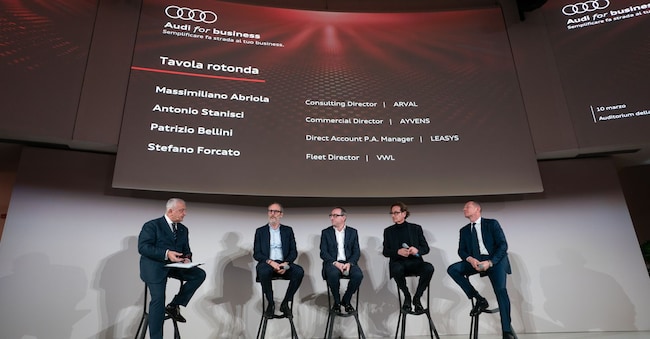
In the automotive landscape of Italia in 2026, the business sector is no longer a mere market segment, but the real driving force, accounting for 46% of the national total. In this context, Audi Italia stands out as a leader: today, two out of three Audi customers are companies. A success that does not come about by chance, but from the ability to transform the concept of 'company car' into an ecosystem of integrated services under the umbrella of the Audi for business programme.
To take stock of a constantly evolving sector, Audi chose the prestigious Confindustria headquarters in Rome for an unprecedented national conference. The objective? To bring together fleet managers, tax experts and the Audi dealer network.
Under the guidance of economist Pier Luigi Del Viscovo and with the technical support of Il Sole 24 Ore, the debate touched on the raw nerves of modern mobility: the management of fringe benefits and the explosion of long-term rental, which for Audi is already worth 30 per cent of registrations. The certainty of investment and the clarity of operating costs have become the new pillars for those managing complex car fleets.
One of the most interesting moments of the discussion concerned the proper use of hybrid technologies. We know that plug-in technology, if not managed well, can paradoxically increase consumption. Audi responded with a concrete solution: the Battery Charge function.
Available on key models such as the new Audi A5, Q5 and A6, this technology allows the battery to be recharged while driving using the combustion engine. It is a 'time-saving' strategy designed for those who grind out kilometres on the motorway, guaranteeing efficiency that comes close to that of diesel engines, but with the fiscal advantages of electrification.

