Test drive

Audi Q5 e-hybrid, the plug-in SUV tailor-made for fleets

The engine range of the four-ring SUV is extended with the new generation of the plug-in hybrid system, which achieves a zero-emission range of around 100 kilometres

by Giulia Paganoni

3' min read

Translated by AI
Versione italiana

3' min read

Translated by AI
Versione italiana

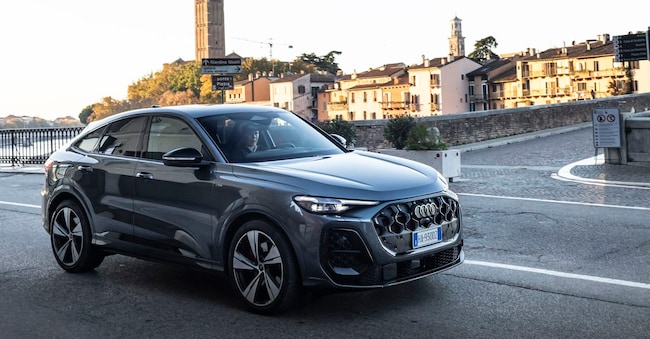
The engine range of the Audi Q5 welcomes the e-hybrid variant, a name that indicates the plug-in hybrid technology available in two power ratings (299 and 367 hp) at a list price that starts at almost 70 thousand euro. We went to test it on the roads around the city of Verona, to test comfort and the car's dynamic qualities.

Dimensions and Style

Developed on the PPC (Premium Platform Combustion) platform, dedicated to models with a longitudinal front combustion engine, the Audi Q5 boasts generous dimensions that place it within the D-Suv segment: 4.72 metres long, 1.90 metres wide, 1.65 metres high and a wheelbase of 2.82 metres. Load capacity stands at 438 and reaches a maximum of 1,358 litres.

Loading...

The styling is typical of the SUV of the four rings, robust and elegant with, depending on the version, some sporty details. In addition, wheels up to 20 inches allow for a large footprint.

Plug-in hybrid technology

Audi Q5, in both Suv and Sportback versions, now adopts the new generation of the plug-in hybrid system characterised by brilliant performance, efficiency and an electric range of around 100 kilometres.

The system comprises a 4-cylinder 2.0 TFSI (turbocharged direct petrol injection) Miller cycle engine with a permanent magnet synchronous electric motor integrated in the seven-speed S tronic gearbox and powered by a high-voltage battery with a nominal capacity of 25.9 kWh (20.7 kWh effective): 45 per cent higher than the accumulators of the previous Audi plug-in generation.

The maximum charging power in alternating current (AC) increases from the 7.4 kW of the previous generation to 11 kW (+49%), allowing the energy level in the accumulator to be fully restored in 2.5 hours. On the other hand, there is no DC recharging, since Audi engineers preferred to combine the Battery Hold function with the Battery Charge function, which allows energy produced by the combustion engine or from the energy recovery system to be stored up to a maximum of 75 per cent.

There are two overall power steps available, 299 hp and 367 hp, differing only by a different electronic calibration, which also results in a different range, between 83 and 100 kilometres for the less powerful and between 82 and 94 kilometres for the second.

The tested variant, with 367 hp and 500 Nm of torque, sprints from 0 to 100 km/h in 5.1 seconds while the 299 hp and 450 Nm configuration goes from 0 to 100 km/h in 6.2 seconds. For all of them, the top speed is 250 km/h, limited to 140 km/h in electric mode.

Audi Q5 e-hybrid, le foto della versione ibrida plug-in

Photogallery14 foto


How to drive

The Audi Q5 e-hybrid is a viable solution for both private customers and fleets thanks to its on-board comfort and generous load capacity.

On board, the driver can count on a raised seat and the 11.9-inch digital dashboard as well as the 14.5-inch display in the centre of the dashboard.

Despite its height from the ground and weight of over 2,200 kilograms, the Audi Q5 e-hybrid SUV is equipped with standard sports suspension, which results in a 20 mm reduction in height and a reduction in roll.

The cue of the 367 hp version is aggressive but not extreme, as one would expect from such a model. Original equipment includes progressive, variable-assist and variable-gear steering, which allows the car to manoeuvre in tight spaces despite its generous dimensions.

The energy recovery system, derived from Bev models in the range, provides good pedal feel and braking that transfers safety to the driver.

Consumption

The Audi Q5 plug-in is equipped with a battery with adequate capacity to enable easy urban commuting on electric power.

The manufacturer of the four rings claims fuel consumption of between 2.7 and 3.3 l/100 km and electric consumption of between 16.0 and 16.9 kWh/100 km, both in the combined cycle. While as far as emissions are concerned, the declared figure is 62-76 g/km, all data measured according to the Wltp homologation cycle.

Copyright reserved ©
Loading...

Brand connect

Loading...

Newsletter

Notizie e approfondimenti sugli avvenimenti politici, economici e finanziari.

Iscriviti