

La figlia del clan racconta la ’ndrangheta a caccia della libertà
di Raffaella Calandra

4' min read
4' min read
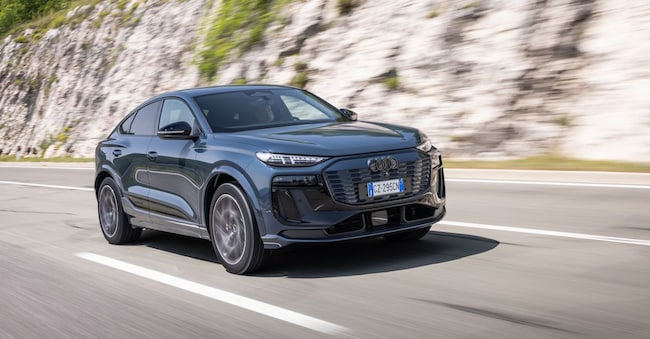
Audi's updated strategy rests on the term flexibility, which the brand uses to emphasise both that the electric range, which for a long time has been indicated as the one that would become definitive for the brand, is always flanked by the thermal range, albeit electrified, and to convey the fact that the range of bodies in its line-up allows it to satisfy practically any type of requirement. The electric-only Q6 Sportback e-tron is one of the youngest offspring of this vision, extending the line of models that combine coupe-inspired looks with, in many cases, station wagon-like functionality. Like the Q6 e-tron in standard suv format, the Sportback is also based on the Premium Platform Electric architecture that Audi developed with Porsche, albeit with modifications to tie it to its own DNA, from which it departs not only in appearance but also somewhat dynamically.
In detail, the Q6 Sportback e-tron is offered in entry level rear-wheel drive versions with 292 horsepower and 83 kWh battery for a range of 547 kilometres and Performance with 326 horsepower which, thanks to the 100 kWh battery, promises a range of 658 kilometres. These are joined by the twin-engine four-wheel drive e-tron quattro with 387 horsepower and the SQ6 with 517 horsepower also with 100 kWh batteries promising a range of 638 and 609 kilometres respectively. The 800 V electric grid guarantees short charging times for the batteries of all Q6 Sportback e-tron cars, which are of a new high-density generation. For example, the Performance with 270 kW systems stores electricity to travel 265 kilometres in ten minutes, while the other rear-wheel-drive variants with 83 and 100 kWh batteries accept fast recharges of up to 225 kW and 260 kW respectively. The Q6 Sportback family also boasts specific settings for passive damping suspension and adaptive air suspension, available for some versions, as well as customised steering calibration, which together with the prevailing rear-axle drive distribution also offered by the all-wheel-drive versions give the Sportback a sportier dynamism than that of the Q6 with its classic SUV line-up.
The technical outfit confirms what the sleek lines of the Q6 Sportback e-tron promise. It marries good aerodynamic profiling that results in a Cx of 0.26 that is really good for the type of car and benefits efficiency with sportiness and elegance, but without reflecting on the spaciousness that the cabin of a car of a robust size must offer. In fact, this Q6 is 4.77 metres long, 1.96 metres wide and 1.66 metres high. Its appearance differs from that of the suv version, in particular, starting with the windscreen thanks to the arched design of the roof, inspired by that of the first generation TT coupé, which descends on the tail and draws a very slender profile linking up with the rear of the car, to which it leans, linking up with the upper part of the muscular wheel arches to connect them with the spoiler under the rear window. The latter appears to be supported by the strip of LEDs linking the Oled 2.0 technology headlights, which are also elements of communication with the outside world since in case of emergency situations they turn into displays that launch warnings to those following. Even in the front, substantially the same as the Q6 suv, the light signature is made up of Oled elements.
The sloping design of the roofline together with the 2.90 metre wheelbase and the Ppe architecture layout generate an interior that, despite what the sleek lines of the Q6 Sportback might suggest, offers plenty of space for all passengers. The interior design is that debuted on the regular Q6 e-tron, which is rampant on newer Audis such as the A6 as well as the A5 and Q5, and offers a dashboard that can be dominated by the presence of three displays when the 11.9" instrument cluster and the 14.5" infotainment display are joined by the 10.9" display in front of the front passenger. Thanks to the E3 1.2 electronic architecture and the Android Automotive OS platform, the level of digitisation is very high, the human-machine interaction intuitive thanks to the support of ChatGPT and the intelligent voice assistant with self-learning function (online and offline) with which it is possible to both control various functions of the car and obtain information of all kinds.
In the cabin of this Q6 Sportback you travel first class both because it is carefully finished and because it offers a high level of comfort, as the insulation keeps out annoying noise and the adaptive suspension gradually overcomes road irregularities. The set-up together with the good amount of weight placed down by the large battery pack and the quick steering make driving far more instinctive than its size and mass might suggest. In fact, this Q6 moves through the bends rather casually and reliably. The powertrain that delivers 326 horsepower and 485 Nm of torque and pushes it up to 210 km/h and 100 km/h in 6"7 against a declared consumption of 16/18.3 kWh/100 km has a marked inclination to always receive the accelerator commands correctly and promptly both in quiet use and when it is stressed. Obviously, maintaining the linear delivery typical of full-electric

