
Audi RS5, the Four Rings' first plug-in hybrid sports car debuts. What it looks like
Audi Sport's new signature model packs 639 horsepower, 825 Nm of torque and 84 km in all-electric mode
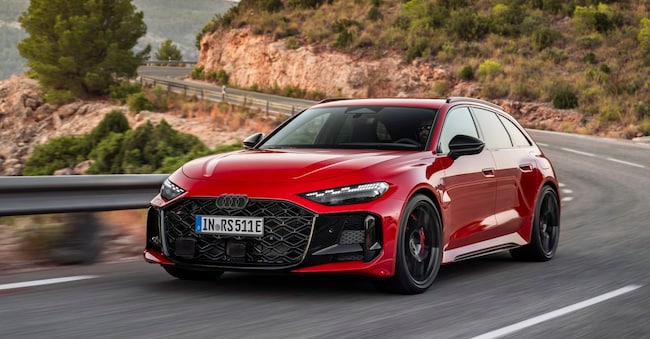
Key points
The new RS5 marks Audi Sport's entry into high-performance plug-in hybrid technology. The model replaces the current RS4 and is positioned at the top of the A5 range, introducing for the first time on an RS a Phev system with advanced all-wheel drive. Overall power output is 639bhp with 825Nm of torque, 189bhp and 225Nm more than the RS4. In addition to its supercar qualities, also highlighted by track widths of 93 mm at the front and 84 mm at the rear compared to the RS4, it can travel around 85 kilometres in all-electric mode.
New Audi RS5 2026
The hybrid system combines a twin-turbo V6 2.9 TFSI with 510 bhp and an electric motor with 177 bhp and 460 Nm, integrated in the eight-speed tiptronic automatic transmission with torque converter. Combined power reaches 639 bhp and 825 Nm. The combustion engine delivers 600 Nm and benefits from higher injection pressure, a new intake system and air-water intercooler, a solution adopted for the first time on this V6. Supercharging is handled by two variable geometry turbochargers. The engine operates according to the Miller cycle, with a shorter compression phase than the expansion phase, to improve thermal efficiency and reduce fuel consumption and emissions. The electric motor uses an external rotor configuration, with a stator inside the rotor. The solution allows compact dimensions, high torque and increased cooling capacity. The 25.9 kWh nominal battery (22 kWh net) is located under the boot floor and powers both the electric motor and the 400 volt system. AC recharging is up to 11 kW, with claimed times of around 2.5 hours for a full charge.
Interior new Audi RS5
Inside, the ambience remains typical of the latest RS, with a strongly driver-oriented layout. The Oled display system includes the 11.9-inch virtual cockpit and the 14.5-inch central touch screen, flanked by a 10.9-inch passenger display. RS-specific graphics allow data such as lateral acceleration, tyre temperatures and lap times to be monitored, while the Audi driving experience function allows performance to be recorded and analysed even on the track, with the possibility of dividing circuits into sectors and comparing results.
Full-wheel drive: pre-loaded central differential
The RS5 introduces a new evolution of the self-locking centre differential. The system adopts a permanent preload, which keeps the differential always partially locked. In this way, torque distribution takes place without the need for pre-slip, with more linear reactions during release and cornering. Torque can be up to 70 per cent at the front or 85 per cent at the rear depending on driving conditions. The solution aims to reduce understeer and improve the precision of the front end during corner entry.
Dynamic Torque Control: electromechanical torque vectoring
Debuting at the rear is Dynamic Torque Control, an electromechanical torque vectoring system integrated into the rear axle. The system uses a 10.9 hp, 40 Nm permanent magnet electric actuator, a gearbox and a conventional differential. The actuator can transfer torque between the rear wheels in about 15 milliseconds, with a maximum differential of 2,000 Nm between the left and right sides. The system operates both when accelerating and when releasing or braking, with bi-directional torque management. The control logic is entrusted to the electronic driving dynamics platform, which updates the parameters at 200 Hz, i.e. every 5 milliseconds. The aim is to reduce understeer, manage oversteer and improve stability during cornering.

