
Austria, government appointment of outgoing premier Nehammer. Extreme right excluded
The historic victory on 29 September does not open the door to government for the FPÖ, in the face of the refusal of all other parties to govern with its controversial leader Herbert Kickl. Difficult negotiations open between Populars and Social Democrats

2' min read
2' min read
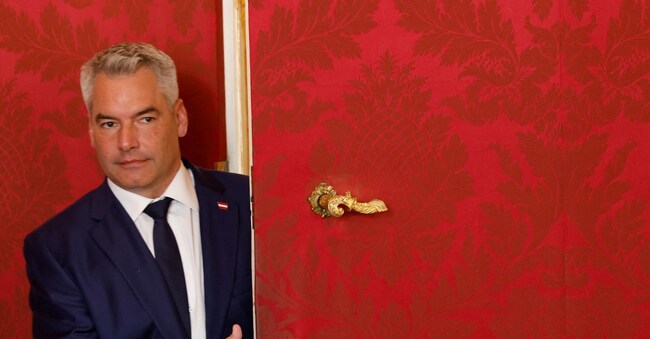
The historic victory in the 29 September elections does not open the door to government for Austria's extreme right, as several analysts had assumed. Indeed, President Alexander van der Bellen has officially charged the outgoing chancellor, Karl Nehammer, leader of the ÖVP Populars, with forming the executive, inviting him to enter into consultations with the SPÖ social democrats.
Behind the FPÖ's exclusion from office, the refusal of all other parties to govern with the controversial leader of the Freedom Party, Herbert Kickl, pre-announced before the vote and reiterated in the following three weeks. President van der Bellen, himself known for positions that are anything but favourable to the FPÖ, wanted to make this explicit after the appointment: 'The elections on 29 September,' the 80-year-old head of state said in a televised speech, 'were not a race in which the party that crosses the finish line first automatically gets the job of forming the government. If a party wants to govern alone, it must exceed 50 per cent. It is not enough to reach 10, 20 or 30 per cent'.
Kickl immediately reacted by stating that it would be undemocratic not to let his party govern and warned against forming a 'coalition of losers' that would exclude him. 'This,' he wrote on Facebook addressed to his supporters, 'may seem like a slap in the face to many of you. But,' he concluded, 'I promise you that the last word has not yet been said,' adding that he will await the outcome of the coalition talks.
However, the talks do not promise to be easy, as Nehammer's cautious words made clear.
The Freedom Party last month was the most voted for, for the first time in a national vote, with 29% of the vote, ahead of the ÖVP and the SPÖ. Together, the two parties, which are divided by rather distant agendas, especially on taxes, would only have a majority of one seat, which is why Nehammer was quick to specify that 'a third partner will be needed to guarantee a stable parliamentary majority', most likely the NEOS Liberals (fourth) rather than the Greens.


